About Cuculus pallidus (Latham, 1802)
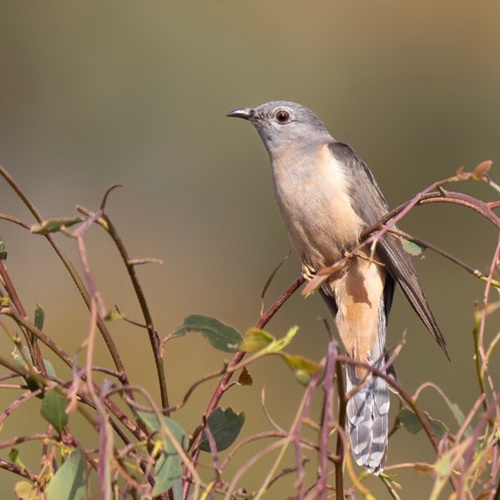
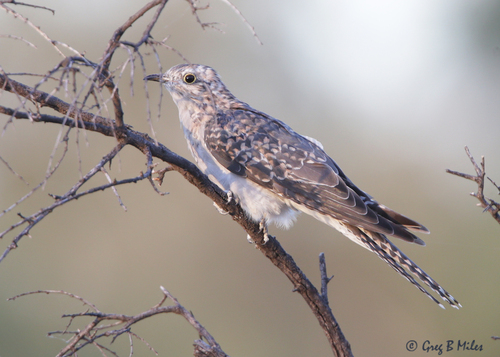
The pallid cuckoo has the scientific name Cuculus pallidus (Latham, 1802). This species has a set of distinct appearance characteristics: a dark bill, a dark eye surrounded by a gold eye-ring, a faint dark stripe running from the eye down the neck, a white or buff nape mark, olive grey feet, and prominent white or buff tooth-like markings along the edge of the tail. In flight, its long tail shows clear, conspicuous white and dark bars. Its silhouette is similar to that of a falcon, and this similarity often causes passerines to give alarm calls. Pallid cuckoos can display different color morphs, which include light rufous morph and dark rufous morph. In adult males, the upperparts (including the head and neck) are grey-brown, and large spots are present on the wing-coverts. The light-rufous morph adult female resembles the adult male, but the dark rufous morph adult female has a hind neck patch that extends onto the mantle and barring on the chest. A defining feature of the Cuculidae cuckoo family is zygodactyl feet, where the two inner toes point forward and the two outer toes point backward. The pallid cuckoo is widely distributed across mainland Australia and Tasmania. During winter, it resides in central inland Australia and the Northern Territory, then migrates to the coastal regions of southeastern Australia and Tasmania, generally arriving around September or October, and sometimes arriving earlier. Occasional winter migration to the islands of Timor and Papua New Guinea has also been observed. It is a rare vagrant to New Zealand. The pallid cuckoo can be found in a wide variety of habitats, including woodland, shrubland, mangrove forest, pastoral country, farmland, golf courses, and gardens. It prefers lightly timbered country with trees, shrubs, and a sparse understory, which provides the best conditions for it to hunt prey. The pallid cuckoo feeds primarily on insects such as caterpillars. It hops down from elevated vantage points to seize its prey, either on trees or in grass, and it prefers to eat hairy caterpillars.