About Cuculus micropterus Gould, 1838
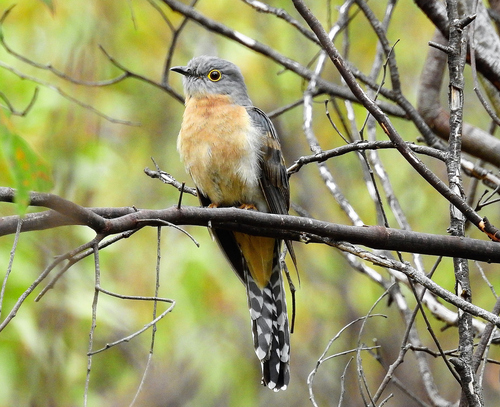
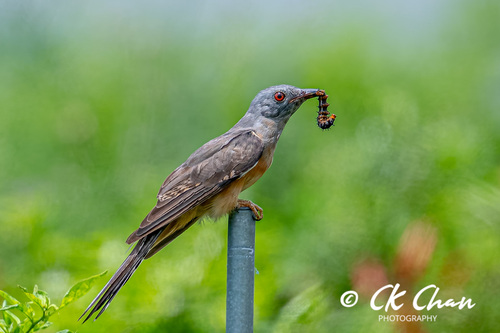
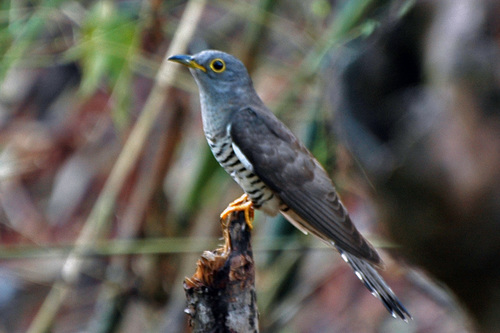
Cuculus micropterus, the Indian cuckoo, is a medium-sized cuckoo species with generally similar appearance between males and females. Adults have grey upperparts and an underside marked with broad black barring. Their barred tail features a broad dark subterminal band and a white tip. Juvenile birds differ from adults: young individuals have white markings on the crown, plus a white chin and throat that contrast with a dark face. Younger juveniles are browner overall, with broad white tips on their head and wing feathers. This species has a grey to yellow eye-ring, a feature it shares with the common hawk-cuckoo. The iris ranges from light brown to reddish. Females differ slightly from males: they have slightly paler grey throats, more brown on the breast and tail, and narrower belly barring than males. Nestlings have an orange-red mouth and yellow gape flanges. The call of the Indian cuckoo is a loud four-note call, which has been variously transcribed as "orange-pekoe", "bo-ko-ta-ko", "crossword puzzle", or "one more bottle". In northern India, this cuckoo can be locally common during the breeding season, with an estimated density of one calling bird per 2 square kilometers (0.77 square miles). Indian cuckoos feed primarily on hairy caterpillars and other insects, and will sometimes also eat fruits. They usually feed in the upper canopy, gleaning insects from vegetation, and will sometimes make aerial sallies to catch flying termites; rarely, they may even hover lower near the ground while foraging. This species is widely distributed across Asia, ranging from the Indian subcontinent eastward to Southeast Asia. Its preferred habitats are deciduous and evergreen forests, but it also occurs in garden lands and thick scrub. Some Indian populations migrate south for winter, though permanent breeding populations also exist in southern India, and specimens have been netted at night or recorded at lighthouses. The population found in Amurland, Russia, is fully migratory. The Indian cuckoo is a brood parasite. In Russia, breeding females pair with specific males during the breeding season: the male diverts the attention of host birds away from their nest, giving the female time to lay her egg. The female almost always lays a single egg per host nest, most commonly in the nests of drongos and crows. In Russia, brown shrikes have been recorded as a host species. Before laying her own egg, the female removes and eats one egg from the host nest. The breeding season for this species varies by location: it runs from May to July in northern China, March to August in India, January to June in Burma, and January to August in the Malay Peninsula. Recorded host species include the brown shrike (Lanius cristatus) in the Amur region, black drongo and azure-winged magpie (Pica cyanea) in China. In India, Indian cuckoo chicks have been observed being fed by black drongos and ashy drongos. Other recorded hosts include black-headed oriole, streaked spiderhunter, Eurylaimus ochromalus, and greater racket-tailed drongo (Dicrurus paradiseus). The cuckoo's eggs hatch in 12 days, while the eggs of the Amur region brown shrike host take 15 days to hatch. When touched on the third or fourth day after hatching, the young cuckoo bends its back and heaves other host eggs or nestlings out of the nest; this instinct is lost soon after development.