About Cuculus gularis Stephens, 1815
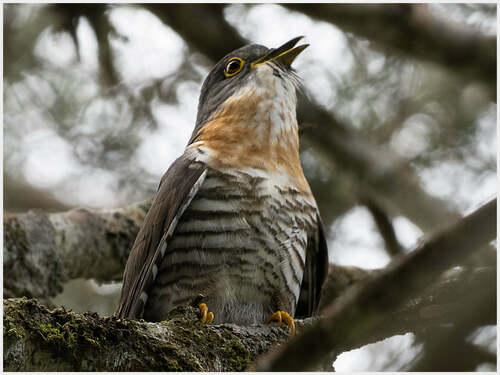
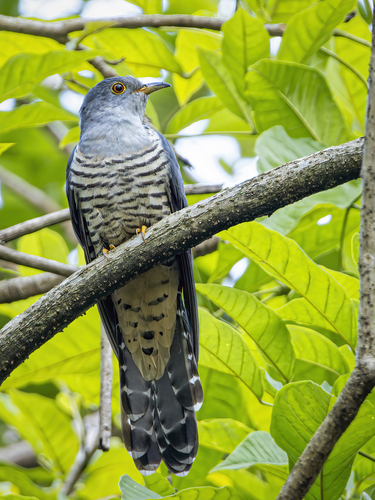
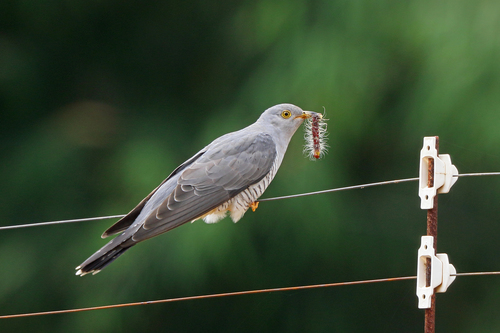
This is a medium-sized cuckoo species with a long tail, reaching a total length of 32 cm (13 in). Its swift flight makes it resemble a bird of prey. The sexes have similar plumage: the head, upper parts, and wings are dark grey, the throat and breast are pale grey, and the belly is white with dark grey barring. The tail is dark grey with dark barring and a white tip. Males have yellow eyes, while females have light brown eyes. The beak is yellow, tipped with black or horn-colored material, and the legs and feet are yellowish. Juveniles have two color forms: the grey morph is greyer than adults with white barring, and its underparts are creamy-white with dense dark barring. The hepatic morph is brown instead of grey, and white areas are replaced by buff or tawny hues. Males produce a "coo-coo" call, with the second note higher and louder than the first. Females give a bubbling "Kwik-kwik-kwik" call. The African cuckoo (Cuculus gularis Stephens, 1815) is found in Angola, Benin, Botswana, Burkina Faso, Cameroon, Central African Republic, Chad, Republic of the Congo, DRC, Ivory Coast, Djibouti, Eritrea, Eswatini, Ethiopia, Gabon, Gambia, Ghana, Guinea-Bissau, Kenya, Liberia, Malawi, Mali, Mauritania, Mozambique, Namibia, Niger, Nigeria, Rwanda, Senegal, Sierra Leone, Somalia, South Africa, Sudan, Tanzania, Togo, Uganda, Zambia, and Zimbabwe. These birds migrate to West Africa when the rainy season arrives, breed there, and then depart, though they appear to be present year-round in some localities such as Nigeria. In East Africa, their arrival also coincides with the rainy season, and they may be present from October to May; in southern Africa, they are present from September to April. Their typical habitat is savannah with scattered acacia trees and open woodland. They do not occur in dense forest or arid regions. They are fairly common but inconspicuous except when calling. This species is generally solitary. It forages for insects in trees and on the ground, searching through foliage and probing cattle dung. Its diet consists mainly of both hairy and smooth caterpillars, and also includes other insects such as beetles and winged termites. It perches almost vertically. Males are territorial; in southern Africa, a pair of African cuckoos occupies a territory of more than 60 hectares (150 acres), and drives off other cuckoos. Like many other cuckoos, the African cuckoo is a brood parasite: females lay their eggs in the nests of other bird species, and remove one egg that is already present in the nest. Target host species vary across the African cuckoo's range, and the cuckoo's eggs usually closely match the color and size of the host species' eggs. The yellow-billed shrike (Corvinella corvina) and fork-tailed drongo (Dicrurus adsimilis) are often targeted hosts. Incubation lasts between twelve and seventeen days, usually twelve days, and the cuckoo eggs hatch before the host's eggs. The cuckoo chick ejects any other eggs and nestlings from the nest. Its eyes open after eight days, and it fledges in three weeks, remaining dependent on its foster parents for several more weeks. Breeding success in South Africa is up to 38 percent. One yellow-billed shrike nest was abandoned by foster parents before the cuckoo chick fledged, and the foster parents built a new nest elsewhere. A study in Zambia revealed that fork-tailed drongo hosts reject African cuckoo eggs at a rate as high as 93.7%.