About Ctenucha brunnea Stretch, 1872
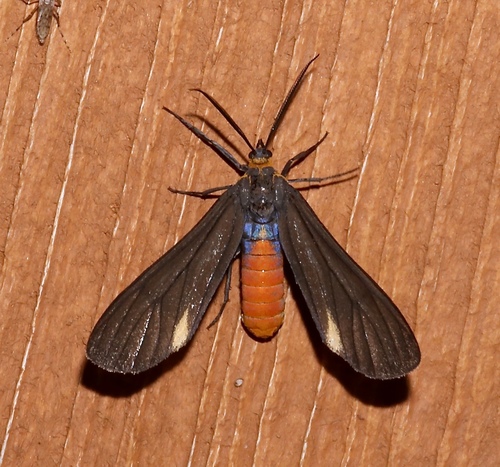
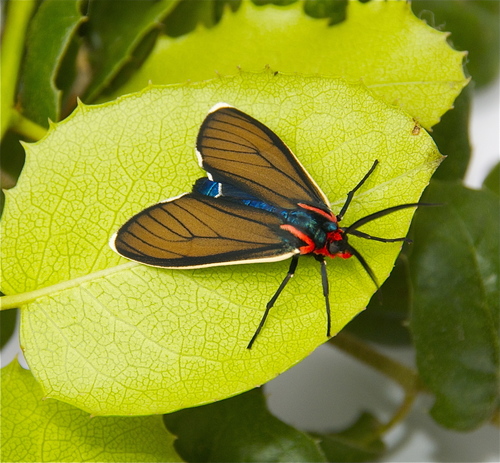
Ctenucha brunnea, commonly known as the brown ctenucha or brown-winged ctenucha, is a moth species belonging to the family Erebidae. The species was first formally described by Richard Harper Stretch in 1872. This is a day-active (diurnal) moth found in the United States, along the California coast from central to southern areas. In regions north of this range, Ctenucha brunnea is replaced by the related species Ctenucha multifaria. Adult individuals have blue bodies 20 to 26 millimetres (0.79 to 1.02 inches) long, with red markings on their heads and shoulders. The forewings of adults measure 18 to 20 millimetres (0.71 to 0.79 inches) in length. Adult moths are active in flight from mid-May to mid-July. They feed on nectar from Heteromeles arbutifolia. The species produces round eggs that fade from white to yellow as they develop, and are laid in orderly rows. Larvae are black and covered in buff or yellow hairs, with two black tufts positioned at the front and rear of the body, and an amber or orange head. Larvae feed on Leymus condensatus, plus other grasses and sedges. Pupae are chestnut-colored, and enclosed in a loose cocoon woven from the larva’s own hairs.