About Ctenotus spaldingi (Macleay, 1877)
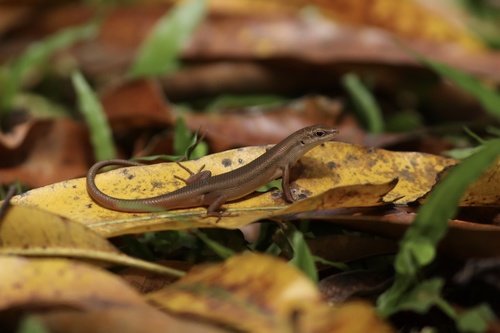
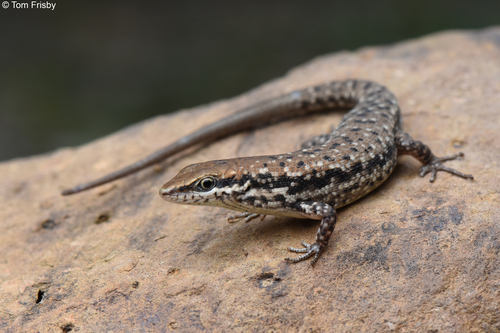
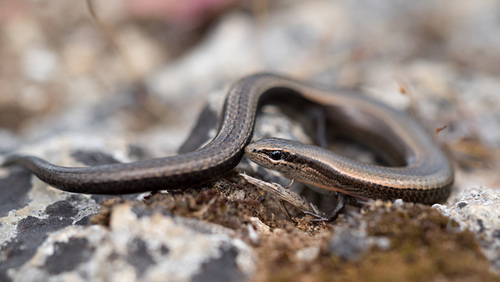
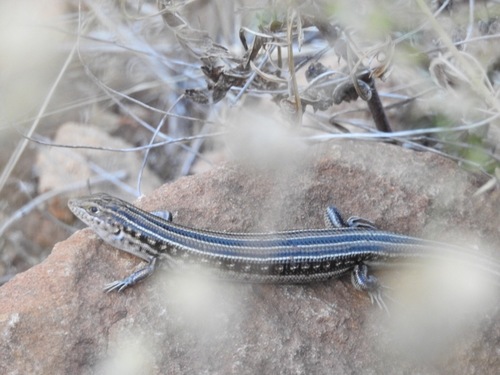
Ctenotus spaldingi is a species of skink that reaches a total snout-to-tail length of up to 30 cm, with a maximum snout-vent length (SVL) of up to 10 cm. This skink is primarily brown, with a complex striped and spotted pattern. It has white-edged dark stripes running the full length of its back and tail, along with broad brown stripes along its body sides that are marked with rows of white spots. The sides lighten to an off-white color toward the skink's underside. Ctenotus spaldingi is frequently misidentified as Ctenotus robustus, as the two species have similar physical descriptions and occupy overlapping habitats. This species has two main geographically separated populations. The northern population ranges from northern New South Wales to far north Queensland, extending across the northern half of the Northern Territory. The southern population is found in eastern South Australia, along the western edge of New South Wales, and throughout most of Victoria except for southeastern Victoria. The species has also been recorded between these two population areas, and in Tasmania and Papua New Guinea; it is not endemic to Tasmania or Papua New Guinea, and its presence in these locations is the result of human-assisted transport. Ctenotus spaldingi inhabits areas with grasses and low vegetation, and rocky outcrops, within savannah woodland, grassy coastal dunes, monsoon scrub, and heathland. When disturbed, it typically hides from predators such as feral cats or snakes in ground debris or shallow burrows. Ctenotus spaldingi is oviparous, laying annual clutches of eggs. There is no formal published information available on this species' reproductive behavior or maximum lifespan. It is thought to behave similarly to Ctenotus robustus, which is a closely related species that shares its habitat.