About Ctenotus pantherinus (Peters, 1866)
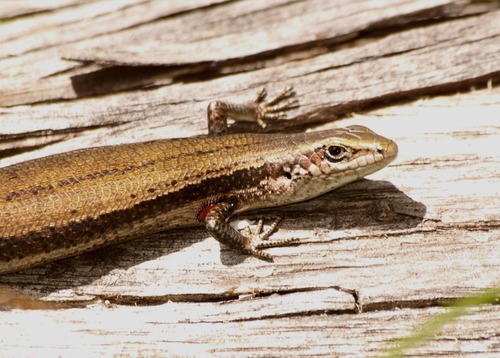
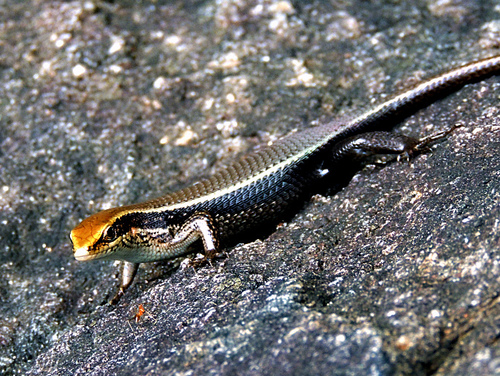
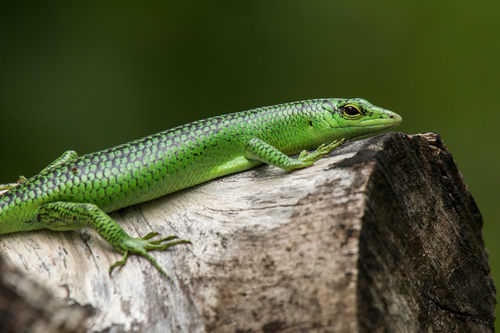
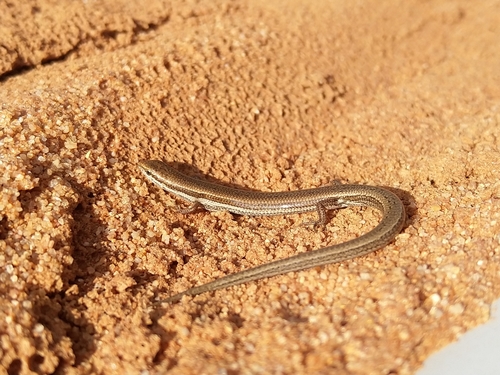
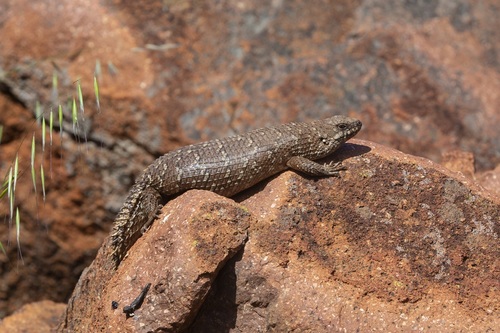
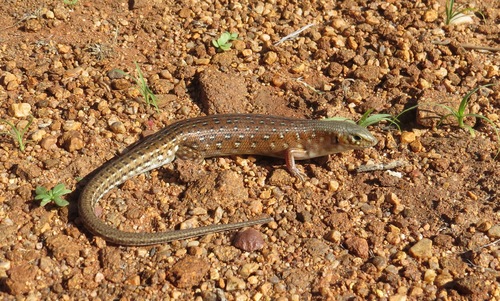
This species, commonly called the leopard ctenotus, is a brown or grey lizard with a tail that is almost equal in length to its body. It has four short, stubby legs of similar length, each ending in a clawed foot with five digits. Yellow or white spots outlined in black or brown start behind the head and extend all the way to the tip of the tail. Some adult leopard ctenotus have white or yellow stripes on the side of the tail that begin at the hind leg. The underbelly is a pale white or yellow colour. Leopard ctenotus are one of the largest and fastest growing Ctenotus species in Australia. They grow more during winter than other Ctenotus species and are active year-round. Males typically grow at a slightly faster rate than females, and juveniles born in autumn grow faster over winter than juveniles born in summer. Ctenotus pantherinus is endemic to Australia, where it occurs in the semi-arid and arid regions of Western Australia, the Northern Territory, Queensland, New South Wales and South Australia. It inhabits semi-arid and arid areas, which are typically sandy or stony landscapes with abundant Spinifex grasses. Hatchlings measure 33mm in snout to vent length, and mature adults can reach a maximum snout to vent length of 86mm. Leopard ctenotus are oviparous, meaning they lay eggs that hatch after a period of development. They reproduce at least once per year, with clutch sizes ranging from 4 to 7 eggs. Egg production usually takes place from late spring to early summer. Compared to other Ctenotus species living in the same area, their reproductive rate is above average, and their clutch size is relatively large compared to other skink species. On average, juvenile leopard ctenotus reach sexual maturity at 10 to 11 months of age. Within the Ctenotus genus, Ctenotus pantherinus is unique in that females are smaller in size than their male counterparts. This trait has helped the species adapt to its environment and maintain stable populations.