About Ctenosaura similis (Gray, 1831)
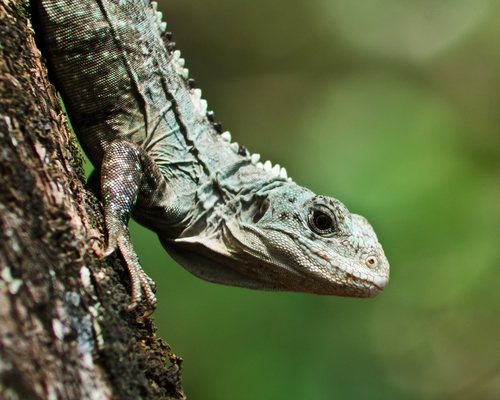
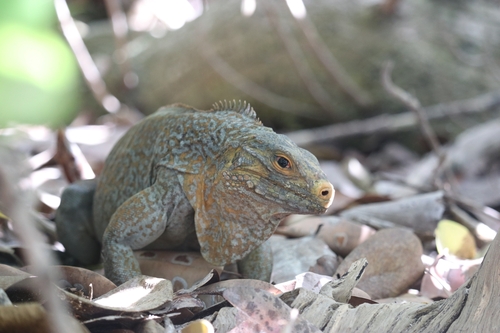
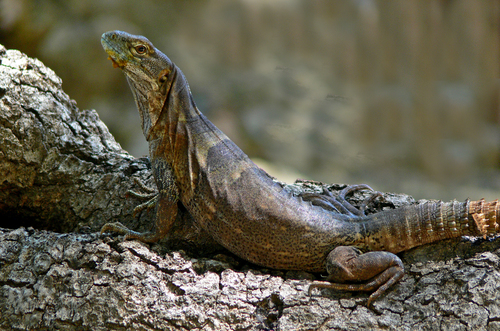
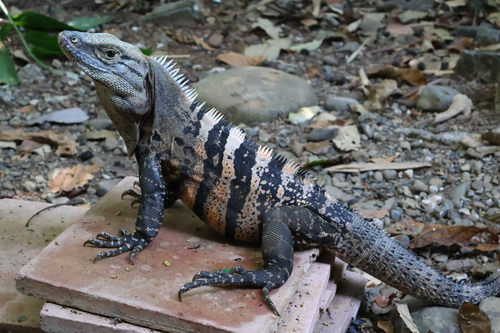
Ctenosaura similis, commonly called the black spiny-tailed iguana, gets its common name from the distinctive black, keeled scales covering its tail. It is the largest species in the genus Ctenosaura. Males can grow up to 1.3 meters (4 ft 3 in) in total length, while females are slightly shorter, reaching 0.8 to 1 meter (2 ft 7 in – 3 ft 3 in). A crest of long spines runs down the center of this iguana’s back. While individual coloration varies greatly even within the same population, adult individuals usually have a whitish gray or tan base body color, paired with 4 to 12 well-defined dark bands along the back that extend almost to the belly scales. During breeding season, males develop orange coloring around their head and throat, with blue and peach highlights on their jowls.
The black spiny-tailed iguana is native to southern Mexico and Central America, ranging south from the Isthmus of Tehuantepec to Panama. It occurs from sea level up to approximately 1,320 meters in elevation, but is not found in interior highlands. On the Atlantic versant, its distribution is irregular and discontinuous: it occupies parts of Tabasco, northern Chiapas, Campeche, Yucatan, and Quintana Roo in Mexico, most of Belize, Guatemala, and the northern coast of Honduras, often moving along rivers into interior valleys and canyons. Only a few isolated, disjunct occurrence records exist for this species further south in eastern Nicaragua, Costa Rica, and Panama. On the Pacific coast, its distribution is continuous, stretching from extreme southeast Oaxaca and southern Chiapas, Mexico, south through Guatemala, El Salvador, Honduras, Nicaragua, and Costa Rica to the Azuero Peninsula in Panama.
This species also lives on many Caribbean and Pacific islands, including Isla Aguada, Isla Contoy, Cozumel, and Isla Mujeres in Mexico; Ambergris Caye, Glover's Reef, and Half Moon Caye in Belize; Isla de Utila, Guanaja, Roatán, and the islands in the Golfo de Fonseca in Honduras; Isla de Maíz Grande (the Corn Islands) in Nicaragua; Coiba Island and Isla del Rey in Panamá; and Isla San Andrés and Providencia in Colombia. It is unclear whether populations on some of these islands are native or introduced. Some herpetologists assume the species reached the Islas San Andrés and Providencia, Colombia during the Quaternary period, while another researcher suspects these populations, along with some other island populations, are "likely" human introductions. Ctenosaura similis has been intentionally or accidentally introduced and is now established in southern Florida, a few islands in the Bahamas, Malpelo Island (Colombia), and Venezuela.
Mating typically takes place at the start of the dry season. Males court females and signal interest using low-amplitude head bobbing and repeated flick-licking of the female. A receptive female will allow mating with a large male, and females may violently reject attempts at forced copulation. Eight to ten weeks after mating, females travel to a communal nesting site. At the site, females (along with other nesting females) repeatedly visit open nest spots, and eventually lay clutches containing up to 30 eggs. The eggs hatch after 90 days, and hatchlings dig their way out of the sand. Juvenile black spiny-tailed iguanas are typically green with brown markings, though entirely brown hatchlings have also been recorded. Juveniles reach reproductive maturity around 2 to 3 years of age.