About Ctenophorus spinodomus Sadlier, Colgan, Beatson & Cogger, 2019
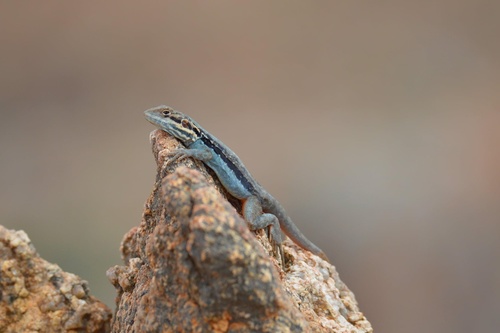
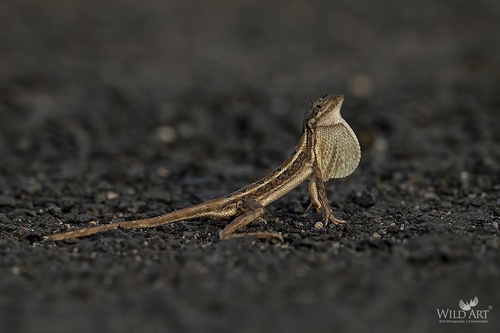
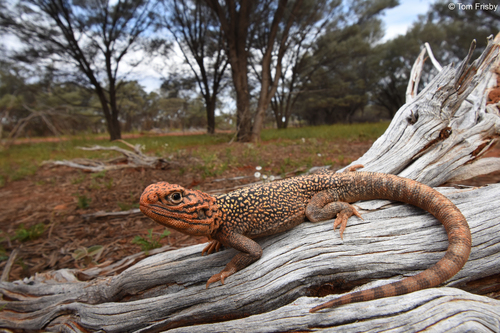
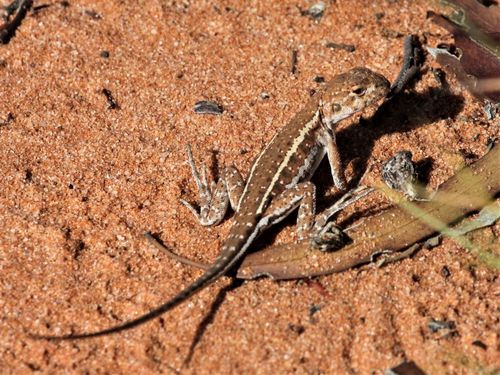
Ctenophorus spinodomus, commonly called the Eastern Mallee dragon, has physical features that set it apart from other agamid lizards and support its survival. Adult males have a continuous row of 15–22 femoral pores on each side, arranged in an arch toward the midline. Their dorsal surface is pale brown to medium sandy orange, with a pale dorsolateral stripe bordered by dark edges, plus dark blotches on the dorsal surface and large dark markings on the upper-lateral surface. A pale stripe, sometimes with scattered flecks, runs along the mid-lateral surface. The tail has pale spots along its dorsolateral edge; the side of the tail is dark, forming a distinct stripe bordered by a pale stripe across its basal third. The ventral surface is pale, with scattered dark speckling on the throat and a dark chest patch broken by white flecks that may align along the midline to form a poorly defined T-shape. Adult females have a similar patterning but in lighter tones, and their ventral surface lacks significant dark markings. Both sexes can be identified by a fine, typically uninterrupted pale dorsolateral stripe that extends from the neck to just past the hind limbs. Eastern Mallee dragons are relatively small, with a typical total length of 15.5–18 cm. Adult females are generally larger in body size than males, while adult males have longer tails and hind limbs: male tail length is approximately 2.1–2.4 times body length, compared to 1.95–2.15 times body length in females. The Eastern Mallee dragon is endemic to the eastern Mallee region of Australia. Its range covers red sand plains and Mallee woodlands of south central and south western New South Wales, extending along the northern side of the Murray River into South Australia. It is well adapted to the arid and semi-arid landscapes of this region, and its range is highly restricted to areas with Spinifex hummock grass (Triodia), which it uses for foraging, shelter, and social interactions. Spinifex grows as a groundcover in Mallee woodland habitat known as Triodia Mallee vegetation, and Eastern Mallee dragons also require this habitat to be paired with a red sand substrate, which provides nesting and overwintering sites. Eastern Mallee dragons are diurnal, terrestrial agamid lizards that mostly follow an annual life cycle, though some individuals live into a second season, and very rarely into a third. A large rise in adult mortality starts in late December and continues through January, killing as much as 85% of the population during this period. Males have larger home ranges on average, around 0.032 hectares, while females have smaller average home ranges of about 0.015 hectares. Juveniles have even smaller ranges, approximately 0.007 hectares, than adults. There is very little change in home range size, negligible migration, and no observed territorial behaviour in this species. The species is more common in landscapes with extensive Triodia Mallee vegetation, and its presence is strongly linked to substantial Spinifex coverage and large, healthy Spinifex hummocks. These conditions typically develop 20–50 years after fire, with population peaking around 35 years post-fire; after this peak, population densities gradually decline. The species follows a 24-hour diel cycle tied to using Spinifex clumps at different times of day. Like many reptiles, Eastern Mallee dragons are ectothermic and rely on external heat to regulate body temperature. They are often seen basking in the sun, especially in the morning and late afternoon. At night, individuals shelter inside Spinifex clumps, and they bask among the clump's spines to reach a suitable body temperature for activity. After emerging, they usually stay within a few meters of the clump, and during the hottest part of the day they retreat into the nearest Spinifex clump, where humidity is higher than the surrounding environment and temperature is notably cooler than the surroundings, especially the substrate. During winter, few individuals stay inactive within Spinifex; instead, observations indicate they dig into the soil to shelter underground. Eastern Mallee dragons are oviparous, meaning they lay eggs. Their breeding season falls in the warmer months of the year, with egg-laying usually occurring in late spring or early summer, and peak egg deposition around mid-November. Males compete through combat displays that include head-bobbing and tail-waving, to establish dominance and attract females. Females usually lay clutches of 2–3 eggs, which they bury in a carefully prepared underground nest chamber that is constructed and sealed the same day as laying. Incubation occurs in the warm, protected nest environment, and hatching takes place in under 8 weeks. Hatchlings are independent from birth and must fend for themselves; on average, only 20% of hatchlings reach reproductive maturity.