About Ctenophorus nuchalis (De Vis, 1884)
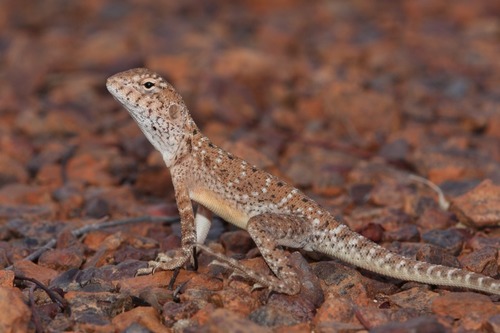
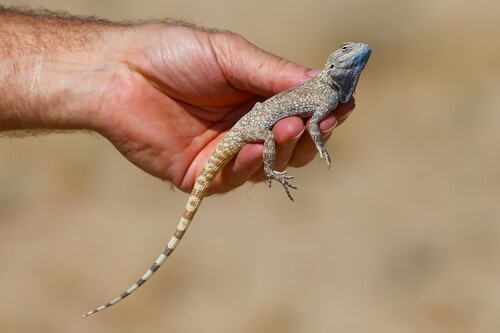
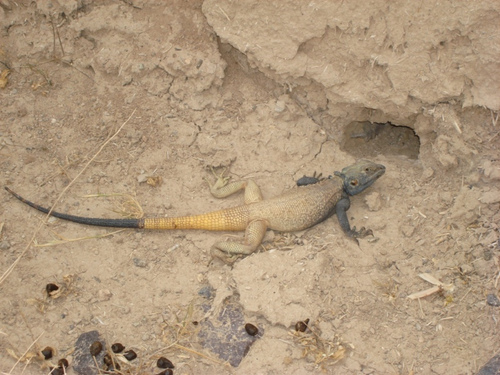
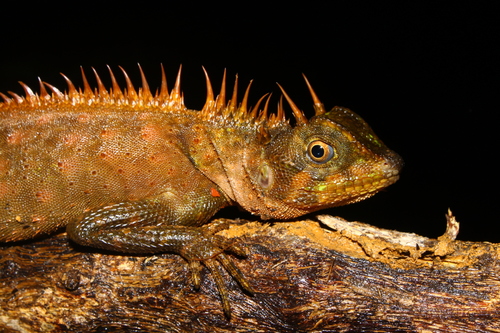
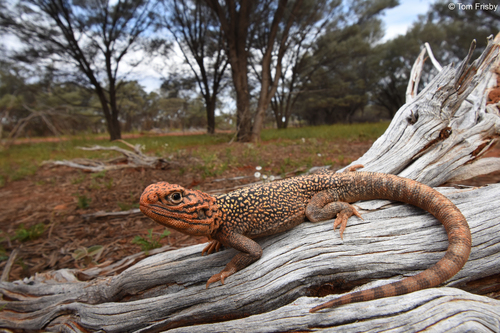
The central netted dragon (scientific name Ctenophorus nuchalis (De Vis, 1884)) is a medium-sized terrestrial lizard. Its body ranges in color from pale reddish-brown to bright orange-brown, and it gets its common name from a dark chocolate-brown net-like (reticulated) pattern covering its head and body. This camouflage pattern helps the lizard blend into its habitat to avoid predators. It has short, strong limbs with long toes and strong claws, which let it run at high speeds and dig burrows. Compared to other iguanids and agamids, its head is short and blunt, a trait thought to be linked to its herbivorous diet and burrowing behavior. Its ears are exposed, a row of enlarged scales curves under each eye, and small spines surround the head. It has a low crest along the top of its neck, a narrow vertebral stripe running the full length of its body, and small, smooth body scales. Adult males measure 25–28 cm from snout to tail, with a 10 cm snout-to-vent length and the tail making up the remaining length. This species shows sexual dimorphism: males are slightly larger overall, and have proportionally larger heads than females. In the wild, this dragon is relatively short-lived, with a typical lifespan of 2 to 4 years. Central netted dragons are distributed across the desert plains of Western Australia, the Northern Territory, western Queensland, and New South Wales. They are abundant in open, sandy areas with sparse vegetation, and surveys show the species becomes more abundant in grazed areas, and may also increase in number in cleared or burnt areas. Central netted dragons are burrowing, diurnal (day-active), ground-dwelling lizards. They spend their days basking on logs, stones, and termite mounds. Like most reptiles, they are ectotherms, relying on their environment to regulate their body temperature, which averages 36.1 °C. A dragon starts its day by basking in the sun to raise its body temperature and gain energy, because adequate body heat is required for these lizards to digest their food. When desert temperatures peak at midday, they either retreat to their burrows to cool down, or climb plants to escape extreme heat. They typically have six to eight separate burrows, often built at the base of living spinifex (Triodia) grass stumps, or within hillocks formed by dead grass hummocks. These are relatively shallow, dead-end burrows located in different parts of the lizard's home range, and are primarily used as nocturnal retreats and escape routes from predators. They often back-fill the entrance of their burrow to block predator access and keep external heat out. They prefer perches with high vantage points, such as termite mounds (which also act as a food source for this insectivorous species), dirt hills, logs, and fence posts. Vegetation cover is an important part of this species' ecology: it dominates areas with low vegetation, for example after drought when spinifex has died back and ground cover is sparse (less than 10%). Like many dragon species, central netted dragons communicate with conspecifics by bobbing their heads and waving their legs. Males are quite territorial, and use these displays to intimidate rival males to fend off attempts to take over their territory. Central netted dragons are oviparous, meaning they lay eggs rather than giving birth to live young. Females lay two or three clutches of 2 to 6 eggs each, usually during spring and summer, with timing varying by location and conditions. During the breeding season, males actively defend territories and often fight with other males to establish dominance. The species has an annual lifecycle, with adults making up the majority of the population during the breeding season, and juveniles predominating during other seasons. Juveniles usually reach sexual maturity at 5 to 6 months of age, after winter. Reproductive timing is primarily determined by rainfall: breeding occurs predictably after winter rains in the southern part of the species' range, and in late summer after cyclonic rains in the Pilbara region further north. Breeding may also occur in spring in the Pilbara, but only if winter rainfall was substantial. Rainfall appears linked to improved survival, improved growth, and possibly larger clutch sizes and higher hatching success.