About Ctenophorus caudicinctus (Günther, 1875)
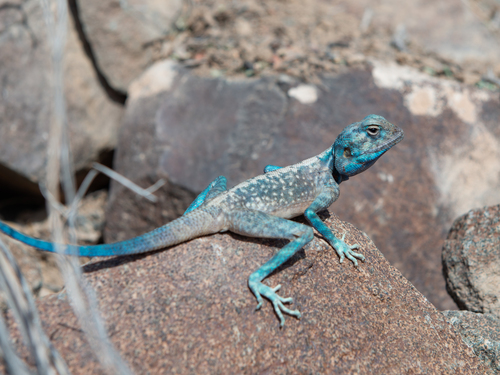
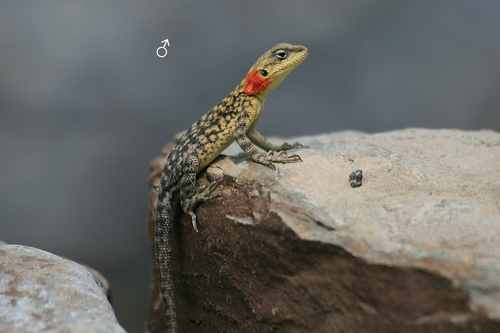
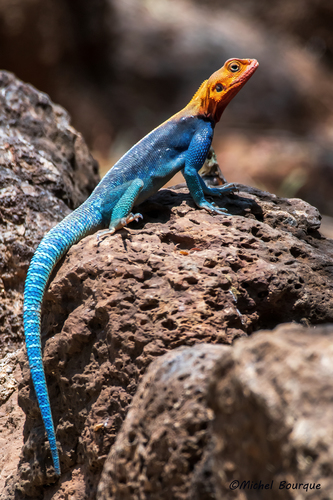
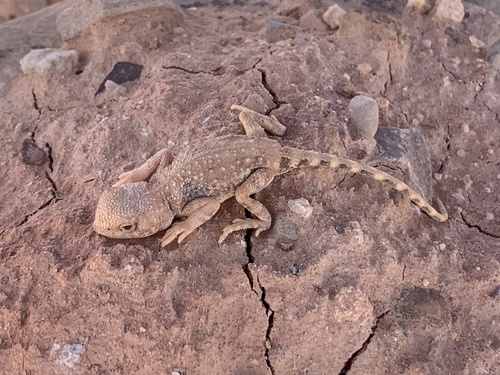
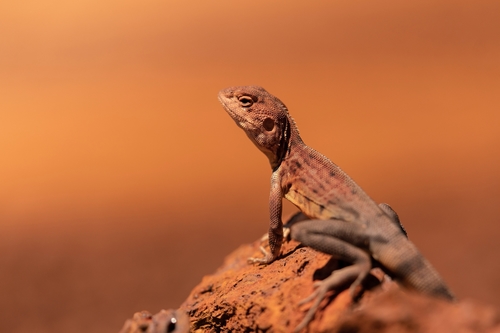
Ctenophorus caudicinctus, commonly called the ring-tailed dragon, is recognized for its bright colouration, survival tactics, and sexual dimorphism. Males display brighter colours than females to attract mates. An individual’s colour is also affected by its age, the season, and its body temperature. This lizard reaches a total length of 25–35 cm, and can be distinguished from other lizards by a line of spines that curves beneath its eyes. Its body colour ranges from pale beige to dark orange, it has distinctive banding around its tail, and its underbelly is white to yellow. It also has a short crest of nuchal spines that varies in colour between individuals. For sensory perception, Ctenophorus caudicinctus has vestibular hearing. Hair cells in the neuroepithelial structures of its inner ear act as receptors: these cells convert mechanical energy from sound-wave-caused displacement of their surroundings into electrochemical energy, and the lizard uses the balance of its head to perceive its surrounding environment. Ctenophorus caudicinctus inhabits rocky, arid areas with low vegetation, and is highly territorial. It is primarily found in the Hamersley Ranges, Pilbara, MacDonnell Ranges, James Range and Musgrave Ranges in Western Australia. The reproductive cycle of the ring-tailed dragon is timed to favour the best conditions for offspring survival and growth, so reproductive cycles vary annually based on rainfall and food availability. Most commonly, Ctenophorus caudicinctus breeds in spring, from September to October. Winter rainfall in the following months stimulates increases in insect populations, which provides abundant food for the lizards. Adequate food availability supports successful fertilization, spermatogenesis, and healthy reproduction. For males, the main spermiogenesis season runs from February to August, as this is when they produce maximum amounts of sperm and conditions are optimal for breeding. Some males do not mate until they reach maturity, and will delay breeding until the next mating season. Ctenophorus caudicinctus is oviparous. The number of surviving offspring is lower than the number of eggs produced, because the species provides no maternal egg protection.