About Ctenolabrus rupestris (Linnaeus, 1758)
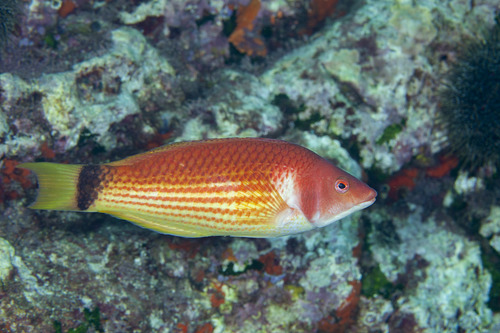
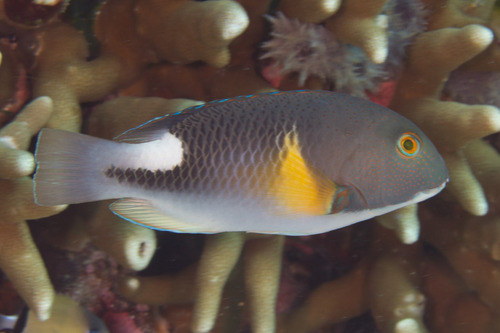
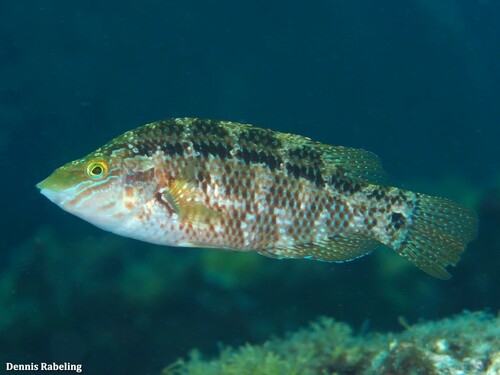
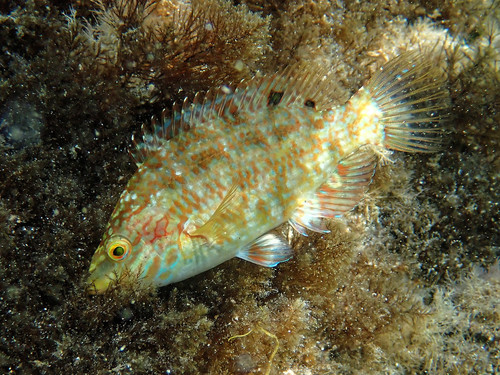
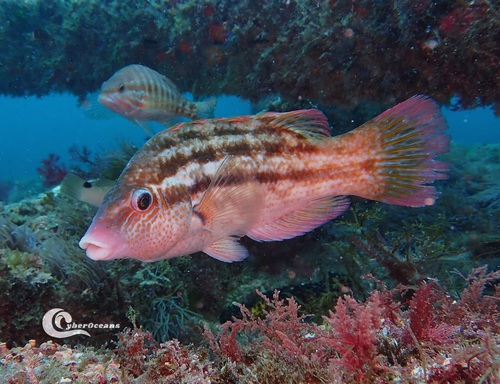
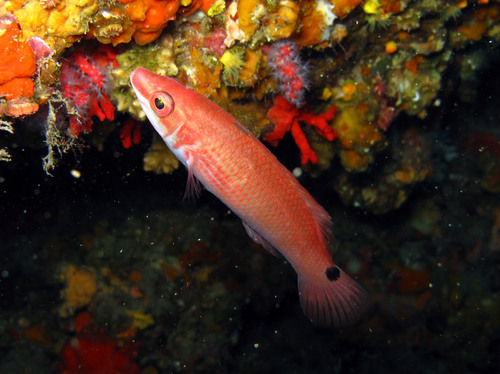
The goldsinny wrasse, Ctenolabrus rupestris (Linnaeus, 1758), can reach a total length of 18 cm (7.1 in), though most individuals do not grow longer than 12 cm (4.7 in). Its body color can be brown, greenish, or orange-red. Two distinct dark spots, one on the dorsal fin and one on the caudal peduncle just in front of the caudal fin, easily distinguish this species from other wrasses native to the eastern Atlantic. It has a slender body, a small pointed head, and large eyes. Its mouth, which has large fleshy lips, holds two rows of small teeth in each jaw.
This wrasse is distributed across the eastern Atlantic Ocean, ranging from Norway south to Morocco. It is also found throughout the western and central Mediterranean Sea, reaching as far east as Antalya, Turkey, but is not present in the far eastern Mediterranean. Its range extends through the Sea of Marmara into the Black Sea.
Goldsinny wrasses typically inhabit areas dominated by rock or boulders, and require many crevices to hide in. They are most commonly found at depths between 10 and 50 metres (33–164 ft), but are occasionally recorded in rockpools near the low water mark. They are often found associated with algae and eelgrass beds. Their diet is made up of bryozoans, small crustaceans, and molluscs.
These wrasses reach maturity at two years of age, can live up to eight years, and do not show sexual dimorphism. Spawning occurs from winter through summer. During the breeding season, males defend breeding territories. Spawning takes place in mid water; the eggs are pelagic, and newly hatched larvae are planktonic.
Goldsinny wrasses feed on sea lice, so they are used alongside Ballan wrasse to clean salmon in commercial aquaculture. Both wrasse species are difficult to keep contained in salmon farms, as they are much smaller than salmon and can escape through farm nets. This species is caught as food by local indigenous peoples, is a popular game fish, and is commonly displayed in public aquaria.