About Ctenochaetus truncatus Randall & Clements, 2001
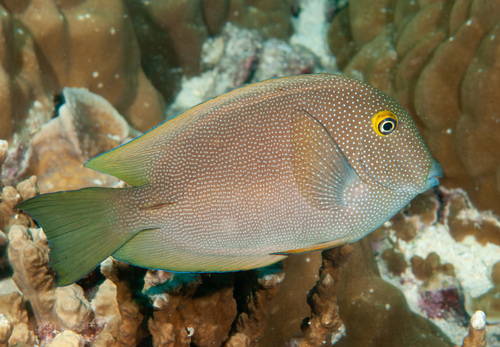
Ctenochaetus truncatus, formally described by Randall & Clements in 2001, has a dorsal fin supported by 8 spines and 25 to 27 soft rays. Its anal fin is supported by 3 spines and 23 to 25 soft rays. The lip margins are either smooth, or covered in small wart-like bumps. The caudal fin is truncate, or slightly emarginate. The overall body color is orange-brown, with numerous pale blue to yellow spots across the head, body, and base of the dorsal fin. A yellow ring surrounds the eye. The caudal, dorsal, anal, and pelvic fins all have a yellow hue. Juveniles of this species are entirely bright yellow. The maximum published standard length for this species is 16 cm (6.3 in). Ctenochaetus truncatus is endemic to the Indian Ocean. Its distribution extends along the eastern African coast, from Kenya south to KwaZulu-Natal, and from off southern Oman east across Indian Ocean islands as far as the Andaman Sea, the Cocos (Keeling) Islands, and Christmas Island. This species occurs at depths ranging from 1 to 21 m (3 ft 3 in to 68 ft 11 in), where it lives over sheltered reef crests and slopes. It can be found either alone, or in small aggregations among large corals or in channels.