About Ctenochaetus tominiensis Randall, 1955
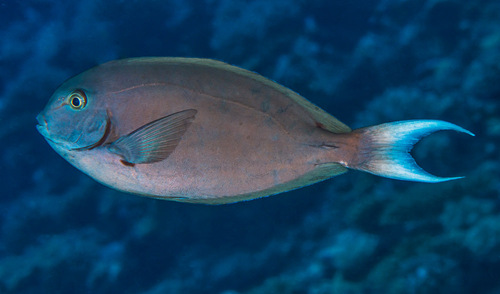
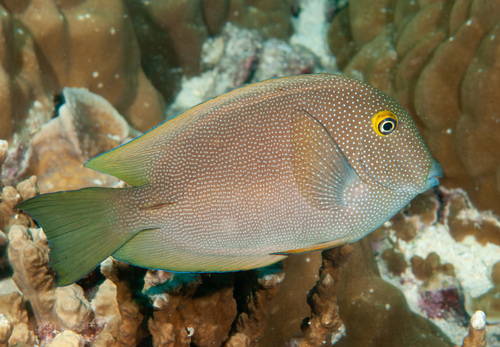
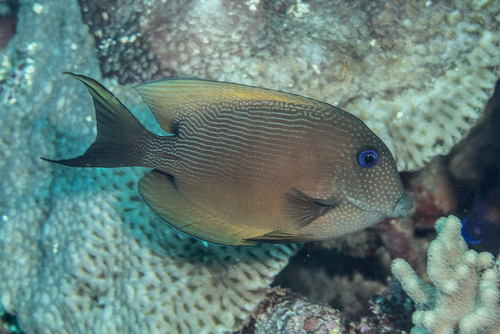
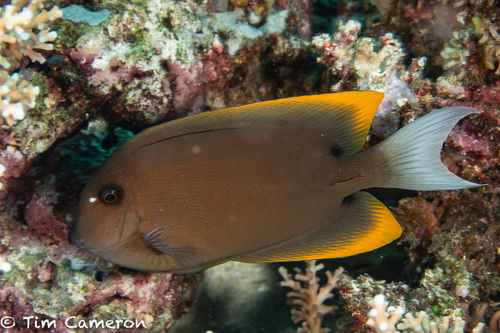
Ctenochaetus tominiensis, a species of the genus Ctenochaetus, has 8 spines and 24 to 25 soft rays supporting its dorsal fin, while 3 spines and 22 to 23 soft rays support its anal fin. Uniquely among species in the genus Ctenochaetus, the posterior ends of the dorsal and anal fins are angular. The margins of its lips are warty. Juveniles have a forked caudal fin, and adults have a lunate caudal fin. The maximum published standard length for this fish is 16 centimetres (6.3 inches). The overall body color is yellowish brown, with a white caudal fin and broad yellow margins on the dorsal and anal fins. Ctenochaetus tominiensis occurs in the western central Pacific Ocean, ranging from Malaysia and Indonesia eastward through East Timor, the Philippines, Palau, Micronesia, Papua New Guinea, the Solomon Islands, Tuvalu, Vanuatu and Fiji, and south to the Great Barrier Reef. It has also been recorded in Tonga. This species can be found either alone or in small groups on steep drop-offs with dense coral growth, in inshore, sheltered waters at depths ranging from 0 to 45 metres (0 to 148 feet).