About Ctenochaetus hawaiiensis Randall, 1955
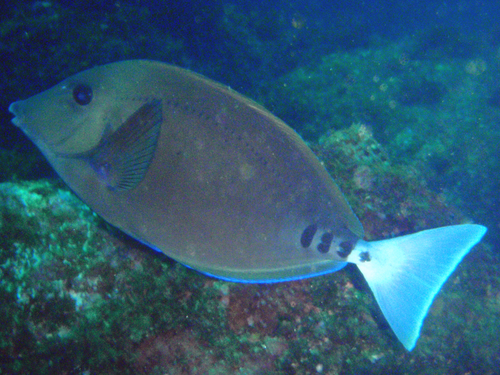
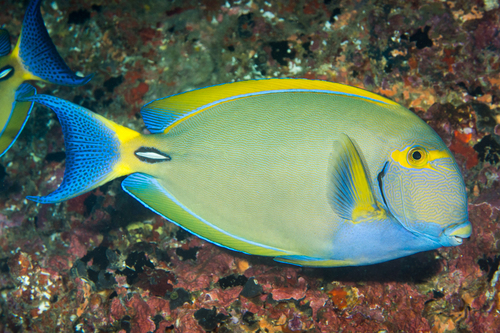
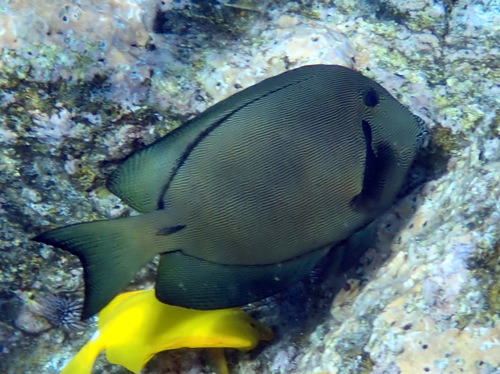
Ctenochaetus hawaiiensis has a maximum published total length of 25 centimeters (9.8 inches). Its dorsal fin is supported by 8 spines and between 27 and 29 soft rays, while its anal fin is supported by 3 spines and 25 or 26 soft rays. To distant observers, adult individuals appear black; when viewed up close, their uniform base color is interrupted by many thin, longitudinal green stripes. Juveniles have very different flank color patterns from adults. They are bright orange-red overall, and marked with many dark chevron-shaped markings, a trait that gives this species one of its common names, chevron tang. Juveniles also have deeper bodies than adults. This species has a wide distribution across the tropical Pacific Ocean. Its range extends from the Ryukyu Islands of southern Japan in the west, through most of Micronesia and French Polynesia, to Hawaii in the east, and reaches as far south as the Pitcairn Islands and Rapa Iti. Ctenochaetus hawaiiensis is an uncommon species found on seaward reefs, including both rocky and coral reefs. Juveniles of this species typically occur in deeper, coral-rich waters.