About Cryptotermes brevis (Walker, 1853)
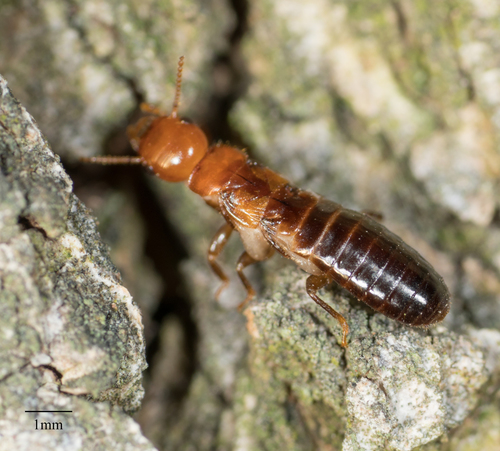
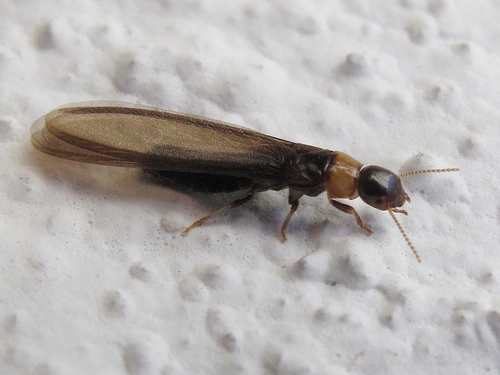
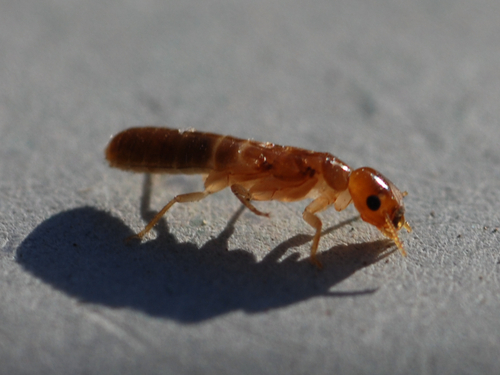
Cryptotermes brevis (Walker, 1853), commonly known as the West Indian drywood termite, is a eusocial insect. Colonies build their nests inside timber, creating chambers to rear larvae and forming short connected galleries. Compared to underground-dwelling termite species, this drywood termite is larger and has a deeper body, shorter limbs, and moves more slowly. All colony members except the reproductive caste are blind. These termites have strong jaws for chewing wood fiber, claws to grip wooden surfaces, and bead-like antennae similar to beads strung on a necklace. Colonies are organized into distinct castes: reproductives (queen, king, and unmated winged alates), soldiers, and pseudergates (false workers). The king and queen have dark brown, chitinous cuticles, while all other colony members have soft bodies. Soldiers measure 4 to 5 mm (0.16 to 0.20 in) long, with colourless bodies and black, wrinkled, squarish heads. They have relatively small mandibles, and can block nest galleries with their heads to stop invading ants from entering the colony. Sausage-shaped pseudergates are immature termites that fulfill the worker caste’s roles: they care for the colony’s brood, excavate tunnels, consume wood, and feed other colony members. Alates have two pairs of transparent membranous wings, with dark veins running close to the leading edge of each wing. Species identification for these termites is difficult, and typically relies on the appearance and structure of soldiers' heads. This species is introduced to new locations more frequently than any other termite species in the world. British entomologist Francis Walker first described it in 1853 from specimens collected in Jamaica, though the species is not thought to have originated in the West Indies. As a drywood termite, it can get all the moisture it needs to survive from the wood it inhabits, which makes it easy for the species to be transported to new locations accidentally. It may have originated in the Neotropics, then spread to Jamaica and other areas via wooden ships or wooden items like furniture. After that initial spread, it continued to spread by the same routes to other Caribbean islands, and reached the coastal areas of the southeastern United States before 1919. Today, Cryptotermes brevis has a wide worldwide distribution. It is found in the Caribbean region, the United States, Central America, tropical South America, Peru, Chile, St Helena, tropical Africa, South Africa, and Madagascar. It is invasive in Australia, where it was first recorded in 1966, and is also present in New Caledonia, New Zealand, French Polynesia, and Fiji, with reported occurrences in Egypt, Italy, and Spain. The queen of Cryptotermes brevis lays kidney-shaped eggs; the pseudergates care for both the eggs and developing larvae. After several moults, developing termites become pseudergates and begin contributing work to the colony. Over time, some pseudergates develop wing pads and become nymphs; after three additional moults, these nymphs mature into winged reproductive alates. Other pseudergates develop into presoldiers with white heads, and after a final moult become black-headed soldiers. Colonies hold approximately 50 pseudergates for every one soldier, and alates are only present in the nest during specific times of year. Alates exit the colony through temporary openings during the swarming season. In Florida, dispersal flights occur at night between April and June. Alates are poor fliers, and soon after landing they shed their wings. A mated pair then searches for suitable timber to start a new colony, enters through an existing hole or crack, seals the entrance with an intestinal secretion, and excavates a brood chamber. The founding pair cares for their first batch of eggs for several months, but once the larvae develop into pseudergates, the pair can focus entirely on egg laying. The first soldier in a new colony does not appear until the second or third year, and alates typically develop around the fifth year. A mature colony can hold over one thousand termites and survive for 10 years or more.