About Cryptosula pallasiana (Moll, 1803)
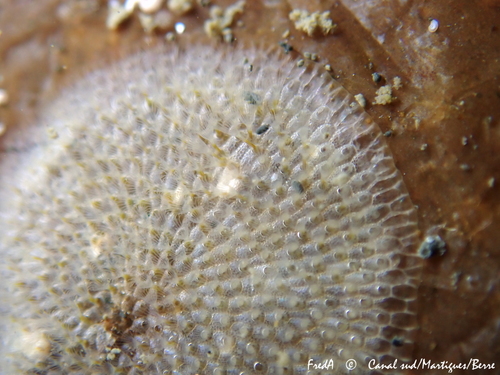
Cryptosula pallasiana is an encrusting colonial bryozoan that forms roughly circular colony patches a few centimetres in diameter. Each colony is made up of many individual organisms called zooids, each housed inside a rigid, rectangular box-like structure called a zooecium. Zooecia measure up to 1 mm (0.04 in) long and 0.5 mm (0.02 in) wide. They fit together in a regular pattern that radiates outward from the spot where the original founding zooid settled to start the colony, with each daughter zooid's head positioned farther from the colony's centre than its foot. The upper surface of the zooecium has an opening called an aperture at the head end; the zooid extends its feeding structure, the lophophore, through this aperture to feed. The aperture is shaped like a square with rounded corners, and pores are present on the upper surface of the zooecium both above and below the aperture. Colonies can be white, beige, pink, or orange. Cryptosula pallasiana is native to the North Atlantic Ocean. On the North Atlantic's eastern side, its range stretches from Norway and the United Kingdom down to the Mediterranean Sea, the Black Sea, and Morocco. On the western side, it ranges from Nova Scotia to Florida. It was first recorded in the Pacific Ocean in the 1940s, initially in California's San Francisco Bay and Newport Bay, and later in other areas of California, as well as British Columbia, Washington, and Oregon. By the 1960s, it had also been reported from Japan, Hawaii, New Zealand, Australia, Argentina, and Chile. It acts as a fouling organism, and researchers believe it has spread to new regions attached to ship hulls, and possibly through the transfer of oysters or other shellfish. This species grows in shallow water on a wide variety of hard surfaces, including rocks, pilings, docks, breakwaters, seaweed, sea grasses, shellfish, floating debris, and ship hulls. Colonies provide suitable habitat for other invertebrates and juvenile fish. Zooids feed via filter feeding: they extend their lophophores into the water to capture and extract particles smaller than 0.045 mm (0.002 in) in diameter. The sea slug Okenia eolida feeds on fouling bryozoans, including C. pallasiana, and has been transported around the world along with this bryozoan.

