About Cryptostylis hunteriana Nicholls
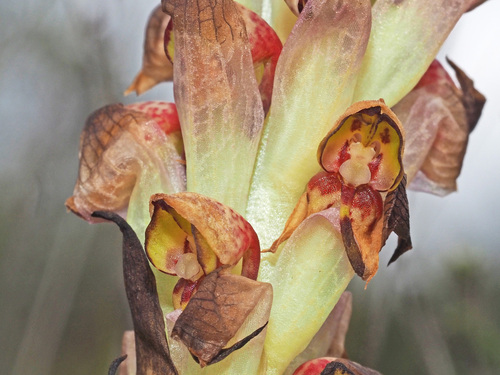
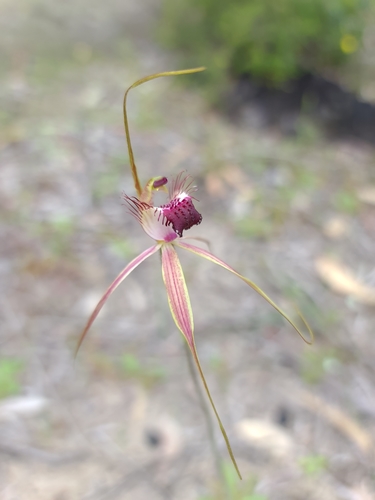
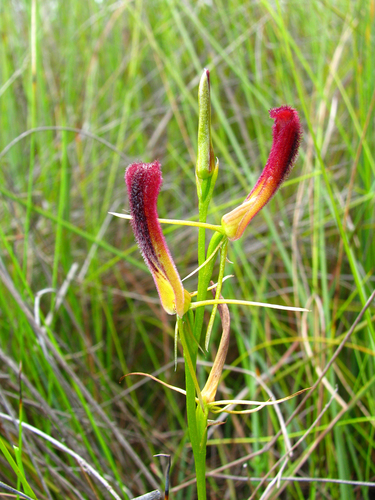
Cryptostylis hunteriana is a terrestrial, perennial, deciduous, saprophytic herb. Its flowering stem grows 80–450 mm (3–20 in) high, and bears up to ten flowers. Each flower is 20–30 mm (0.79–1.2 in) long and 6–8 mm (0.2–0.3 in) wide. The flower's most prominent feature is its spatula-shaped labellum, which is red or maroon with a green base, and is distinctly hairy. The labellum is 20–33 mm (0.8–1 in) long and 6–8 mm (0.2–0.3 in) wide, with inrolled margins and a smooth underside. Thin green sepals 15–22 mm (0.6–0.9 in) long and about 1 mm (0.04 in) wide grow from the base of the flower. Petals are similar to the sepals, but shorter and narrower. Flowering occurs mainly from December to February. This leafless tongue-orchid grows singly or in small colonies across a range of habitats, including wet heath, sedgeland, grasstree plains, and woodland with scribbly gum, silvertop ash, red bloodwood and black sheoak. It often grows near the other tongue-orchids, C. subulata and C. erecta. The species occurs in coastal areas and nearby inland ranges, from south of Gibraltar Range National Park in New South Wales to East Gippsland between Marlo and Genoa in Victoria. In Queensland, it has been recorded from the coast between Tin Can Bay and the Glass House Mountains. Like other Australian members of its genus, C. hunteriana is pollinated by the ichneumon wasp Lissopimpla excelsa, commonly called the orchid dupe wasp. Male wasps mistake the flower parts for female wasps and copulate with the flower to achieve pollination. Unlike other members of the genus, it does not produce leaves. It is thought to rely on a fungal relationship to support its metabolism.