About Cryptostylis erecta R.Br.
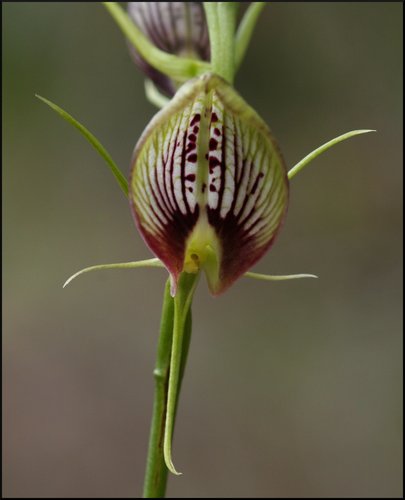
Cryptostylis erecta R.Br. is a terrestrial, perennial, deciduous herb. It produces one to several egg-shaped to lance-shaped leaves, each 60–130 mm (2–5 in) long and 13–30 mm (0.5–1 in) wide, borne on a 10–100 mm (0.4–4 in) long petiole. The upper surface of the leaves is dark green, while the lower surface is purple. Between two and twelve flowers grow on a 300–800 mm (10–30 in) high flower spike; each flower is 25–30 mm (0.98–1.2 in) long and 10–15 mm (0.4–0.6 in) wide. The flower's most prominent feature is its hood- or bonnet-shaped labellum, which measures 20–30 mm (0.8–1 in) long and 10–15 mm (0.4–0.6 in) wide. This labellum ranges in color from greenish to lilac, marked with a network of purple or maroon veins and a small number of purple spots. Its narrow base surrounds the flower's column. The green sepals are 18–25 mm (0.7–1 in) long and 1.5–2 mm (0.06–0.08 in) wide, while the petals are 10–15 mm (0.4–0.6 in) long and around 1 mm (0.04 in) wide. All sepals and petals spread away from each other. Flowering takes place between September and April. This species naturally grows on sandy soils in dry eucalyptus woodlands and heathlands. Its range runs from Kroombit Tops National Park in Queensland, south through New South Wales to eastern Gippsland in Victoria. It grows mainly in coastal districts, though it is also found in the Upper Blue Mountains. Like other Australian members of its genus, C. erecta is pollinated by Lissopimpla excelsa, the ichneumon wasp commonly called the orchid dupe wasp. Male wasps mistake the flower's parts for female wasps and copulate with the flower to achieve pollination. Orchid enthusiasts have successfully grown Cryptostylis erecta, but it is a slow-growing species. Its rhizomes are delicate, do not tolerate disturbance, and require consistently moist conditions at all times.