About Cryptoprocta ferox Bennett, 1833
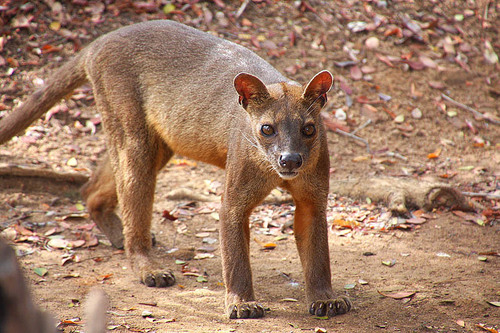
The fossa (Cryptoprocta ferox Bennett, 1833) looks like a smaller version of a large wild cat such as a cougar, with a slender body, muscular limbs, and a tail that is almost as long as the rest of its body. Its head is similar to that of a mongoose, and is relatively longer than a cat's head. It has a broad, short muzzle, and large, rounded ears. Its medium brown eyes are set fairly wide apart, and their pupils contract to slits. Like many nocturnal hunting carnivorans, fossa eyes reflect light, and the reflected light has an orange hue. The fossa's head-body length measures 70–80 cm (28–31 in), while its tail is 65–70 cm (26–28 in) long. This species shows sexual dimorphism: adult males, which weigh 6.2–8.6 kg (14–19 lb), are larger than adult females, which weigh 5.5–6.8 kg (12–15 lb). Smaller fossa individuals are typically found in northern and eastern Madagascar, while larger individuals live in the south and west. Unusually large individuals weighing up to 20 kg (44 lb) have been reported, but the reliability of these measurements is questioned. The fossa has a strong sense of smell, hearing, and sight. It is a hardy animal, and illness is rare among captive fossas. Both male and female fossa have short, straight, relatively dense fur that has no spots or other markings. Most adults are reddish-brown on their dorsal (back) side and dirty cream on their ventral (belly) side. During the breeding rut, the abdomen may take on an orange tint from a reddish substance secreted by a chest gland, though not all researchers have consistently observed this change. The fossa's tail is usually lighter in color than the sides of its body. Juvenile fossas are either gray or almost white. Many of the fossa's physical traits are adaptations for climbing through trees. It uses its tail to help maintain balance, and has semi-retractable claws that it uses to climb trees while searching for prey. It has semiplantigrade feet, and switches between a plantigrade-like gait when moving through trees and a digitigrade-like gait when moving on the ground. The soles of its paws are nearly hairless and covered with thick, strong pads. The fossa's ankles are very flexible, letting it easily grip tree trunks to climb up or down trees head-first, or leap to another tree. Captive juvenile fossas have been observed swinging upside down by their hind feet from knotted ropes. The fossa has multiple scent glands, which are less developed in females. Like herpestids (mongooses and related species), it has a perianal skin gland inside an anal sac that surrounds the anus like a pocket. This pocket opens to the outside through a horizontal slit below the tail. Additional scent glands are located near the penis (in males) or vagina (in females), and penile glands produce a strong scent. Just like herpestids, the fossa does not have prescrotal glands. Among Malagasy carnivores, the fossa has the widest geographical range. It generally occurs in low numbers across Madagascar in remaining forest areas, and prefers undisturbed, pristine forest habitat. It can also be found in some degraded forests, but in lower population numbers. While the fossa lives in all known forest habitats across Madagascar, including western dry deciduous forests, eastern rainforests, and southern spiny forests, it is seen more often in humid forests than in dry forests. This may be because dry forests have a sparser canopy that provides less shade, and the fossa appears to move more easily through humid forests. The fossa is not found in areas with the most severe habitat disturbance, and like most of Madagascar's native wildlife, it is not present on the country's central high plateau. The fossa has been recorded across a range of elevations in undisturbed parts of protected areas throughout Madagascar. In the Réserve Naturelle Intégrale d'Andringitra, evidence of the fossa has been recorded at four separate sites ranging from 810 to 1,625 m (2,657 to 5,331 ft). The highest confirmed elevation the fossa has been found at is 2,000 m (6,600 ft); its presence at high elevations on the Andringitra Massif was confirmed in 1996. Similarly, fossa presence has been recorded at elevations from 440 m (1,440 ft) to 1,875 m (6,152 ft) in Andohahela National Park. The fossa's occurrence at these different elevations confirms its ability to adapt to a range of elevations, which matches its known distribution across all forest types in Madagascar.