About Cryptomyzus ribis (Linnaeus, 1758)
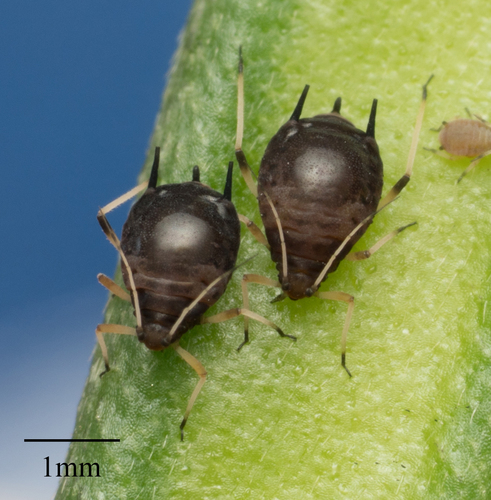
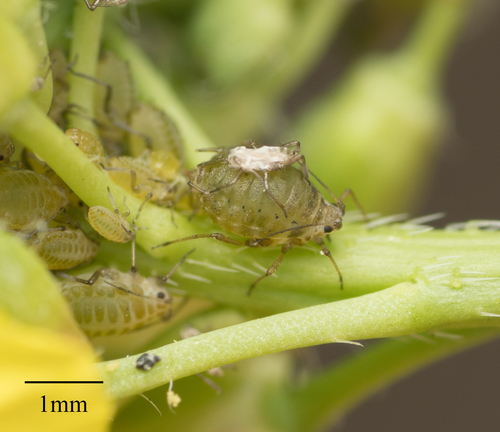
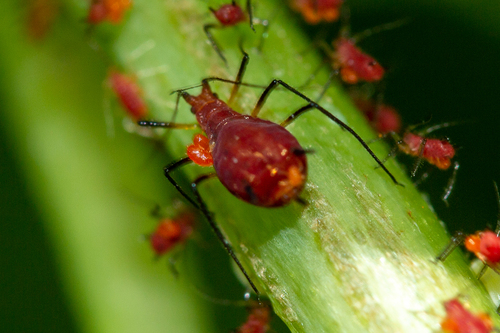
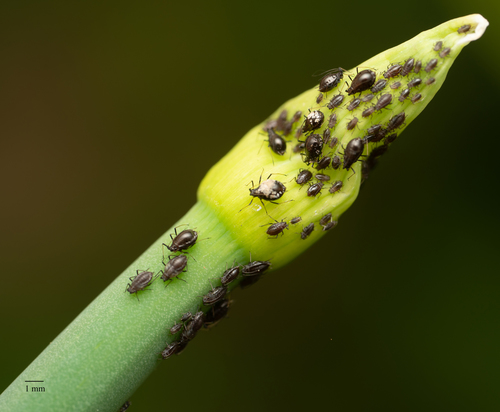
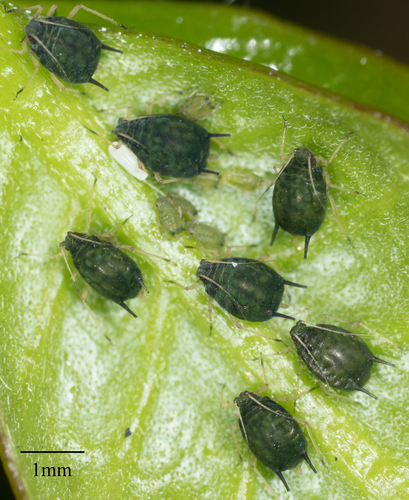
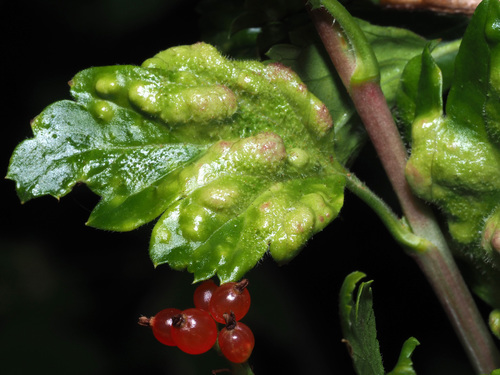
The most recognizable signs of an infestation by Cryptomyzus ribis are domed blisters (galls) that form on the leaves of host plants, most commonly red and white currant bushes. Galls appear shortly after leaves open in spring, starting yellow and turning red by early summer. Infested leaves may also become crinkled; colonies of yellow-greenish aphids live within hairy depressions on the undersides of affected leaves. This aphid prefers red currant cultivars, including white currant varieties. Adult C. ribis measure 1 to 2 millimetres (0.039 to 0.079 inches) in length. In summer, some mature aphids leave the galls and migrate to the secondary host plant hedge woundwort (Stachys sylvatica), while others remain on currant plants. All groups produce several generations per year. In autumn, females lay overwintering eggs on currant twigs, which hatch the following spring. Beyond red currant (Ribes rubrum) and its white currant varieties, C. ribis has also been recorded on mountain currant (Ribes alpinum), wild black currant (Ribes americanum), golden currant (Ribes aureum), blackcurrant (Ribes nigrum), Canadian gooseberry (Ribes oxyacanthoides), rock currant (Ribes petraeum) and European gooseberry (Ribes uva-crispa). Leaf damage such as buckling, crumpling, inrolling and distortion can be caused by other aphid species, but these cases do not involve thickened plant tissue, so the resulting growths are not classified as true galls. C. ribis is distributed across most of mainland Europe, and is absent from Albania, Austria, Croatia, Gibraltar, Liechtenstein, Luxembourg, Portugal and Turkey.