About Cryptomitrium tenerum (Hook.) Austin ex Underw.
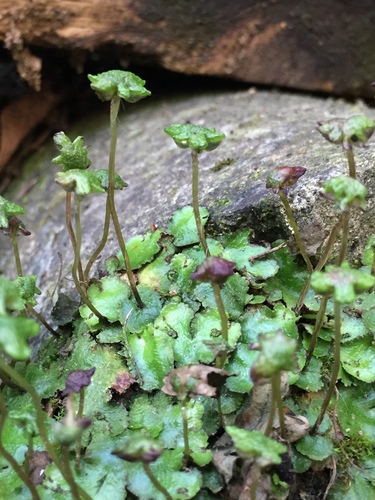
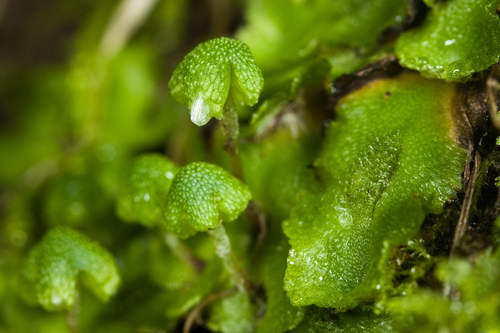
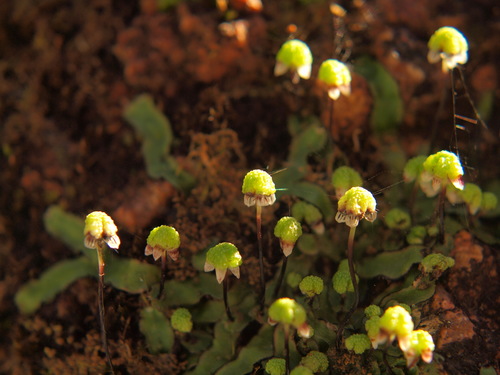
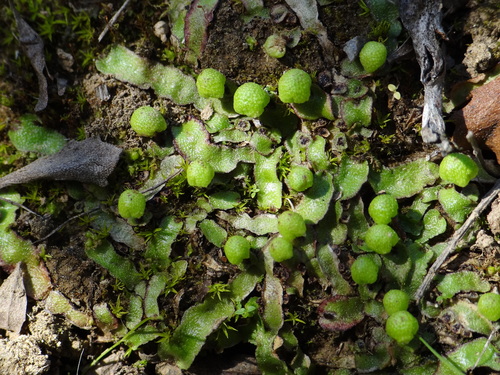
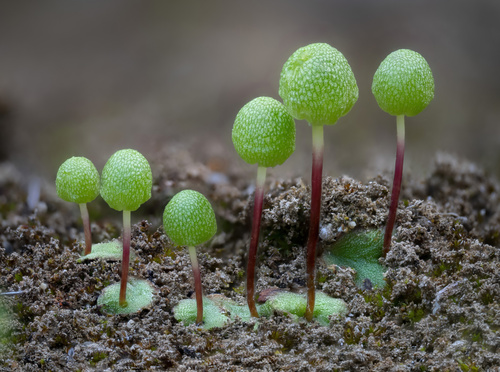
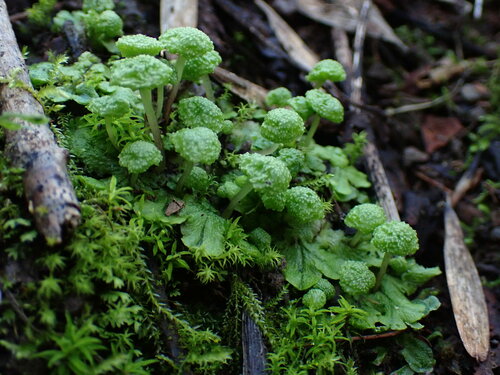
Like most other Marchantiales, Cryptomitrium tenerum has a flat, dichotomously branched thallus. For this specific species, the thallus is pale green, flattened, thin, and somewhat shiny, measuring 0.6 to 1.5 cm long and less than 1 cm wide. Patches along the thallus margins are brownish purple, and the margins are somewhat undulate, curling upward when the plant is dry. The dorsal thallus surface bears a faint pattern of irregular polygons surrounding inconspicuous pores that open into air chambers below. The ventral thallus surface is dark purple, shiny toward the margins, and green in its medial section. Ventral scales are small, dark purple, and poorly developed when the plant reaches maturity. The peculiar oil bodies common to many liverworts are scattered throughout the thallus, ventral scales, and sporogonial receptacle of this species. Cryptomitrium tenerum does not reproduce asexually via gemmae. It usually reaches its full best development in February or March, depending on the amount and distribution of winter rainfall. During the long rainless season, the plants dry up; when autumn rains arrive, the thallus tips revive and grow into new plants. Cryptomitrium tenerum occurs in Mediterranean climates that have cool wet winters and dry summers. It forms small to locally extensive mats on bare, usually shaded, humid soil on hillsides, rock outcrops, and streambanks. Wildfires are suspected to play a role in maintaining its habitat. Capsules develop in late winter to early spring, depending on elevation. The species is a poor competitor with vascular plants, and its populations tend to disappear as ecological succession progresses. This species is monoecious. As in certain related species such as Asterella, the antheridia form a narrow, elongated, median group on the dorsal surface, positioned immediately posterior to the female receptacle. The female receptacle is terminal. Its stalk has a single rhizoid furrow. The receptacle disk is hemispherical when young, and eventually becomes circular and nearly flat. It has no lobes when mature. The distinctive mature discoid carpocephalum is easily recognized; earlier in development it may be more or less low-pyramidal, but it is never lobed, making it quite distinctive. Sporangia are brown, nearly spherical, with very short seta. There are three to seven sporangia per receptacle, and each opens by a lid. Sporangia mature in early spring. Spores are brown, ranging 35-450 um, more or less distinctly tetrahedral, irregularly areolate-lamellate, with a pellucid margin. Elaters are attenuate, 300-450 um, contorted, often branched, and spiraled.