About Cryptococcus fagisuga Lindinger, 1936
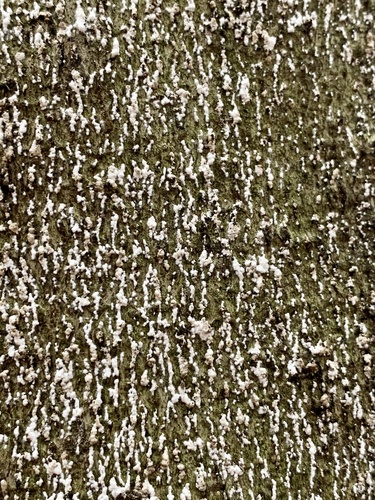
Description: Adult beech scale insects are elliptical in shape, roughly one millimetre in length, and covered by a cream-coloured, cottony wax secretion. They have reddish-brown eyes, no wings, rudimentary antennae and legs, and numerous tiny wax-secreting glands. Their sap-sucking stylet can reach up to two millimetres in length.
History and distribution: Cryptococcus fagisuga is the insect that causes beech bark disease, which has been documented affecting common beech trees (Fagus sylvatica) in Europe since before 1849. Prior to 1914, researchers believed the beech scale insect itself caused the disease. It was later discovered that a fungus, then identified as Neonectria ditissima, is actually what kills trees infested by this scale insect. Around 1890, the scale insect was accidentally introduced to Nova Scotia. By 1932, the scale and its associated Neonectria fungus had spread to many areas of the Maritime Provinces and parts of eastern and south-central Maine. The species continues to spread across North America, and is now found in Quebec, Ontario, New England, New York, New Jersey, Pennsylvania and West Virginia. Researchers are working to identify the geographic origin of beech scale to find natural enemies that could be used for biological control. Studies and associated ribosomal DNA analysis suggest this pest likely originated in the region encompassing northeast Greece, northern Iran, the Caucasus and the Black Sea drainage basin, living on the host beech subspecies F. sylvatica orientalis.
Life cycle: No male beech scale insects exist; all females reproduce through parthenogenesis. Starting in midsummer, females deposit four to eight pale yellow eggs in end-to-end strings attached to the bark of the trees they feed on. Wingless larvae hatch approximately twenty days later; these larvae are called crawlers or nymphs. Crawlers have fully developed legs and short antennae. Some crawlers stay hidden under the dead female body (the female dies after laying eggs), while others disperse to cracks and crevices on the tree. A small number are washed off the tree or fall to the ground, and most of these individuals die. Occasionally a crawler reaches another beech tree—often carried there by wind or on a bird's foot—and establishes a new colony. After settling on a suitable tree, a crawler pushes its tubular stylet into the bark and begins feeding. At this point, it moults into a second-stage, legless nymph, and remains sedentary for the rest of its life. It secretes wax from its glands and soon becomes covered in a protective wool-like coating. After overwintering, it undergoes a second moult in spring to become a fully mature female.