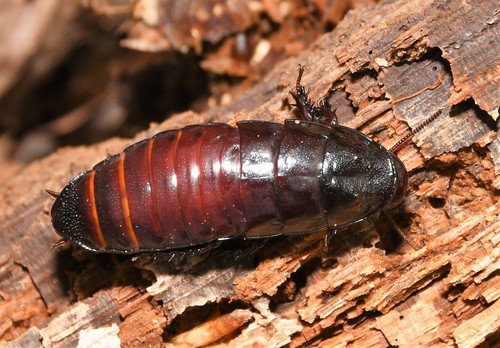
About Cryptocercus punctulatus Scudder, 1862
Cryptocercus punctulatus Scudder, 1862 is an oviparous wingless cockroach species in the family Cryptocercidae. Adults are brown to black, and measure between 23 and 30 mm in body length. The genus Cryptocercus is closely related to termites, and the genus’ life habits and gut symbiosis are thought to be ancestral traits for the group. Across its known geographic range, C. punctulatus forms a cryptic species complex that includes four distinct karyotypes: 2n=37, 2n=39, 2n=43, and 2n=45. Despite these genetic differences, all karyotypes are identical in phenotype, behavior, and life history, so the complex is still treated as a single species. This species is distributed across the eastern United States, with its range concentrated in the Appalachian Mountains of western Virginia and Pennsylvania. It is found specifically in western Virginia, West Virginia, and Pennsylvania, inhabiting temperate deciduous or mixed deciduous-coniferous forests in the Appalachian and Allegheny Mountain Ranges. It occurs almost exclusively at elevations greater than 400 meters above sea level. It shares this general mountain habitat with three other closely related congeneric species: C. darwini, C. garciai, and C. wrighti. No sympatry between C. punctulatus and these three species has ever been documented, and C. punctulatus never occupies logs that host any of the other species. As a wingless species, its distribution is limited by walking distance and the spacing of fallen logs. Molecular dating estimates C. punctulatus diverged from its three close relatives between 13 and 38 million years ago, and the species has occupied these mountain forests for tens of millions of years. There is evidence that the species shifted its range up and down mountain slopes in response to past glacial and interglacial climate periods. C. punctulatus is a xylophagous (wood-eating) cockroach that spends its entire lifespan inside moist dead logs that it feeds on. It excavates extensive galleries through fallen logs, with gallery placement following the moisture distribution inside the wood: denser sections of wood contain fewer tunnels than softer, moister sections. Many occupied logs contain brown rot and other fungi, and C. punctulatus may prefer logs that host specific fungal species. This species can live in both deciduous and coniferous logs, and has been collected from 11 different coniferous tree species across all tree-bearing montane elevations in the Appalachian Mountains. Its ability to use both deciduous and coniferous wood gives it greater resilience to climate change. It is only found in older, mature forests, as it requires established dead fallen trees and cannot survive in young, regenerating forest stands. It contributes to forest health by decomposing dead wood and releasing nutrients back into the surrounding soil. C. punctulatus is a subsocial species that provides basic bi-parental care to its eggs, larvae, and young. Mature individuals form mating pairs, and produce their first (and usually only) clutch of offspring one year after pairing. Field observations show pairs have a single reproductive episode, producing an average of 73 eggs across up to four oothecae. After eggs hatch, adults provide an extended period of brood care that lasts three years or longer. This care includes defending the family group, excavating shared galleries, maintaining nest sanitation, and trophallactically feeding young nymphs during their early development. Newly hatched nymphs are born without the cellulolytic protozoan symbionts they need to digest wood, so they depend entirely on adult parents to obtain both these symbionts and nourishment. C. punctulatus currently holds the record for the most altricial development of any known cockroach: nymphs hatch blind, with a thin pale cuticle, remain protected in the parent nest, and rely fully on parents for food and symbionts. It takes this species 5 to 6 years to reach reproductive maturity. It is often described as the best living model of the ancestral state of termites, and provides key insight into the role of parental care in the evolution of termite eusociality.

