About Cryptocarya laevigata Blume
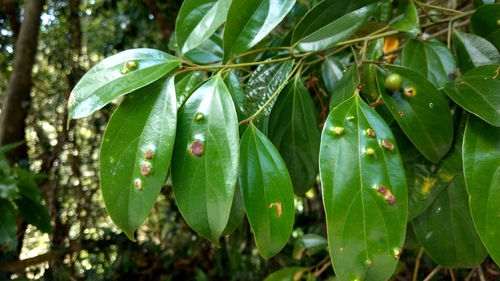
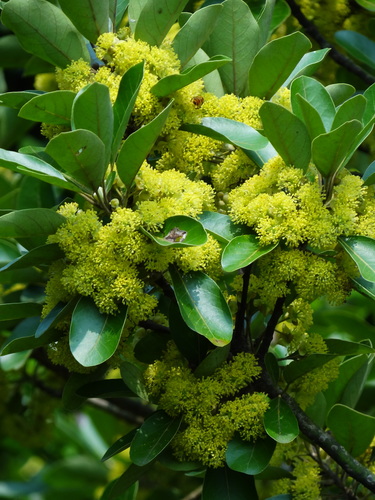
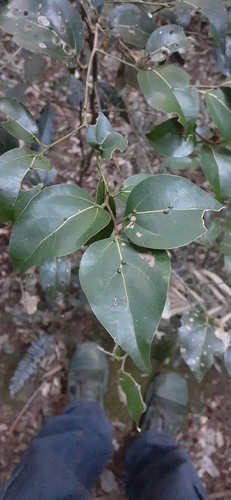
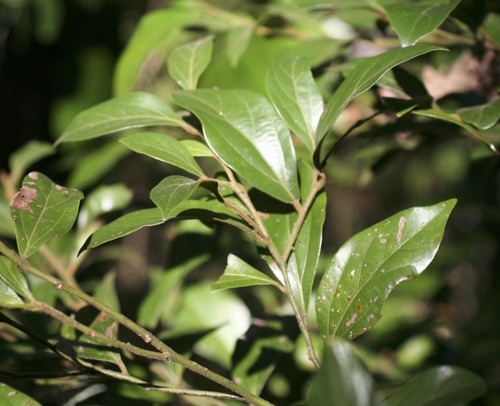
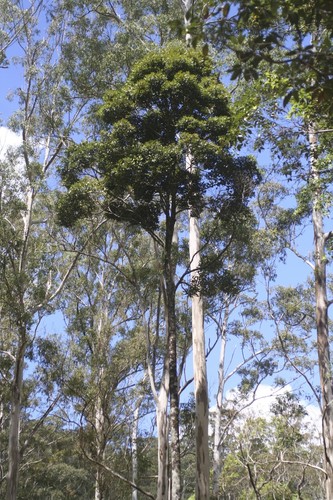
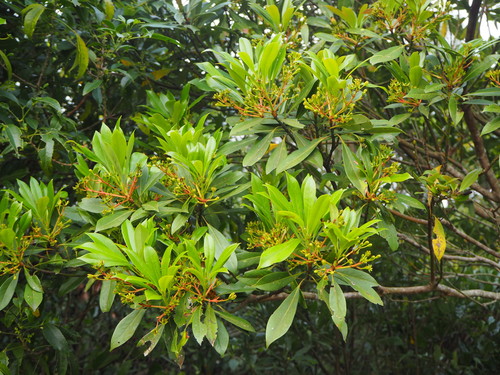
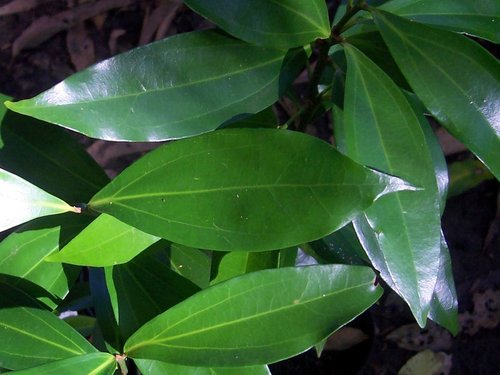
Cryptocarya laevigata Blume is a shrub or tree that usually grows to a maximum height of 7 meters (23 feet), and its stems do not form buttresses. Its leaves are lance-shaped to elliptic, measuring 50–155 mm (2.0–6.1 in) long and 13–61 mm (0.5–2.4 in) wide, and are borne on a petiole 2–11 mm (0.08–0.43 in) long. The flowers are arranged in racemes or panicles in leaf axils, and are shorter than the leaves. They are pale brown, creamy white, or pale green, and have a fragrance. The perianth tube is 1.1–1.8 mm (0.04–0.07 in) long and 1.0–2.8 mm (0.04–0.11 in) wide. Outer tepals are 2.2–3.0 mm (0.09–0.12 in) long and 1.4–2 mm (0.06–0.08 in) wide, while inner tepals are 2.3–3.2 mm (0.09–0.13 in) long and 1.4–2.1 mm (0.06–0.08 in) wide. Outer anthers measure 0.7–1.2 mm (0.03–0.05 in) long and 1.4–2.0 mm (0.06–0.08 in) wide, and inner anthers measure 0.7–1.3 mm (0.03–0.05 in) long and 0.4–0.7 mm (0.02–0.03 in) wide. Flowering takes place from September to December. The fruit is a spherical, red to orange-yellow drupe 17–33 mm (0.7–1.3 in) long and 17–38 mm (0.7–1.5 in) wide, with creamy cotyledons. This species grows in tropical and subtropical moist broadleaf forests, and is distributed across Sumatra, Peninsular Malaysia, Borneo, Java, Sulawesi, the Philippines, New Guinea, the Bismarck Archipelago, the Solomon Islands, and Australia. In Australia, it occurs in Queensland and in New South Wales north of Lismore. In horticulture, its glossy leaves, small mature size, and attractive red fruit make it suitable for use as an ornamental tree. As with most Australian Cryptocarya fruit, removing the slimy red aril is recommended to improve seed germination success. Roots and shoots typically emerge within three to twelve months after sowing.