About Cryptocarya glaucescens R.Br.
Cryptocarya glaucescens, commonly known as jackwood, is a tree that usually grows up to 30 meters (98 feet) in height, with a trunk diameter at breast height of up to 90 centimeters (35 inches). Its stem is sometimes buttressed, and its bark is dark brown or reddish brown, often with a scaly texture.
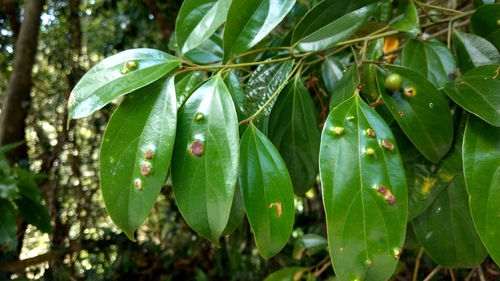
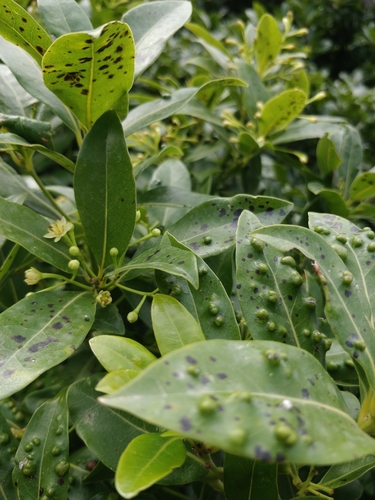
The leaves are alternately arranged, and range from lance-shaped to elliptic. Each leaf is 55–100 mm (2.2–3.9 in) long, 25–40 mm (0.98–1.57 in) wide, and attached to a 5–9 mm (0.20–0.35 in) long petiole; the lower surface of the leaf is glaucous.
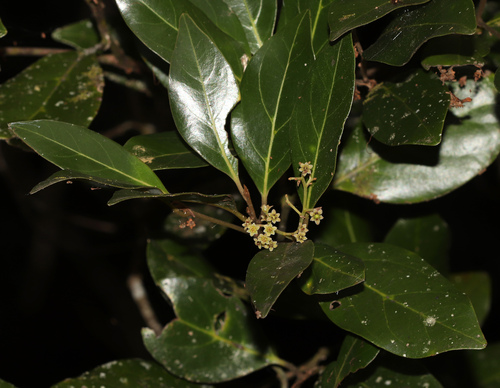
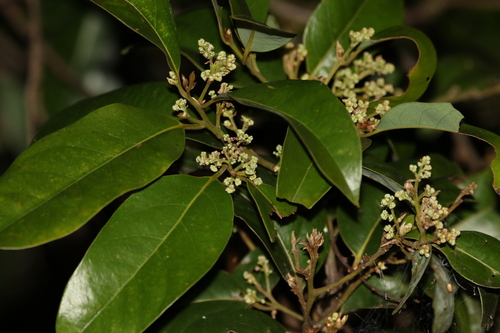
The flowers are cream-coloured to green, scented, and arranged in panicles that grow from leaf axils. These panicles are usually shorter than the leaves. The perianth tube measures 1.0–1.5 mm (0.039–0.059 in) long and 1.0–1.3 mm (0.039–0.051 in) wide. Outer tepals are 0.5–0.6 mm (0.020–0.024 in) long and 0.4–0.5 mm (0.016–0.020 in) wide, while inner tepals are 0.5–0.6 mm (0.020–0.024 in) long and 0.2–0.4 mm (0.0079–0.0157 in) wide. The ovary is 0.8–1.0 mm (0.031–0.039 in) long, 0.4–0.5 mm (0.016–0.020 in) wide, glabrous, and has a glabrous style. Flowering takes place in October and November.
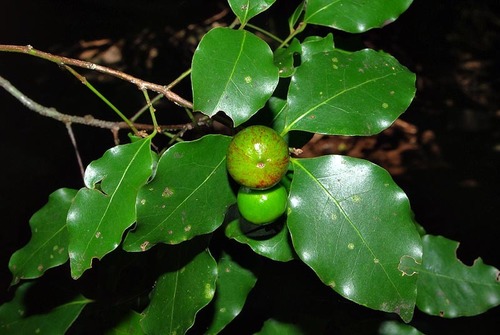
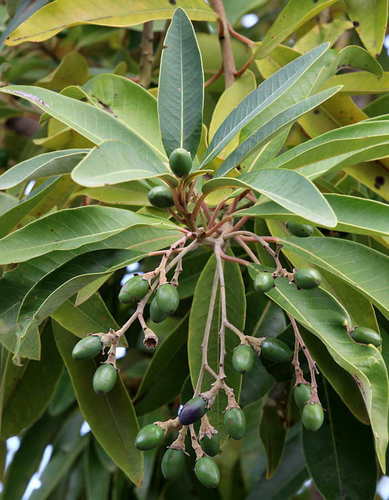
The fruit is a laterally compressed black drupe, 12–21 mm (0.47–0.83 in) long and 13–25 mm (0.51–0.98 in) wide. Fruit ripen from March to June. This species grows in rainforest, usually on poorer soils, at altitudes from sea level up to 1,000 m (3,300 ft). Its natural range extends from Mount Dromedary at 36° S in southern New South Wales north to Eungella National Park at 20° S in central Queensland. The fruit of Cryptocarya glaucescens is eaten by rainforest birds, including the topknot pigeon.