About Cryptocarya foetida R.T.Baker
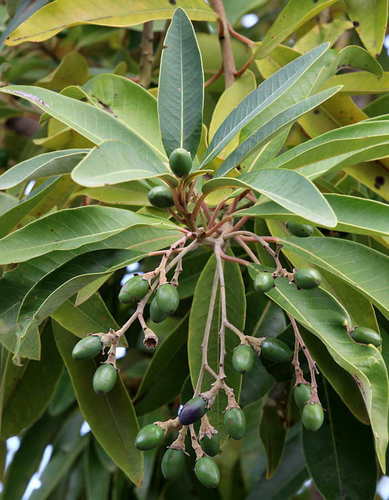
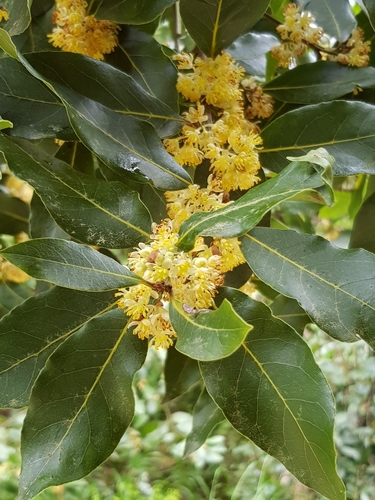
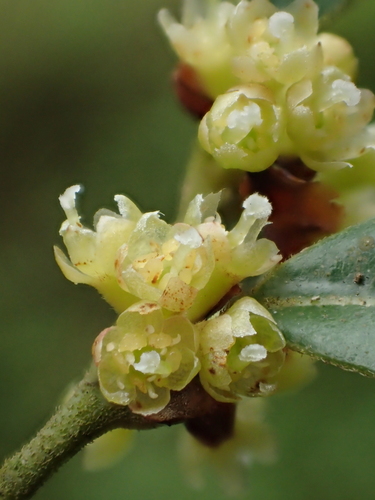
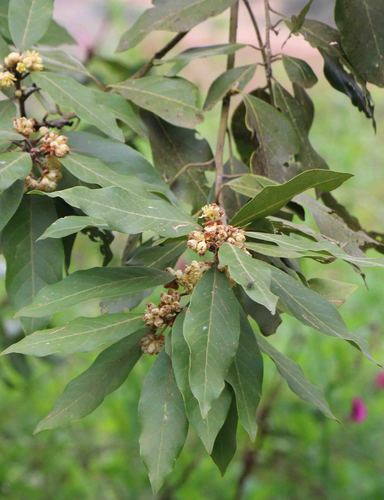
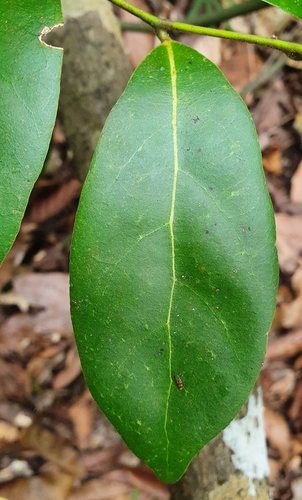
Cryptocarya foetida is a small to medium-sized tree that usually grows up to 25 meters (82 feet) tall. Its trunk has a diameter at breast height of 25 centimeters (9.8 inches) and lacks buttresses. Its leaves are egg-shaped to elliptic or oval, 8–150 millimeters (0.31–5.91 inches) long and 33–44 millimeters (1.3–1.7 inches) wide, borne on a 6–10 millimeter (0.24–0.39 inch) long petiole. Both surfaces of the leaves are hairless and have prominent veins, and the lower leaf surface is paler than the upper surface. Flowers are arranged in dense panicles that are shorter than the leaves. The perianth tube measures 1.1–1.2 millimeters (0.043–0.047 inches) long and 1.5–1.7 millimeters (0.059–0.067 inches) wide. Tepals are 1.7–1.9 millimeters (0.067–0.075 inches) long and 0.8–0.9 millimeters (0.031–0.035 inches) wide. Outer anthers are 0.7–0.8 millimeters (0.028–0.031 inches) long and 0.5–0.6 millimeters (0.020–0.024 inches) wide, while inner anthers are 0.8 millimeters (0.031 inches) long and 0.4 millimeters (0.016 inches) wide. Flowering occurs mainly in February. The fruit is a spherical black to purplish-black drupe, 8–13 millimeters (0.31–0.51 inches) long and 8–15 millimeters (0.31–0.59 inches) wide. This species, commonly called stinking cryptocarya, is distributed from east of Gympie in southern Queensland to Iluka in northern New South Wales. It grows in littoral rainforest on old sand dunes.