About Cryptobranchus alleganiensis (Sonnini de Manoncourt & Latreille, 1801)
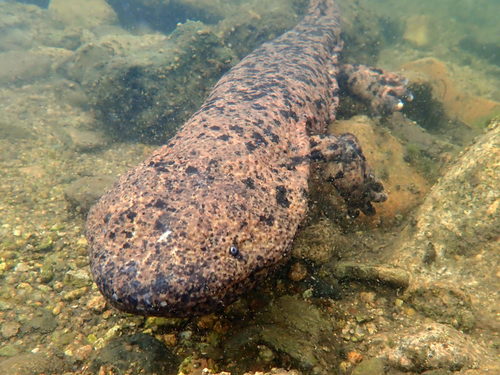
Cryptobranchus alleganiensis, commonly called the hellbender, has a flat body and flat head, with small beady eyes positioned on the top of its head and slimy skin. Like most salamanders, it has short legs: four toes on each front leg and five toes on each hind limb. Its tail is keeled for propulsion and shaped like a rudder, but it is rarely used for swimming. Instead, these salamanders use toe pads to grip rocks and walk along streambeds rather than swimming. The hellbender has functional lungs, and often retains gill slits throughout life, though only young immature specimens have true gills. Adult hellbenders absorb oxygen from water through capillaries in their side frills, which run along each side of the body from the neck down to the base of the tail. These frills work by increasing the hellbender’s total surface area to assist with respiration. The hellbender only rarely leaves the water, and makes very little use of its lungs. Juveniles lose their external gills when they reach around 18 months of age, or roughly 125 mm (4.9 in) in length. Its base coloration is typically blotchy brown or red-brown, with a paler underbelly; hellbenders may also be gray, yellowish-brown, or even solid black. For both males and females, adult snout-to-vent length ranges from 24 to 40 cm (9.4 to 15.7 in), with a total body length of 30 to 74 cm (12 to 29 in). This makes the hellbender the fourth-largest aquatic salamander species in the world, after the South China giant salamander, Chinese giant salamander, and Japanese giant salamander, and the largest amphibian native to North America. The reticulated siren of the southeastern United States reaches a comparable total length, but has a much leaner body build than the hellbender. While males and females grow at similar rates, females tend to live longer and therefore reach a larger final size. Adult hellbenders weigh 1.5 to 2.5 kg (3.3 to 5.5 lb), making them the fifth heaviest living amphibian in the world, following the South China giant salamander, Chinese giant salamander, Japanese giant salamander, and goliath frog. The largest cane toads may reach a similar weight to hellbenders. Hellbenders reach sexual maturity at around five years of age, and may live up to 30 years in captivity. Several key characteristics distinguish the hellbender from other native North American salamanders: a very large, dorsoventrally flattened body with thick folds running down its sides, a single open gill slit on each side, and five toes on each hind foot. Their large size alone is enough to separate them from most local endemic salamander species; the only species that requires further differentiation is the common mudpuppy (Necturus maculosus), which overlaps with hellbenders in both distribution and size range. The two can be told apart because common mudpuppies retain external gills as adults (which hellbenders lack) and have four toes on each hind foot (compared to five for hellbenders). Additionally, the average adult size of the nominate subspecies C. a. alleganiensis is 45–60 cm (18–24 in), with individuals recorded up to 74 cm (29 in), while the average adult size of N. m. maculosus is 28 to 40 cm (11 to 16 in), so adult hellbenders are almost always noticeably larger than even the largest adult mudpuppies. Hellbenders occur across multiple Eastern U.S. states, ranging from southern New York to northern Georgia, including parts of Ohio, Pennsylvania, Maryland, West Virginia, Virginia, Kentucky, Illinois, Indiana, Tennessee, North Carolina, South Carolina, Alabama, Mississippi, Arkansas, and Missouri, with their range extending into Oklahoma and Kansas. Only one documented sighting of the hellbender has ever been recorded in South Carolina. Depending on taxonomic classification, the subspecies (or separate species) C. a. bishopi is restricted to the Ozarks region of northern Arkansas and southern Missouri, while C. a. alleganiensis is found across the rest of the hellbender’s range. Historically, some hellbender populations in Missouri, Pennsylvania, and Tennessee were quite abundant, but a combination of human-caused threats has led to serious population declines across the species’ entire range. In Missouri, populations are estimated to have declined by 77% since the 1980s. As of 1981, hellbender populations were already recorded as extirpated or endangered in Illinois, Indiana, Iowa, and Maryland, decreasing in Arkansas and Kentucky, and overall threatened across their range by multiple human activities and development. Hellbenders only live in clear, clean water, so their presence serves as an indicator of good water quality. They are considered habitat specialists, adapted to a specific niche that depends on consistent dissolved oxygen levels, water temperature, and water flow found in swift-moving water areas. This specialization restricts them to a narrow set of suitable stream and river habitats. As a result of this specialization, hellbenders are generally found in areas with large, irregularly shaped, scattered rocks and swiftly moving water, and they avoid wider, slow-moving waters with muddy banks and/or flat slab rock bottoms. This specialization also made populations vulnerable to over-collecting, as collectors could easily identify their specific preferred habitats. One collector recorded that at one time, “one could find a specimen under almost every suitable rock”, but after years of collecting, the population had declined significantly. The same collector also noted he “never found two specimens under the same rock”, which matches other research observations that hellbenders are generally solitary, only gathering during the mating season. When suitable rocks are not available, hellbenders may use holes in stream banks as habitat. As of a 2005 study, the average hellbender home range is estimated at 198 square meters. The ideal hellbender habitat has large amounts of gravel, low pH, cool water temperatures, and low specific conductivity; gravel provides hiding places, cool water supports more efficient cutaneous gas exchange, and low specific conductivity typically indicates an undisturbed stream. Hellbender communities tend to be more concentrated in undisturbed areas. Both C. a. alleganiensis and C. a. bishopi undergo metamorphosis after around one and a half years of life. At this stage, when they are roughly 13.5 cm (5.3 in) long, they lose the external gills they had during the larval stage. Before metamorphosis, young hellbenders are easily confused with mudpuppies, and can often only be distinguished by toe count. After metamorphosis, hellbenders must absorb all required oxygen through the folds of their skin, which is the main reason they require fast-moving, well-oxygenated water. If a hellbender ends up in slow-moving water, not enough water will pass over its skin over time to gather enough oxygen to support basic respiratory function, and lower-than-ideal oxygen levels create similar problems. Hellbenders are preyed on by a variety of predators, including multiple species of fish and reptiles (both snakes and turtles). Largemouth bass in particular is a known predator of hellbenders 1 to 3 years old. Cannibalism of hellbender eggs is also a common occurrence. One study found that filial (egg) cannibalism is more likely in areas with increased deforestation. In a 2018 study by Kenison & Wilson, researchers observed that young captive hellbenders changed their behavior in response to nearby predatory fish. The altered behavior led researchers to conclude that hellbenders can detect kairomones, which are chemical cues released by predatory species, meaning hellbenders can recognize kairomones as stressful stimuli and identify potential predators. The hellbender breeding season begins in late August or early to mid-September, and can continue as late as the end of November, varying by region. Hellbenders do not show sexual dimorphism except during the fall mating season, when males develop a bulging ring around their cloacal glands. Unlike most salamanders, hellbenders use external fertilization. Before mating, each male digs a brood site: a saucer-shaped depression under a rock or log, with the entrance positioned out of direct current, usually pointing downstream. The male stays in the brood site waiting for a female. Males fight for nest sites, often biting to defend their chosen nest rock. When a female approaches, the male guides or drives her into his burrow and prevents her from leaving until she lays her eggs. Females lay 150–200 eggs over a two to three day period. The eggs measure 18–20 mm (0.71–0.79 in) in diameter, and are connected by five to ten cords. As the female lays eggs, the male positions himself alongside or slightly above the clutch, spraying sperm over the eggs while swaying his tail and moving his hind limbs to disperse the sperm evenly across the eggs. Males often attract multiple other females to lay eggs in their nest, and as many as 1,946 eggs have been recorded in a single nest. Males also guard their mates and their nesting shelter. Mortality for hellbender eggs is high. Studies have found that until a female successfully reproduces, a male will guard the female within his territory until reproduction is complete. Cannibalism, however, results in far fewer surviving eggs in hellbender nests than would be predicted from raw clutch counts. Adult males are more likely to cannibalize their own offspring in degraded habitats with limited food availability. After egg-laying, the male chases the female away from the nest and guards the eggs. Incubating males rock back and forth and move their lateral skin folds to circulate water around the eggs, which increases the oxygen supply to both the eggs and the guarding adult. Incubation lasts from 45 to 75 days, varying by region. Males provide solitary parental care for the eggs and larvae for at least 7 to 8 months. Hatchling hellbenders are 25–33 mm (0.98–1.30 in) long, have a yolk sac that provides energy for their first few months of life, and do not have fully functional limbs.