About Cryptoblabes bistriga Haworth, 1811
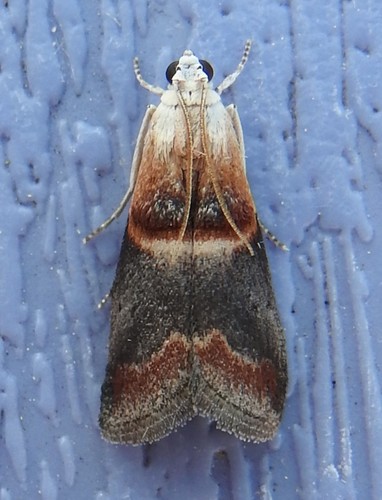
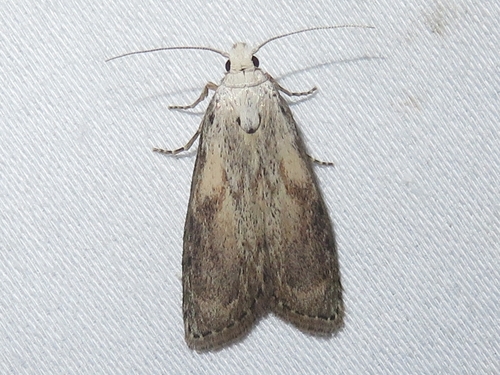
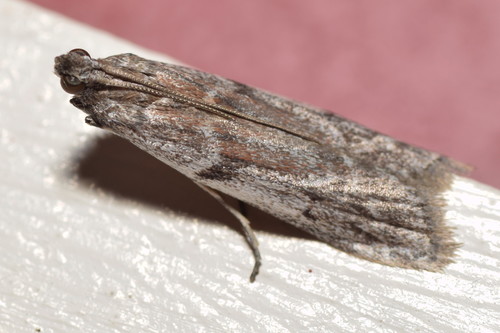
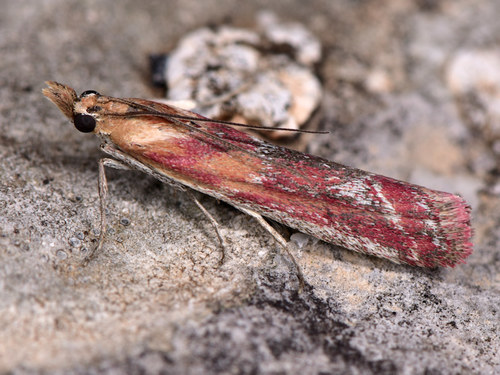
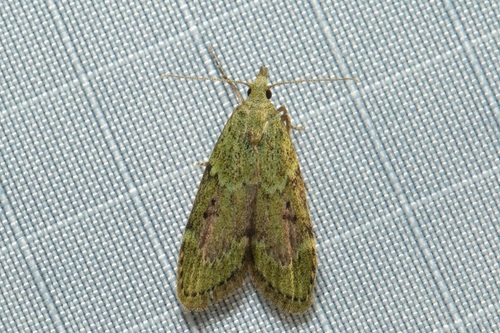
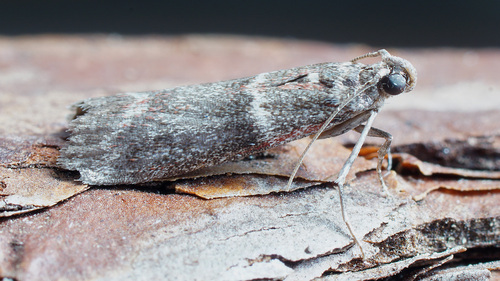
Cryptoblabes bistriga is a species of snout moth belonging to the genus Cryptoblabes. It was first described by Adrian Hardy Haworth in 1811. This moth is found across most of Europe, with the exceptions of Portugal, parts of the Balkan Peninsula, and Ukraine. The wingspan of Cryptoblabes bistriga measures 18–20 mm. Its forewings are fuscous in color, with veins broadly suffused with a fuscous-reddish tone; the lines on the forewings are whitish, with the first line located at one-fourth of the wing length, relatively thick and straight, and the second line located very close to the termen, with a serrate shape. The discal dots are only obscurely visible, and there is a whitish suffusion along the terminal edge of the forewings. The hindwings are a light fuscous shade. The larva is pale brown with darker freckling, it has a darker dorsal line, and blackish-brown subdorsal and lateral lines. The spiracular line is ochreous-whitish and double, there is a brown lateral spot with a black center on the third and twelfth body segments, and the larva's head is light brown. Larvae develop inside folded leaves of oak and alder, with instars occurring in September and October. Adult moths are on wing from late June to July. Larvae feed on the leaves of a range of tree and shrub species, including species in the genera Quercus, Alnus, and Myrica, and they always feed from inside a folded leaf.