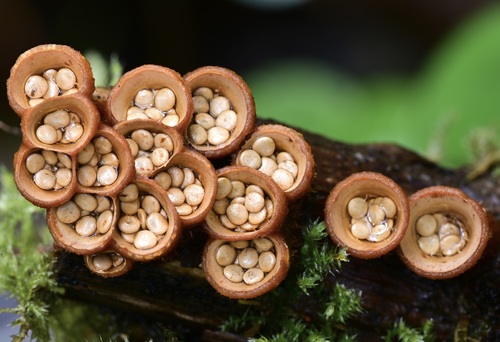
About Crucibulum laeve (Huds.) Kambly
All species in the genus Crucibulum produce light tan to cinnamon-colored cup- or crucible-shaped fruiting bodies called peridia. Peridium size varies by species, ranging from 2–4 mm tall by 1.5–3 mm wide at the mouth for C. parvulum to 5–10 mm tall by 5–8 mm wide for C. laeve. Microscopically, the peridium wall is made of a single tissue layer, which differs from the three-layered peridium wall found in species of the genus Cyathus. The outer surface of the peridium has agglutinated hyphae that create a fibrillose texture with visible filaments; this outer layer of hairs typically wears off as the fruiting body ages, leaving a relatively smooth surface. Young specimens have a thin tissue layer called an epiphragm that covers the opening of the peridium; the epiphragm wears away at maturity to expose the peridioles inside. There are usually four to six peridioles per fruiting body, though up to 15 have been recorded for C. laeve. The peridioles are disc-shaped, whitish, and attached to the endoperidium by a mycelia-made strand called a funicular cord, which tends to wither and disappear as the fruiting body ages. Spores of Crucibulum species are typically elliptical or roughly spherical, thick-walled, translucent (hyaline) or light yellow-brown, and measure 5–15 μm by 5–8 μm. The spores of C. cyathiforme are distinctively slightly or strongly curved. Since the basic fruiting body structure of all genera in the family Nidulariaceae is essentially similar, Crucibulum can easily be confused with species of Nidula or Cyathus, especially older weathered Cyathus specimens that have lost their hairy outer ectoperidium. Crucibulum is distinguished from Nidula by the presence of a funiculus, the cord of hyphae that attaches the peridiole to the endoperidium. Cyathus differs from Crucibulum by having a distinct three-layered peridium wall and a more intricate funiculus. Like other bird's nest fungi, all Crucibulum species are saprobic, meaning they get their nutrients from decomposing organic matter. They typically grow on wood and woody debris such as stems, twigs, wood chips, old nut shells, and old matting, and are sometimes found on dried manure cakes. Brodie notes that C. laeve is "never" found growing on soil or large logs. C. parvulum has been found growing on the roots and stems of old or dead dry land plants such as Juniperus horizontalis and Artemisia species. Crucibulum laeve, the most well-known species of the genus, is a temperate species with a circumpolar distribution. It has been collected in most European countries and the Canary Islands; in North America it occurs from Alaska to Mexico, and in South America it has been found in Chile and Tierra del Fuego. It has also been collected in Australia, Iceland, Japan, and New Zealand. C. parvulum is primarily distributed in North America, where it has been found in Alaska, the southern Alberta badlands, the Canadian Rocky Mountains, and the semi-deserts of Idaho; it was collected in China in 2004. C. cyathiforme is only known from Colombia, where it was found growing at an elevation of nearly 7,000 feet (2,100 m), and from Armenia. The life cycle of Crucibulum includes both haploid and diploid stages, which is typical for Basidiomycota species that can reproduce both asexually via vegetative spores and sexually via meiosis. Like other wood-decay fungi, its life cycle has two functionally distinct phases: a vegetative stage for mycelial spread, and a reproductive stage that produces spore-forming fruiting bodies. The vegetative stage covers all life cycle phases involved with mycelial germination, spread, and survival. Spores germinate under suitable moisture and temperature conditions, and grow into branching filaments called hyphae that extend into rotting wood like roots. These hyphae are homokaryotic, with a single nucleus in each compartment; they increase in length by adding new cell wall material to their growing tips. As tips expand and spread to form new growing points, they develop into a network called a mycelium. Mycelial growth happens via mitosis and the synthesis of new hyphal biomass. When two homokaryotic hyphae from different mating compatibility groups fuse, they form a dikaryotic mycelium in a process called plasmogamy. Suitable humidity and nutrient availability are required for mycelial survival and colonization of a substrate like rotting wood. As C. laeve is saprobic, mycelial growth in rotting wood is enabled by secretion of enzymes that break down complex polysaccharides such as cellulose and lignin into simple sugars that the fungus can use as nutrients. After some time, and under appropriate environmental conditions, dikaryotic mycelia may enter the reproductive stage of the life cycle. Fruiting body formation is affected by external factors including season, which impacts temperature and air humidity, nutrients, and light. As fruiting bodies develop, they produce peridioles that contain basidia, on which new basidiospores are formed. Young basidia hold a pair of haploid sexually compatible nuclei that fuse, and the resulting diploid fusion nucleus undergoes meiosis to produce haploid basidiospores, each with a single haploid nucleus. The dikaryotic mycelia that produce fruiting bodies are long-lived, and will continue to produce new generations of fruiting bodies as long as environmental conditions remain favorable.

