About Croton glandulosus L.
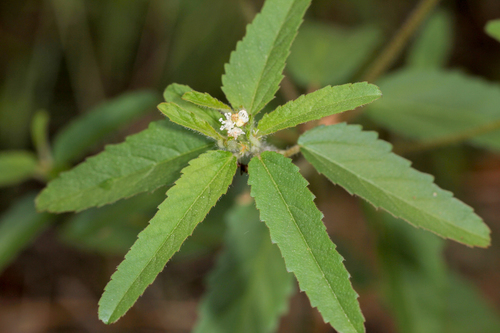
Croton glandulosus L. is a weedy summer annual herbaceous plant that grows to a height of 4 to 24 inches. It is defined by a pungently fragrant tap root that produces its stem, along with stellate hairs and glands on its stem and leaves. Leaves are alternate and oval when young, becoming more lance-shaped and elliptical as they mature. Leaf edges are serrated or toothed, a key trait that makes this species easy to identify. Leaves grow on small petioles, and have a white, oval-like gland on each side of the petiole where it connects to the stem. Leaves form whorls positioned below the plant’s flowers. Both the upper and lower leaf surfaces bear small stellate hairs, and crushing a leaf releases a unique odor. The flowering season for this species, also called tropic croton, typically runs from July to October. It produces white terminal flowers that are 4 or 5-parted, monoecious, and grow in racemose clusters at the ends of stems. Female flowers generally have 4 sepals and 4 petals, while male flowers have 5 sepals and no petals. Fruiting occurs from August to October. The fruit is a brown three-chambered capsule containing three seeds. The seeds are shiny, grayish-tan, stippled with black, and oval-shaped. On seedlings, stems below the cotyledons are mostly covered in star-shaped hairs. Cotyledons are 5 to 7 mm long by 7 to 10 mm wide, dense, heart-shaped, and have palmate venation. The first true leaves that emerge are toothed and egg-shaped. Tropic croton is typically found in dry or sandy soil, in fields, pastures, river terraces, cultivated fields, waste grounds, and along roadsides and railroads. Croton glandulosus occurs throughout the central and eastern United States, Central America, the Caribbean, and tropical South America. It is native to the south-central U.S., and is most prevalent in the coastal plain and Piedmont of Virginia, North Carolina, South Carolina, Tennessee, Georgia, Kentucky, Mississippi, Alabama, and Florida. It has spread to regions as far north as Indiana and Iowa. It has been documented in New Jersey along the railroad above Bishops Bridge, growing on a bed of loose cinder railroad ballast, and also in Philadelphia.