About Croton argyranthemus Michx.
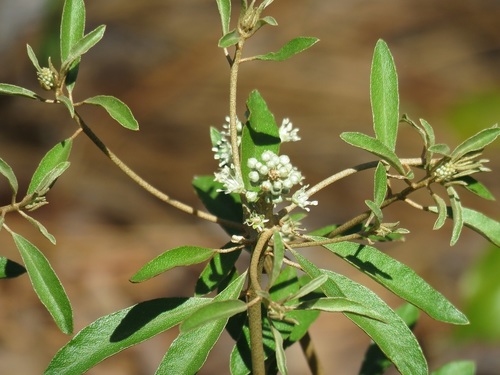
Croton argyranthemus Michx. grows 10–60 cm tall. Several stems grow from its base, and branch into 2–4 parts near the top; these stems are covered in scales. Leaves are arranged singly, with narrow stipules approximately 0.2 mm long, and petioles 0.2–2 cm long that lack glands at their tip. Leaf blades on lower stem sections are oval to narrowly obovate, while blades on upper stem sections are oblong to lance-shaped or broadly elliptic. All leaf blades measure 1–5 cm long and 0.5–3 cm wide, with rounded to narrowed bases, smooth edges, and blunt to rounded tips. The underside of the leaf is silvery and densely covered in scales, while the upper side is darker green with far fewer scales or nearly smooth. Flowers are arranged in bisexual racemes 2–5 cm long, each holding 15–35 staminate (male) flowers and 2–8 pistillate (female) flowers. Pedicels are 1–5 mm long for staminate flowers, and 0–2 mm long for pistillate flowers. Staminate flowers have five sepals and five oblong-spatulate petals, each around 5 mm long, with a densely scaly underside. The petal scales are translucent, giving a glassy appearance, and staminate flowers have 10–15 stamens. Pistillate flowers have 5–7 sepals that are fused for more than half their length, measure 3–4 mm long, have smooth edges, and have incurved tips. Pistillate flowers have no petals. The ovary has three chambers, with three styles 2–4 mm long; each style splits 1–3 times at its tip into 6–24 segments. Mature capsules are 5–6 mm long and 3–4 mm wide, are smooth, and contain a 3-angled columella. Seeds are 4–5 mm long, 2.5–3 mm wide, and have a dull surface. Croton argyranthemus is distributed from central Georgia and southern Alabama south to central peninsular Florida, west to Louisiana, and southwest to Oklahoma, extending south through east and central Texas. It grows in sandy soil, and occurs primarily in longleaf pine sandhill communities. Ecologically, Croton argyranthemus is extremely vulnerable to disturbance, which may be linked to its reliance on native ant species for seed dispersal. Its seeds have elaiosomes that attract ants to disperse the seeds, and seeds are also dispersed via explosive dehiscence. It flowers from March to October, and is fire tolerant. Many species in the Croton genus have medicinal uses, but oil derived from this plant can cause skin blistering and is highly toxic to dogs.