About Crotaphytus collaris (Say, 1822)
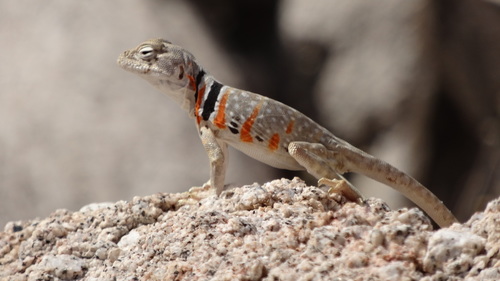
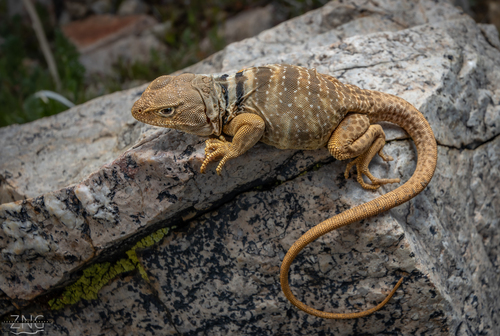
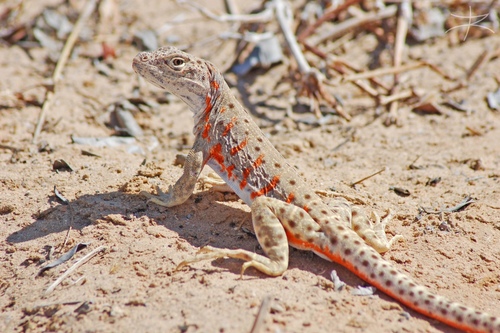
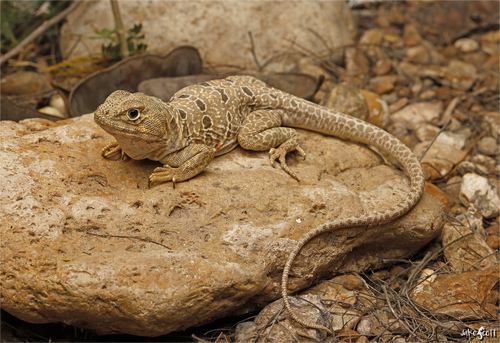
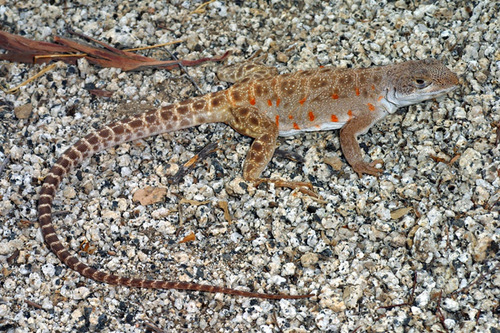
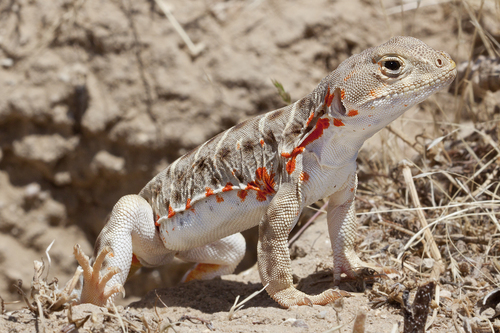
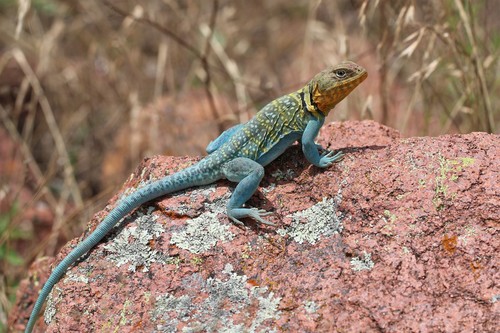
Common collared lizard, scientifically Crotaphytus collaris (Say, 1822), reaches a total length (including the tail) of 8–15 inches (20–38 cm), with a maximum recorded total length of 14 inches. This moderate-sized lizard has a disproportionately large head, powerful jaws, and long hind limbs. Males are larger than females, and adult males have larger, more muscular heads than females. Head dimensions play a key role as a weapon during male combat, and influence dominance, territoriality, fitness, and mating success; larger heads correspond to greater jaw strength and bite force. This species shows a wide range of physical variation, particularly in coloration and spotting patterns, and this phenotypic variability may come from a combination of differences in population, social organization, and habitat. Crotaphytus collaris is both sexually dichromatic and sexually dimorphic. Adult males are more vividly colored than females; male body color ranges from green to tan on the dorsum, while the head ranges from yellow to orange. Males typically have a blue-green body with a light brown head. Females have a lighter brown overall head and body, with more muted body pigmentation that ranges from brown to gray. When reproductively active during the breeding season, females undergo rapid color change: faint orange spots on their heads increase in brightness. This orange spotting peaks during egg maturation, and gradually fades after the female lays eggs and expels them from her oviduct. Both males and females have two distinct black bands around their neck, which gives the species its common name of collared lizard. Compared to adult males, juveniles have dull body coloration similar to adult females, but juveniles have prominent dark brown markings that fade as they mature. As young lizards grow, they lose their sharp cross-band pattern, and their features develop to match those of adult males or females. Crotaphytus collaris is primarily found in dry, open regions of northern Mexico and the south-central and southwestern United States. In the United States, its known range covers Arizona, Arkansas, Colorado, Kansas, Missouri, New Mexico, Oklahoma, and Texas, extending from the Ozark Mountains to western Arizona. These lizards occupy a variety of habitats, from rocky desert landscapes to grasslands, and they most often prefer mountainous regions with high environmental temperatures to support optimal thermoregulation. Hilly topography lets these alert, observant lizards hide between rocks, even with their bright coloration, and watch for predators or intruders into their territory from elevated vantage points. The reproductive season for Crotaphytus collaris runs from mid-March to early April, and ends in mid-July. Females and smaller individuals emerge first from hibernation, with males emerging roughly two weeks later. While lizards can reach sexual maturity and breed after their first hibernation, individuals two years old or older have higher reproductive success due to their larger size. Courtship between adult males and females occurs in late May. After copulation, mature females (usually two years and older) lay their first clutch of eggs in a burrow or under a rock around two weeks after mating. Females can produce a second, and sometimes even a third, clutch through June until mid-July. Clutch size averages 4 to 6 eggs, though larger, older females can produce more eggs per clutch. Incubation length is temperature-dependent, ranging from 50 to 100 days. The earliest clutches hatch in mid-July, and later clutches hatch by mid-October. Upon hatching, juveniles are fully developed and behave independently; Crotaphytus collaris provides no parental care for offspring. By August, adults return to hibernation, and juveniles enter hibernation after hatching.