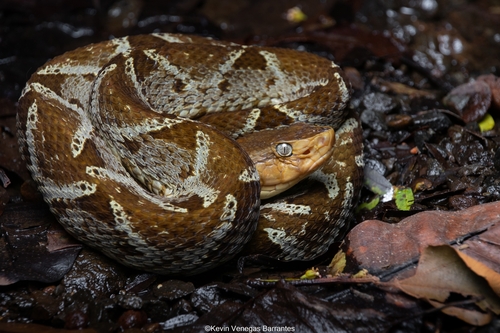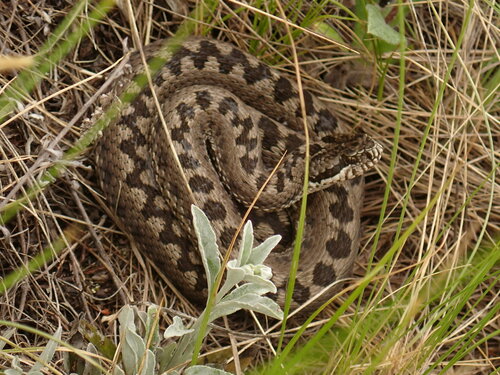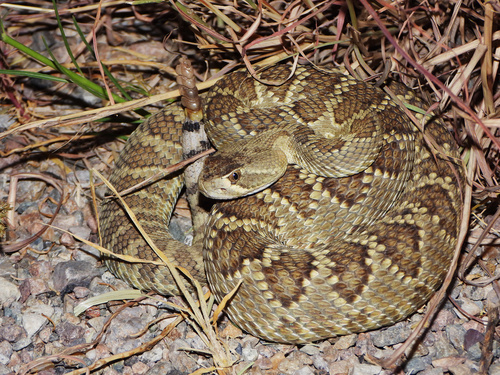
About Crotalus scutulatus Kennicott, 1861
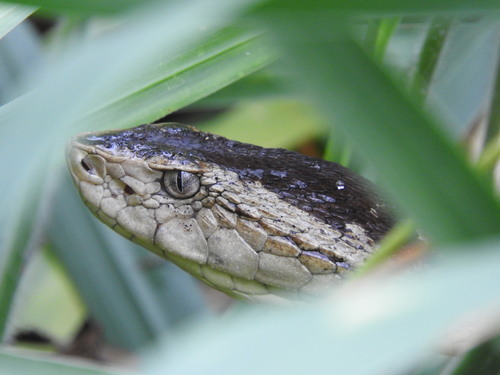
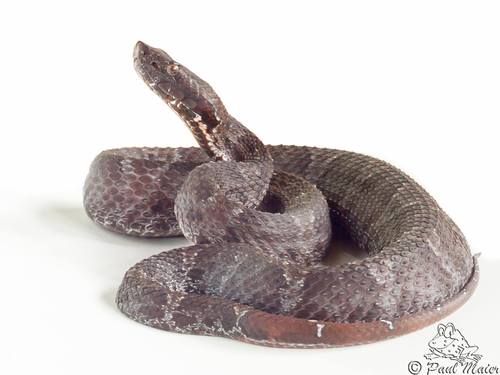
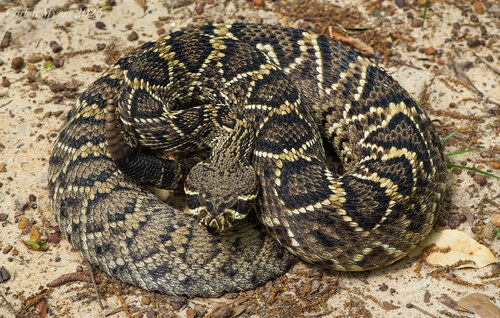
Crotalus scutulatus grows to an average total length (including the tail) of less than 100 cm (3.3 ft). Males of this species reach a maximum total length of 123.6 cm (4.1 ft), while females reach a maximum of 92.2 cm (3.0 ft). No single visual trait can reliably identify C. scutulatus; the most accurate visual identifications come from careful examination of a combination of multiple traits. This species is broadly sympatric with Crotalus atrox, the Western Diamond-backed Rattlesnake, which it very closely resembles. Dorsal body color of C. scutulatus ranges from shades of green to various browns, grays, and even yellowish hues. It has a row of large diamond-shaped dorsal blotches that closely resemble those of C. atrox, but lacks the mix of coarse and fine dark speckling that covers the entire dorsal surface of C. atrox. Additionally, C. scutulatus lacks the white margins along the caudal edges of the dorsal diamond markings that are present in most C. atrox. In C. scutulatus, the light postocular facial stripe usually bends toward the neck and does not intersect the mouth, unlike the stripe in C. atrox. Both species usually have tails marked with alternating pale and dark rings. In C. scutulatus, the dark rings are often (but not always) narrower than the pale rings, and the ring colors are generally less distinct than the bright white and dark black caudal rings seen in most C. atrox. The proximal rattle segment holds live tissue; in C. scutulatus it is usually bicolor (yellow and black) or entirely yellow, while in C. atrox it is entirely black, sometimes with a small patch of white. Compared to rattlesnakes like C. atrox, the crown scales between the supraocular scales of C. scutulatus are relatively large (this is also seen in C. molossus and C. ornatus). These enlarged scales extend behind the supraocular scales in a fan shape, usually with a well-defined margin. The minimum number of scales separating the supraocular scales in C. scutulatus ranges from two to four. In contrast, crown scales on C. atrox are usually smaller and more numerous, and do not form a distinct fan where they meet the scales behind the crown. Robust genetic analyses have revealed the population structure of Crotalus scutulatus across its entire range. Genetic evidence of isolation followed by later secondary contact of subpopulations correlates with corresponding geologic and climatic events. As a result, four genetically distinct clades of modern C. scutulatus have been described. The earliest evolutionary split occurred at the northern margin of the Central Mexican Plateau around 4.1 million years ago (MYA), dividing the species into northern and southern subpopulations. Around 1.8 MYA, the subpopulation now classified as C. scutulatus salvini diverged genetically from individuals on the Central Mexican Plateau. Most recently, around 1.5 MYA, the northern subpopulation was divided at the Continental Divide (the Cochise Filter), creating the Mojave-Sonoran clade to the west and the Chihuahuan clade to the southeast. The boundaries between these clades align with elevational clines. Climatic shifts during Pleistocene glacial advances and retreats likely isolated the subpopulations during cold periods, but allowed secondary contact and renewed gene flow during warmer periods, including the present day. These analyses show that the Central Mexican Plateau clade is more closely related (shares a more recent common ancestor) to the Huamantlan Rattlesnake (currently C. scutulatus salvini) than it is to the northern (Mojave-Sonoran and Chihuahuan) clades. This indicates that classifying salvini as a subspecies of all other C. scutulatus is taxonomically problematic. More recently, researchers analyzed qualitative, meristic, and morphometric traits from 347 C. scutulatus specimens. They concluded that the species "is phenotypically cohesive without discrete subgroups, and that morphology follows a continuous cline in primary color pattern and meristic traits across the major axis of its expansive distribution." This finding suggests that "multiple episodes of isolation and secondary contact among metapopulations during the Pleistocene were sufficient to produce distinctive genetic populations, which have since experienced gene flow to produce clinal variation in phenotypes without discrete or diagnosable distinctions among these original populations." It was recommended that for taxonomic purposes, Crotalus scutulatus "be retained as a single species, although it is possible that C. s. salvini, which is morphologically the most distinctive population, could represent a peripheral isolate in the initial stages of speciation." Crotalus scutulatus occurs in arid habitats. In the southwestern United States, it is found in the Mohave Desert of Los Angeles and San Bernardino Counties, California; across most of western and southern Arizona, southwest of the Mogollon Rim; and from El Paso County, Texas south through the Big Bend region of western Texas. It also ranges as far north as Lincoln County, Nevada; the southwest corner of Washington County, Utah; and parts of extreme southern New Mexico. In Mexico, it is found in Sonora, Chihuahua, and extends south across the Mexican Plateau to the states of Mexico, Puebla, and Veracruz. It inhabits deserts and other areas with xeric vegetation, ranging from near sea level to approximately 2,500 m (8,200 ft) in elevation. Crotalus scutulatus primarily lives in broad desert valleys or lower mountain slopes. It is often found in sparsely vegetated areas dominated by creosote (Larrea), sage (Ambrosia), mesquite (Prosopis), various cacti (Cactaceae), and Joshua trees (Yucca brevifolia). In some locations, it also occurs in juniper (Juniperus) woodland and grassland (Poaceae) habitats. In general, C. scutulatus tends to avoid densely vegetated and extremely rocky areas, and prefers relatively flat, open, xeric habitats.