About Crotalus oreganus Holbrook, 1840
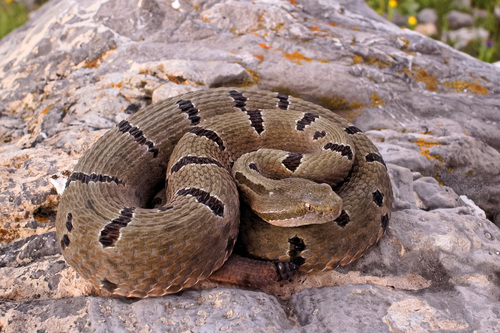
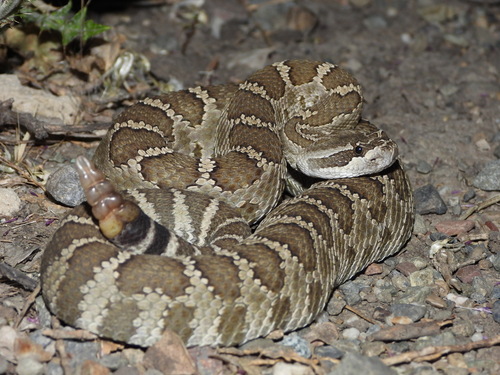
The body size of Crotalus oreganus varies greatly: some populations have stunted growth, while others grow very large. Mainland individuals often reach 100 cm (39 in) in length. The largest recorded specimen of the nominate subspecies C. o. oreganus measures 162.6 cm (64.0 in), per Klauber 1956. Body mass correlates with the length and linearity of an individual’s migration route: individuals with longer, more linear migration paths tend to have greater mass. This species is classified into 6 subspecies, 3 of which are found within the state of California. This species shows considerable ontogenetic variation across its different forms. Juveniles usually have more or less distinct patterns, which fade as the snakes mature. The color of the iris often matches the snake’s ground color, which may be bronze, gold, or different shades of tan, pink, or gray. A snake’s coloration is determined by its habitat and/or the substrate of its home range. For the typical nominate form, C. o. oreganus, the ground color is dark-brown, dark-gray, olive-brown, or sometimes black or pale yellowish. This base color is overlaid on the dorsal side with a series of large, dark blotches with uneven white edges. These blotches are wider than the gaps that separate them. Additionally, a lateral series of blotches, usually darker than the dorsal blotches, is clearly visible on all except the darkest specimens. The first tail rings are about the same color as the last body blotches, but these rings become progressively darker; the last two rings, at the base of the tail, are usually black. The belly is pale yellow, and usually has brown spots. A large, dark-brown blotch on the snout has a pale border behind it that forms transverse bars on the supraoculars. A dark brown postocular stripe with a white border extends from the eye to around the angle of the jaw. This species is found in North America, ranging from southwestern Canada, through much of the western half of the United States, to the Baja California Peninsula of Mexico. In Canada, it occurs in the southern interior of British Columbia, and is one of only three remaining rattlesnake species in the country. In the United States, it is found in Washington, Oregon, California, western and southern Idaho, Nevada, Utah, Arizona, western Colorado, and small parts of New Mexico and Wyoming. In Mexico, it occurs in Baja California and the northern extreme of Baja California Sur. This species undertakes seasonal migrations between winter and summer habitats to adapt to prey availability. It migrates specifically to find winter denning sites and summer foraging grounds. Studies show that C. oreganus seeks hibernacula, or winter dens, with specific characteristics including slope length and rock coverage. Compared to randomly selected sites, the slopes of hibernacula chosen by C. oreganus are much steeper. These sites are often surrounded by medium sized rocks, in contrast to the small or large rocks that may occur in the surrounding terrain. Males reach sexual maturity between two to four years, with most males reproducing for the first time in their third year. By contrast, females mature between three to seven years, with most reproducing for the first time in their fourth year. However, northern populations in British Columbia are known to first reproduce as late as their sixth, seventh, or eighth year. The female reproductive cycle is normally biennial, although 10% of females may produce litters in two consecutive years, and one case of a three-year reproductive interval has been reported. Crotalus oreganus typically mates in spring after emerging from winter dormancy, although British Columbia populations have been reported to mate in fall before entering dormancy. The gestation period was recorded as about 90 days for wild snakes from Idaho, but gestation periods of 143 and 425 days have been reported for captive individuals. Gravid females usually fast. This species is viviparous, meaning it produces live young. Parturition produces 1–15 young, with an average of 3–8, and usually occurs in August or September. Neonate total length ranges from 19–28 cm, with an average of 25.2 cm. One report of a litter of 25 young is regarded as questionable by some herpetologists. Mating usually takes place in concealed areas, such as burrows, rock and log crevices, or dense brush. Mating Crotalus oreganus are highly sensitive to disturbance and will quickly separate when disrupted.