About Crotalus molossus Baird & Girard, 1853
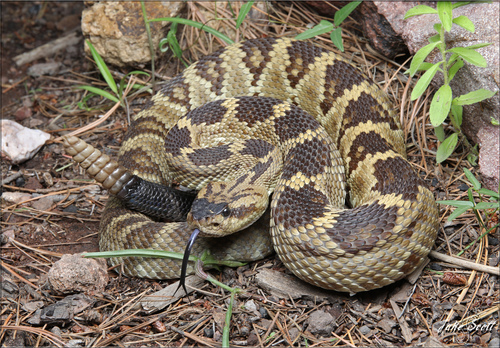
This medium-sized rattlesnake, Crotalus molossus Baird & Girard, 1853, has an average total length of 76 to 107 cm (30 to 42 inches). Most large individuals do not grow much longer than 100 cm (39 inches), though maximum lengths of 125.0 cm (49.2 inches), 125.7 cm (49.5 inches), and 129.5 cm (51.0 inches) have been previously reported by different authors. Females of this species are typically larger than males. Their body color ranges across yellows, olive greens, browns, and black. A key distinguishing feature, consistent regardless of overall body color and referenced in their common name, is entirely black tail scales. This species often has a black facial mask formed by a band that crosses the eyes and extends diagonally downward to the corners of the mouth. Like all other rattlesnakes, C. molossus has a keratin-based rattle at the tip of its tail. A new segment is added to the rattle every time the snake sheds its skin. Since snakes can shed multiple times per year, and the rattle is fragile and easily broken, the length of the rattle cannot accurately indicate a rattlesnake's age unless the outermost terminal button remains intact. The black-tailed rattlesnake is distributed across the southwestern United States, including Arizona, New Mexico, and west and central Texas, as well as Mexico ranging south to Oaxaca. It also occurs on San Estéban and Tiburón Islands in the Gulf of California. Its known range reaches a maximum elevation of 2930 m; it has additionally been recorded at 6900 feet at the McDonald Observatory in the Davis Mountains of west Texas. Its designated type locality is "Fort Webster, St. Rita del Cobre, N. Mex." which corresponds to modern-day Fort Webster, Santa Rita del Cobre, Grant County, New Mexico, USA. Like all rattlesnakes, the black-tailed rattlesnake is carnivorous, with its main prey consisting of rodents, other small mammals, birds, and small reptiles such as small lizards. The activity patterns of northern populations of black-tailed rattlesnakes change throughout the year. In spring and fall, they are mainly diurnal. In summer, they become primarily nocturnal to avoid high summer temperatures. During winter, they hibernate in abandoned dens originally created by other animals, often sharing these dens with other snake species. Their locomotion adjusts to the type of substrate they are moving across, and they actively switch between sidewinding and rectilinear movement. While it is a capable climber and skilled swimmer, C. molossus is primarily a terrestrial species. It inhabits grasslands, desert areas, rocky and mountainous terrain, and high-altitude forests. Breeding takes place in spring, when males follow the pheromone trails left by females. Copulation can last for hours and may happen multiple times across several days. After mating, the male typically remains close to the female for several days to prevent other males from mating with her. Females give birth to live young in summer. Newborns only stay with their mother until they disperse on their own, which usually happens within one to two days. Females are thought to breed every year. Litter sizes can reach 10 to 12 young, but the average litter size is four to six. The average lifespan of this species is 15 to 20 years.