About Crotalus horridus Linnaeus, 1758
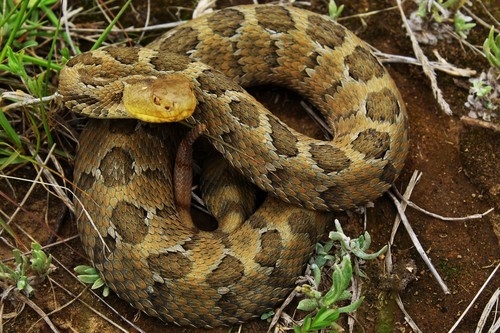
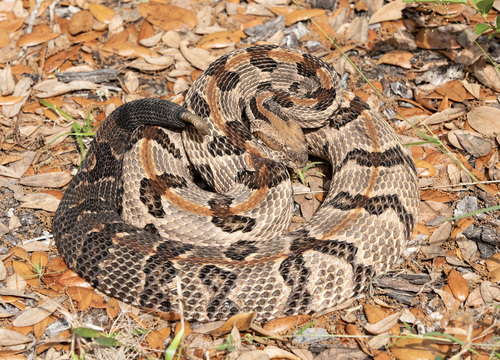
This species, commonly known as the timber rattlesnake (sometimes called canebrake rattlesnake), has the scientific name Crotalus horridus Linnaeus, 1758. Most adult individuals reach a total length between 91–152 cm (36–60 in); most measured adults are under 115 cm (45 in) long, and weigh between 500 and 1,500 g (1.1 and 3.3 lb), most often closer to the lower end of this weight range. In Pennsylvania, the smallest female capable of producing viable eggs measured 72.2 cm (28.4 in). The maximum recorded total length is 189.2 cm (74.5 in), documented by Klauber in 1956. In 1924, Holt reported a large specimen caught in Montgomery County, Alabama that measured 159 cm (62.5 in) long and weighed 2.5 kg (5.5 lb). Large individuals may reportedly weigh up to 4.5 kg (9.9 lb). This species has keeled dorsal scales, arranged in 21–26 rows at midbody: usually 25 rows in the southern part of its geographic range, and 23 rows in the northern part. Males have 158–177 ventral scales, while females have 163–183 ventral scales. Males have 20–30 subcaudal scales, compared to 15–26 in females. The rostral scale is typically slightly taller than it is wide. In the internasal-prefrontal area, there are 4–22 total scales: this includes two large, triangular internasal scales that border the rostral, followed by two large, quadrangular prefrontal scales (anterior canthals) that may contact each other along the midline, or be separated by many small scales. There is only a single canthal scale between the supraocular and internasal scales. Five to seven intersupraocular scales are present. The number of prefoveal scales ranges from two to eight. Most often, the first supralabial scale makes broad contact with the prenasal scale, though it may be slightly to moderately separated along its posteroventral margin by the most anterior prefoveal scales. Dorsally, C. horridus has a pattern of dark brown or black crossbands set against a yellowish-brown or grayish base background. The crossbands have irregular zig-zag edges, and may be V- or M-shaped. A rust-colored vertebral stripe is often present. Ventrally, the snake is yellowish, may be uniform in color, or marked with black. Melanism is common, and some individuals are very dark, almost entirely solid black. The tails of C. horridus are black, and are described as velvety. Timber rattlesnakes are found in the eastern United States, ranging from southern Minnesota and southern New Hampshire in the north, south to East Texas and North Florida. 115 individuals have been marked within Brown County State Park in Indiana, which is one of only a few places the species still occurs in the state. Its historic range once included southern Ontario and southern Quebec in Canada, but in May 2001, the Canadian Species at Risk Act listed it as extirpated from Canada. A Canadian government-sponsored recovery strategy is currently under study to support reintroduction of this species, which preys on many pests, to its former Canadian habitat. Historically, many timber rattlesnakes lived in thick forest areas of central and southeastern Iowa, mostly within the Mississippi, Skunk, Iowa, and Des Moines River valleys. Bites from this species have been widespread in the state, particularly at Geode State Park (southeastern Henry County), Credit Island Park (southern Scott County), and the forested areas of southern Clinton County. The museum at Amana Colony, Iowa states that one founding family lost their three-year-old firstborn daughter to a rattlesnake bite she received while playing on a woodpile in the 19th century. In Pennsylvania, the species is not found west of Chestnut Ridge in the Laurel Highlands, nor is it found in urban areas of the state's southeastern corner. Its range therefore excludes Philadelphia and Pittsburgh, Pennsylvania's two largest cities. C. horridus is extirpated from Michigan, Delaware, Maine and Rhode Island, and is considered nearly extirpated in New Hampshire. In general, this species inhabits deciduous forests on rugged terrain. It can be found in a wide range of terrestrial habitats, including lowland cane thickets (the origin of its common name canebrake rattlesnake), high ground around swamps and river floodplains, hardwood and pine forests, mountainous areas, and rural habitats in farming regions. During the summer, gravid females appear to prefer open, rocky ledges where temperatures are higher, while males and non-gravid females generally spend more time in cooler, denser woodland with a more closed forest canopy. A lifetime reproduction study of a C. horridus population in the Adirondack Mountains of New York found that first reproduction occurs at a mean age of 9.6 years. The mean length of reproductive cycles is 4.2 years, the mean reproductive lifespan is 9.6 years, and average fecundity is 7.7 offspring per litter. Nonviable offspring were found in 20% of the litters observed in the field. Most females only reproduce one time during their lifetime. Macrogeographic differences were observed within this studied population, which may be correlated with resource levels that influence growth rates; additionally, human encounters may affect survival rates.