About Crotalus durissus Linnaeus, 1758
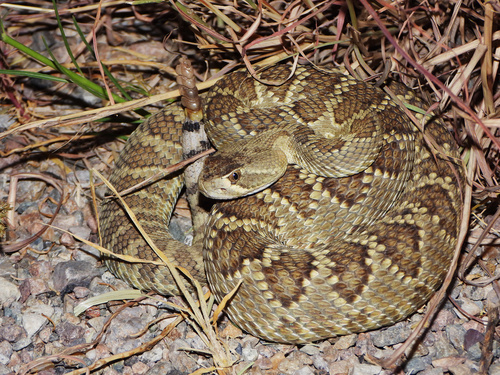
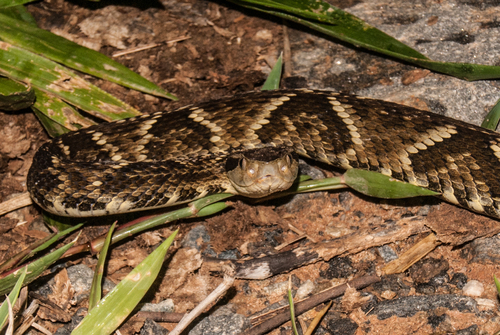
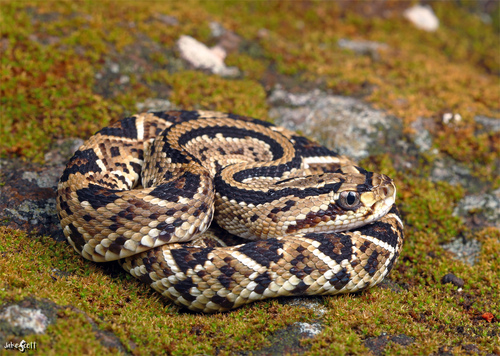
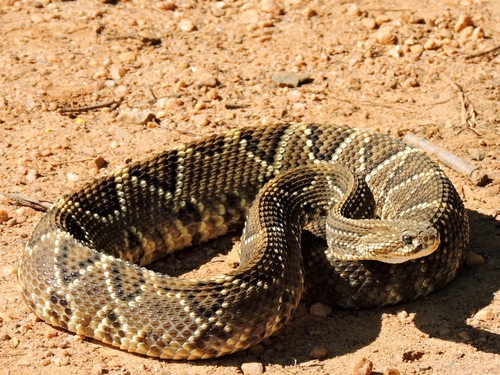
Crotalus durissus, also known as the South American rattlesnake, is a large Neotropical rattlesnake species. Adults typically grow to 1.5 m (4.9 ft) in length, and rarely reach a maximum length of 1.9 m (6.2 ft). This species has two distinct stripes starting at the base of the head; the area inside these stripes is lighter in color than the stripes themselves. Body color and pattern are quite variable across individuals. Most individuals have 18–32 darker diamond or rhombic-shaped spots along the dorsal side of the body, with 25–33 dorsal scale rows, usually 27, at midbody. The top of the head has a dark brown bar, and a dark post-orbital band is also present. Belly color varies, and can be white or yellowish with light gray spots, becoming darker closer to the tail. The tail is usually gray, with faint, dark crossbands. This species is distributed across South America, excluding the Andes Mountains. Its range is discontinuous, with many isolated populations in northern South America: these are located in Colombia, Venezuela, Guyana, Suriname, French Guiana, and northern Brazil. Its range extends from Colombia and eastern Brazil to southeastern Peru, Bolivia, Paraguay, Uruguay, and northern Argentina, specifically in the provinces of Catamarca, Córdoba, Corrientes, Chaco, Entre Rios, Formosa, La Pampa, La Rioja, Mendoza, Misiones, San Juan, San Luis, Santa Fe, Santiago del Estero, and Tucumán. It also occurs on some Caribbean islands, including Aruba. The species’ originally given type locality is simply "America." It prefers savanna and semi-arid zones. It has been recorded in littoral xerophilous scrub, psammophilous and halophilous littoral grassland, thorny xerophilous scrub, tropophilous deciduous and semideciduous scrub, and tropophilous seasonal semideciduous forest in northwestern Venezuela. In the Chaco region of Paraguay, it is found in drier, sandier areas. The South American rattlesnake has a seasonal reproductive cycle. Male competition for access to females begins around the end of summer, copulation takes place in fall, and young are born the following spring or summer. This species is ovoviviparous, and typically gives birth to four to eight young per litter. In Roraima, Brazil, gestation has been recorded to last five months, and individuals there can give birth to up to 14 young per litter.