About Crotalus cerberus (Coues, 1875)
According to Wright and Wright (1957), adult Crotalus cerberus have an average length of 78–109 cm (31–43 in). Klauber (1997) reports a maximum length of 1,032 mm (40+5⁄8 in), which is smaller than the average upper bound provided by Wright and Wright. This source also notes that the smallest measured gravid female is 701 mm (27+5⁄8 in) long. Hubbs and O'Connor (2012) list a different adult size range of 812–1,219 mm (32.0–48.0 in).
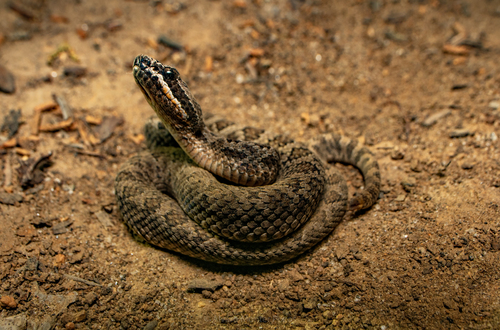
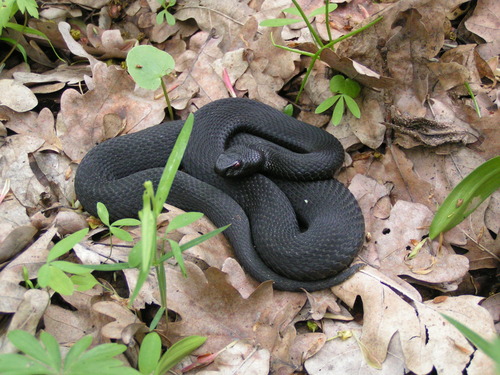
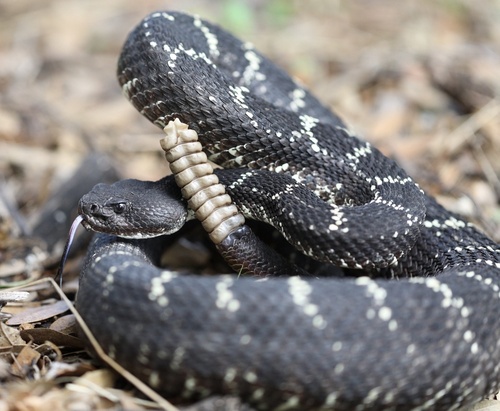
The species has a variable color pattern. Its base ground color can be dark grayish, brownish black, reddish brown, or blackish. This base is overlaid with a dorsal pattern of blotches: the blotches are rectangular toward the front of the body, become subhexagonal toward the rear, and eventually turn into crossbands just before the tail. Some individual specimens have a uniform dark color with no clear dorsal pattern. In other specimens, the dorsal blotches are darker than the base color and bordered by transverse rows of white, cream, or yellow scales. Some specimens may also have a quite pale color pattern with a large amount of yellow mixed in. A postocular stripe is visible in lightly colored specimens, but is much less distinct in darker individuals.
This species is found in the southwestern United States. In Arizona, it occurs from the Hualapai Mountains and Cottonwood Cliffs in the northwest of the state, southeast to the Santa Catalina, Rincon, Pinaleno, and Blue Mountains. It is also found at Steeple Rock, in extreme western New Mexico. The species' type locality is given as the San Francisco Mountains, located in Coconino County, Arizona, USA.
For reproduction, sexually mature females of this species give birth to live young, in broods that contain between 4 and 21 neonates. Crotalus cerberus, commonly called the Arizona black rattlesnake, is the first snake species observed to show complex social behavior. Like all temperate pit vipers, females of this species care for their offspring. Females stay with their young in nests for 7 to 14 days, and mothers have been observed engaging in cooperative parenting of their combined broods.