About Crotalus basiliscus (Cope, 1864)
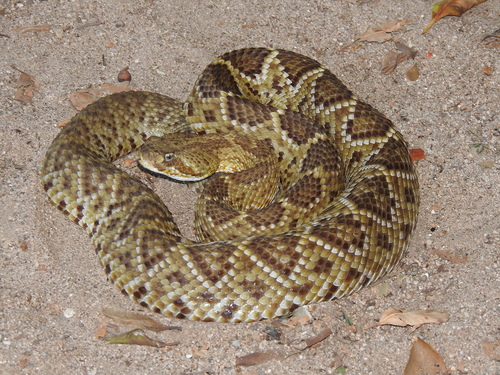
Crotalus basiliscus is one of the largest rattlesnake species. Specimens longer than 150 cm (4.9 ft) are not uncommon, and the maximum recorded size is 204.5 cm (6.71 ft) per 1972 research by Klauber. It has a moderately stout body with a roughly rectangular cross-section. Females of this species reach sexual maturity at a minimum length of 100 cm (3.3 ft) and weight of 700 g (1.5 lb). At midbody, this species has 25 to 29 rows of strongly keeled dorsal scales. It has between 174 and 206 ventral scales, and 18 to 36 subcaudal scales. Its base color is brown or gray, overlaid with 26 to 41 dark diamond-shaped (rhombus-shaped) blotches that have light edges. The head is a uniform grayish-brown, with lighter labial scales and a dark postorbital bar; no distinct pattern appears on the crown or neck. The tail can be gray with darker bands, or almost uniformly colored with no clear markings. The belly is white or cream-colored. Juveniles are mostly red, while adults develop an overall olive green coloration. Within its geographic range, it is the only rattlesnake with diamond-shaped dorsal markings. Crotalus basiliscus often shares its range with Crotalus molossus, and the two species appear to hybridize freely. While the two parent species can be easily distinguished from one another, identifying hybrid specimens is difficult. This rattlesnake occurs in western Mexico, ranging from southern Sonora to Michoacán, and is mostly restricted to the coastal plain. Its given type locality is "Near Colima, Mexico". Near Colima, where Crotalus basiliscus was (or once was) particularly abundant, the local landscape is mostly treeless, covered in short grass with scattered clumps of mesquite, acacias, and other thorny bushes, alongside numerous large cacti. The majority of the species' habitat is tropical thorn forest, with a range extension into tropical deciduous forest.