About Crotalus adamanteus Palisot De Beauvois, 1799
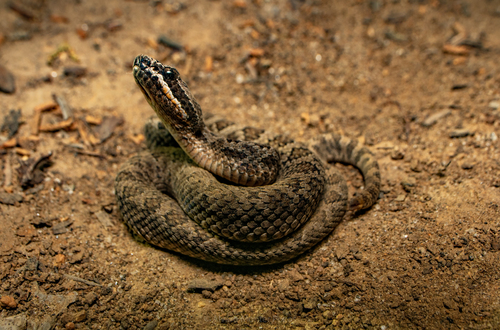
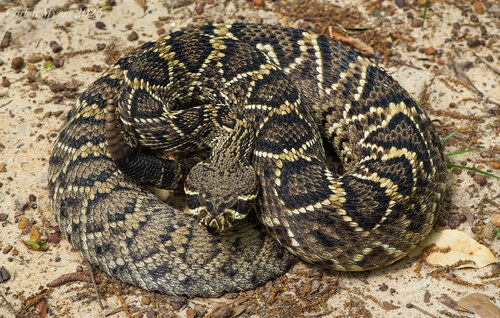
The eastern diamondback rattlesnake (Crotalus adamanteus Palisot De Beauvois, 1799) is the largest rattlesnake species, and is counted among the heaviest known venomous snake species. One 1946 specimen was recorded measuring 2.4 m (7.8 ft) long and weighing 15.4 kg (34 lb). Other venomous snakes can match this species in weight: the king cobra is much longer but more slender, while the shorter Gaboon viper is even bulkier. The maximum reported lengths for this species are 2.4 m (8 ft) and 2.5 m (8.25 ft), but these stated maximum sizes have been called into question due to a lack of voucher specimens. This species shows rare reverse sexual size dimorphism, meaning males are typically larger than females. Specimens over 2.1 m (7 ft) are rare, but they are well documented. In 1998, Klauber published a 1953 letter he received from E. Ross Allen, who explained that he had offered a reward of $100 (later raised to $200) for an 2.4 m (8 ft) specimen, dead or alive, and the reward was never claimed. Allen did receive multiple specimens in the 2.1 m (7 ft) size range, along with some 2.4 m (8 ft) skins, but he noted that such skins can be taken from specimens as short as 1.8 m (6 ft). A 2.2 m (7.3 ft) specimen was caught and killed outside a neighborhood in St. Augustine, Florida, in September 2009. Its average size is much smaller; specimens over 6 feet in length are rarely found. Recorded common length ranges are 1.1 to 1.7 m (3.5 to 5.5 ft), and 0.8 to 1.8 m (2.75 to 6 ft). One study that measured 31 males and 43 females found an average length of 1.7 m (5.6 ft). The average body mass of the species is roughly 2.3 kg (5.1 lb). The average weight of 9 specimens kept in laboratories was 2.55 kg (5.6 lb), with a weight range of 0.8 to 4.9 kg (1.8 to 10.8 lb). Few specimens exceed 5.12 kg (11.3 lb), though exceptional specimens can weigh 6.7 kg (15 lb) or more. For scalation, this species has 25–31 (most often 29) rows of dorsal scales at midbody. Males have 165–176 ventral scales, while females have 170–187. Males have 27–33 subcaudal scales, while females have 20–26. On the head, the rostral scale is higher than it is wide, and it contacts two internasal scales. There are 10–21 scales in the internasal-prefrontal region, and 5–11 (usually 7–8) intersupraocular scales. There are usually two loreal scales between the preoculars and the postnasal. This species has 12–17 (usually 14–15) supralabial scales; the first supralabial is in broad contact with the prenasal. There are 15–21 (usually 17–18) sublabial scales. Its color pattern has a ground color of brownish, brownish-yellow, brownish-gray, or olive, overlaid with a series of 24–35 dark brown to black diamond markings that have slightly lighter centers. Each diamond-shaped blotch is outlined by a row of cream or yellowish scales. Towards the rear of the body, the diamond shapes become more like crossbands, and 5–10 bands wrap around the tail. The belly is yellowish or cream-colored, with diffused dark mottling along the sides. The head has a dark postocular stripe that extends from behind the eye backwards and downwards to the lip, and the back of this stripe touches the angle of the mouth. The postocular stripe is bordered on the anterior and posterior sides by distinct white or yellow stripes. The rattle at the end of the tail is made of hard, loosely attached, hollow segments that break off frequently and are fully replaced when the snake sheds. The eastern diamondback rattlesnake is found in the Southeastern United States. Its range extends from southeastern North Carolina, south along the coastal plain through peninsular Florida to the Florida Keys, and west along the Gulf Coast through southern Alabama and Mississippi to southeastern Louisiana. The original species description does not name a type locality, though Schmidt (1953) proposed restricting it to Charleston, South Carolina, USA. This snake inhabits upland dry pine forest, pine and palmetto flatwoods, sandhills, coastal maritime hammocks, longleaf pine/turkey oak habitats, grass-sedge marshes, swamp forest, cypress swamps, mesic hammocks, sandy mixed woodlands, xeric hammocks, and salt marshes. It also uses wet prairies during dry periods. In many areas, it uses burrows dug by gophers and gopher tortoises during both summer and winter. Like other rattlesnakes, the eastern diamondback rattlesnake is ovoviviparous. Gestation lasts six or seven months, and broods average around a dozen young. The young only stay with their mother for 10–20 days before leaving to hunt and find cover on their own. This species has a slow life history, with females breeding only every 2–4 years. Females give birth to between 4 and 28 young at a time, usually between July and early October. Newborn neonates measure 30–36 cm (12–14 in) in length, and look similar to adults except they only have a small button instead of a rattle at the tip of the tail.