About Crotalaria similis Hemsl.
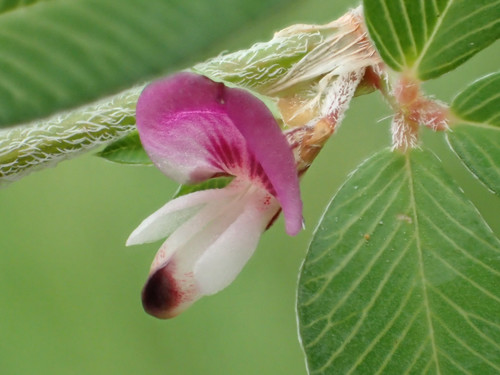
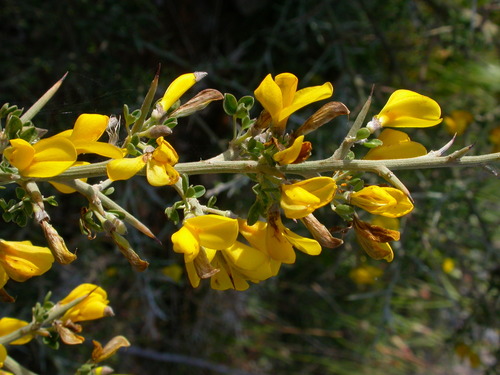
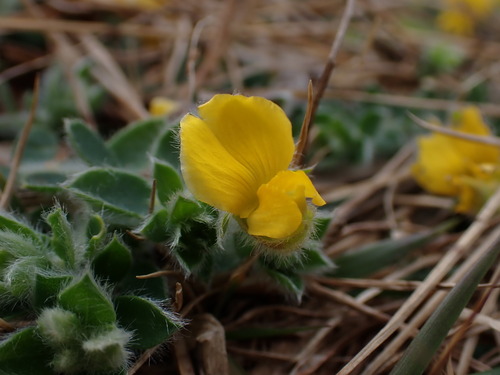
Crotalaria similis Hemsl. is a small herb covered in a dense layer of soft hair, growing 5 to 20 cm (2.0 to 7.9 in) tall on sloping land. It produces simple, nearly sessile leaves that are oval to egg-shaped, 3 to 8 mm (0.12 to 0.31 in) long and 2 to 4 mm (0.079 to 0.157 in) wide, with pointed tips and no stipules. Its inflorescence is a terminal raceme holding 3 to 5 flowers, or it may bear a single solitary flower. Two bracteoles grow at the base of the calyx; the hairy calyx is 6 mm long, has a bifid apex that is slightly connate, and is covered in a dense layer of hair. The yellow corolla is the same length as the calyx. The stamens have dimorphic anthers. The pollen exine has morphology ranging from round pores to fine perforating striae; all pollen grains are approximately 20μ in size and tricolporate in shape. The fruit is a long-circular pod 1 cm long, each containing 10 to 22 seeds. Crotalaria similis is a rare endemic Taiwanese Crotalaria species with the narrowest distribution of all endemic Crotalaria in Taiwan. It is only found in open grass below 100 meters above sea level along the east coast of Kenting. It has two main population centers: one at Fengchuisha on the Hengchun Peninsula, which holds 50% of the entire global population, and another at the Longpan grassland, which holds 30% of the total population. It can grow in multiple habitat types including calcareous red earth, sand, and grassland. It occurs most frequently in grasslands, followed by sandy habitats, and is least common in calcareous red earth. Severe human interference including afforestation, artificial planting, and trampling has led to the disappearance of some populations, while limited interference such as grazing benefits the species' survival.