About Crossopriza lyoni (Blackwall, 1867)
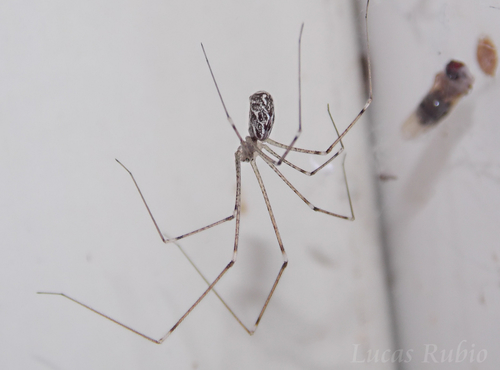
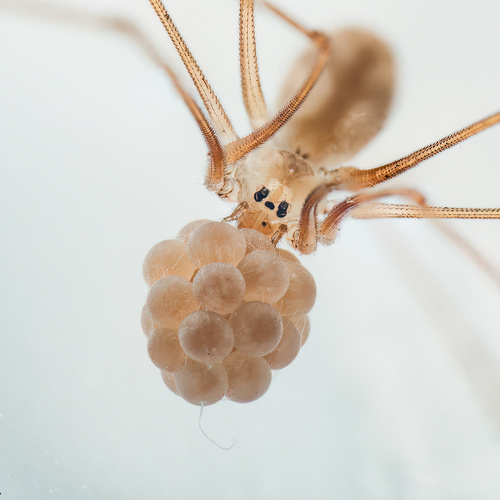
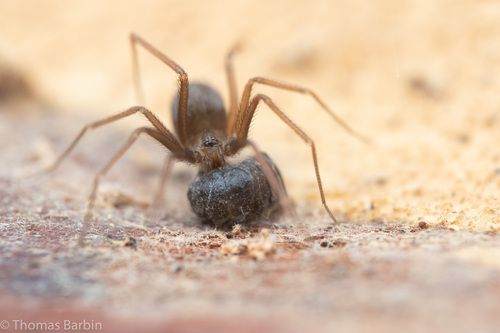
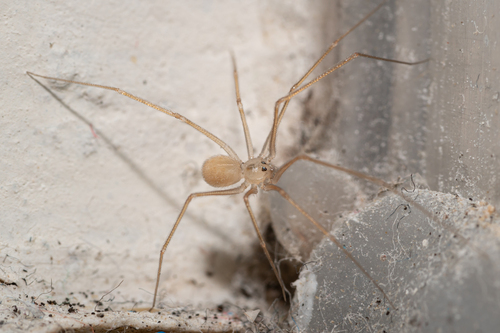
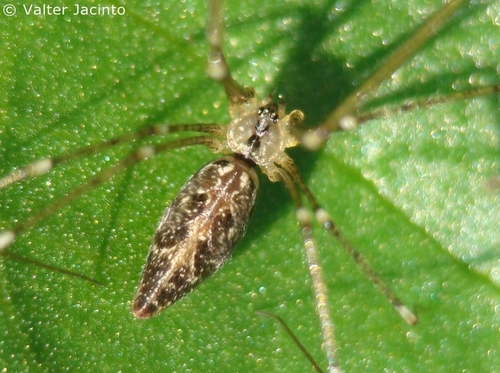
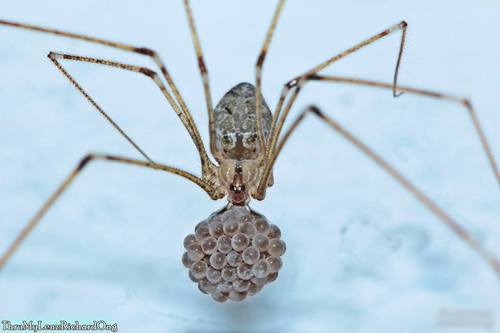
Crossopriza lyoni (Blackwall, 1867) is a sexually dimorphic species of cellar spider. Females measure roughly 3 to 7 mm (0.12 to 0.28 in) in body length, while males are slightly smaller, ranging from 2.5 to 6 mm (0.098 to 0.236 in) in length and bearing prominent pedipalps. Both sexes have extremely long, fragile legs, and males have slightly longer legs than females. In larger male individuals, the first pair of legs can grow up to 6 centimetres (2.4 in) long. Legs range in color from gray to amber, and are covered in numerous small longitudinal brown spots. The leg 'knee joints' are brown, and the ends of the femur and tibiae are encircled by a white band. Males also have a series of 20 to 25 spines (macrosetae) on their femur. This species follows the leg formula I, II, IV, III: the front pair of legs is the longest, and the third pair is the shortest. The cephalothorax is wider than it is long, and ranges in color from greyish-white to pale amber. The carapace is subcircular, with a deep depression called the thoracic fovea in the center of its upper surface, plus a darker longitudinal color band. Like most other cellar spiders, C. lyoni has eight pearly-white eyes, positioned at the tip of the cephalothorax in two lines. The abdomen (opisthosoma) is gray with white lateral stripes and assorted dark and light patches on its sides and upper surface. An irregular darker stripe runs lengthwise along the abdomen's bottom surface. The abdomen is angular and somewhat box-shaped, with a small conical hump on the upper back. C. lyoni has two distinct types of stridulatory sound-producing organs. The first type consists of two triangular protrusions at the posterior tips of the cephalothorax (prosoma); the spider rubs these structures against a matching pair of sclerotized plates on the anterior portion of the abdomen to produce sound, and these structures are more prominent in females. The second type is a set of stridulatory files, formed as a series of small ridges, on the chelicerae; these are rubbed against the pedipalps to produce sound, and this type is more prominent in males. C. lyoni can be told apart from other species in the Crossopriza genus in several ways: by its characteristic boxy abdomen shape (the closely related C. cylindrogaster has a cylindrical abdomen), by the presence of two apophyses (jutting structures) on the male chelicerae (C. pristina, C. semicaudata, and C. soudanensis each only have one apophysis per chelicera), and by geographic distribution. C. lyoni is found globally and is the only Crossopriza species present in the New World, while other species such as C. johncloudsleyi and C. nigrescens are restricted to Africa or the Middle East. C. lyoni is synanthropic, meaning it prefers to live inside or near human-made structures. It typically builds large, irregular webs in the corners of rooms, basements, and cellars, and beneath ceilings. It is easily transported by human activity, especially as a hitchhiker on ships. As a result, it has been introduced to most of the world, including Australia, Asia, Africa, Europe, North America, South America, and some Pacific islands. Its original place of origin is unknown, though hypotheses have suggested it may originate from Africa, where the Crossopriza genus has its highest diversity, or from somewhere in Asia. A single male C. lyoni can mate with multiple females. During mating, the male inserts both of his pedipalps into the female's genital orifice and transfers a previously prepared sperm packet into her spermathecae. Because the male's pedipalps are relatively short compared to the great length of both sexes' legs, the spiders must hold their bodies very close together during mating, creating an appearance of 'snuggling'. Mating lasts for around 40 minutes. In rare cases, females may cannibalize males after copulation. Females deposit eggs 5 to 6 days after copulation. After laying, females bind the eggs into a ball with a small amount of silk, then clutch the finished egg sac with their mouthparts and carry it around, a behavior common to all cellar spiders. Eggs that fall out of the loose egg bundle do not hatch. Females continue to feed while carrying eggs, temporarily setting the egg sac down to eat before picking it up again, and they frequently adjust their grip on the sac. There are recorded instances of females eating some of their own eggs; this is assumed to only target infertile eggs, as C. lyoni produces unfertilized eggs at relatively high rates. Between 5 and 54 spiderlings hatch from the eggs, 11 to 13 days after laying. Spiderlings do not leave the egg bundle immediately; they hatch partially and remain in the bundle carried by their mother for at least one day before leaving completely. They remain mostly inactive for 2 to 3 days after hatching, until their first molt. Spiderlings separated from their mother mature more quickly than those that stay near her, reaching adulthood approximately 80 days after hatching. The maximum recorded lifespan of C. lyoni is at least 194 days, around six and a half months. C. lyoni is an active hunter. It hangs upside down in its irregular cobweb-like web, and quickly captures prey that becomes caught in the web. If sufficiently hungry, it will also actively pursue prey that flies close to its web. It does not use its fangs during the initial hunt; instead, it throws silk over prey and wraps it loosely using its hind legs. It only bites the prey when it begins to feed, which can happen up to six days after capture. C. lyoni regularly cleans its web by removing prey carcasses, and will build a new web when an existing web becomes too dirty. Newly hatched spiderlings are just as active as adult spiders. As early as 2 to 4 days after their first molt, spiderlings can overpower mosquitoes that are four times their own size. Spiderlings may share prey that they caught themselves or prey caught by their mother, and they may also engage in cannibalism by preying on their own siblings. Like other cellar spiders, C. lyoni will violently rotate its body in small circles when threatened, doing this so rapidly that its outline blurs and it becomes very hard to see. This behavior gave cellar spiders the common name 'vibrating spiders', and it is thought to be an antipredator adaptation. If this behavior does not deter the threat, C. lyoni will drop from its web to the ground, or flee awkwardly using its characteristic long-legged gait.