About Crossaster papposus (Linnaeus, 1767)
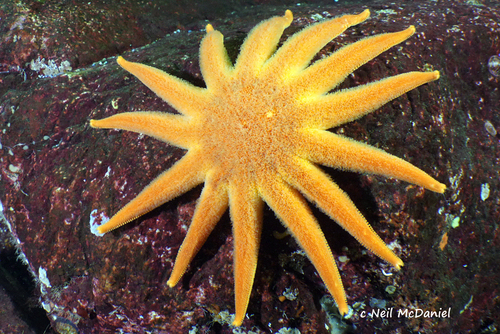
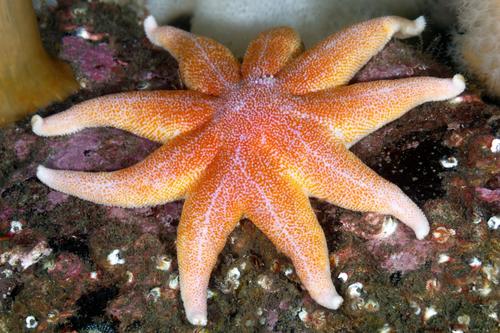
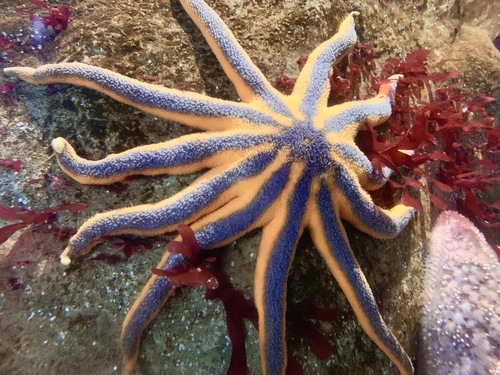
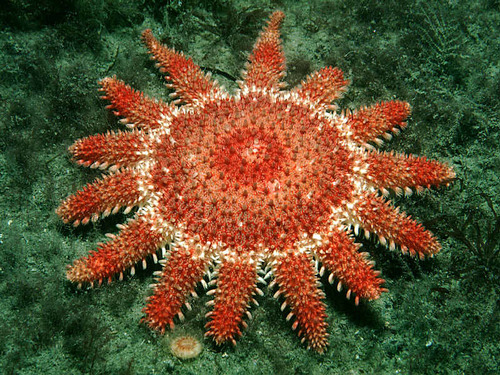
Crossaster papposus, commonly called the common sunstar, has a reddish upper surface marked with concentric bands of white, pink, yellow, or dark red, and a completely white underside. Its upper surface is covered in brush-like spines, and the marginal spines along its edges are somewhat larger than the others. It has a thick, fairly large central disc that features a netlike pattern of raised ridges; the mouth area on its underside is bare of spines. This species has relatively short arms, which usually number between eight and fourteen. Its maximum radius reaches 15 cm (6 inches), and its madreporite plate is clearly visible. The common sunstar has a circumboreal distribution, ranging from the Arctic south to the English Channel and throughout the North Sea. It is also found around Greenland, Iceland, the Barents Sea, Kola Bay, Okhotsk Sea and the White Sea. On North American coasts, it occurs from the Arctic down to the Gulf of Maine on the eastern side, and from Alaska to Puget Sound on the Pacific coast. It is most commonly found on rocky bottoms, coarse sand, and gravel in the infralittoral, circalittoral, and bathyal zones, ranging from the low-tide line down to depths of 300 meters. It prefers areas with high water movement, and very small common sunstars are sometimes found in rock pools. The common sunstar is an omnivorous scavenger that feeds on almost any available food, including smaller starfish and other smaller sunstars, which it swallows whole.