About Cronartium quercuum (Berk.) Miyabe ex Shirai
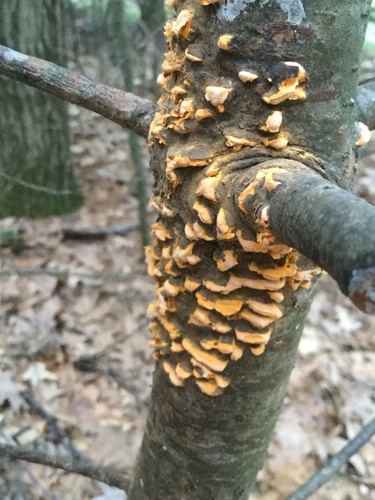
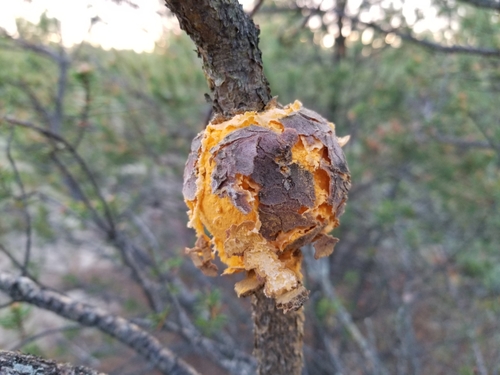
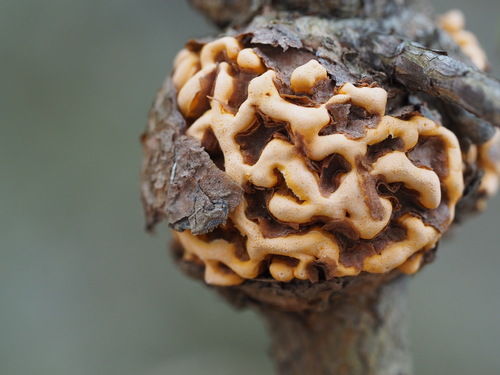
Cronartium quercuum, commonly called pine-oak gall rust, is a fungal disease that affects pine (Pinus spp.) and oak (Quercus spp.) trees. It is similar to pine-pine gall rust in that it infects pine trees, but its second host is an oak tree rather than another pine. This fungus is distributed across North, Central, and South America, the Caribbean, and Asia. In North America, it occurs in Canada, the United States, and Mexico, and is most common in the eastern United States, spreading west as far as the Great Lakes region. In Asia, it has been recorded in China, India, Japan, the Republic of Korea, the Democratic People's Republic of Korea, and the Philippines. One to several years after initial infection of a pine host, pycnia and aecia develop in spring and early summer. Aecia usually emerge one year after pycnia appear. Aeciospores are spread by wind, which allows them to travel long distances to reach their telial host, oak trees. Aeciospores cannot re-infect pine species. One to three weeks after oak infection, uredinia form, and telia develop roughly 15 days after that. Teliospores germinate to produce basidiospores, which are also dispersed by wind, and travel to infect first-year pine needles. Basidiospores cannot re-infect the telial oak host. Basidiospore infection takes place in summer and fall, and the full life cycle is completed once basidiospores successfully infect a pine tree.