About Crocuta crocuta (Erxleben, 1777)
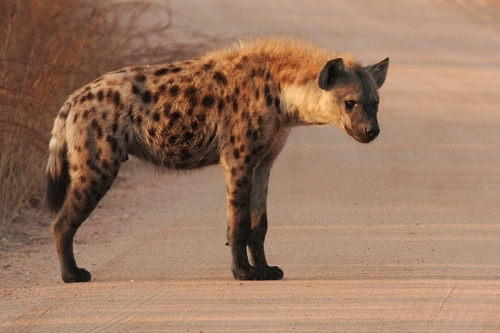
The spotted hyena (Crocuta crocuta), also called the laughing hyena, is a hyena species currently classified as the only living member of the genus Crocuta, native to sub-Saharan Africa. It is listed as Least Concern by the IUCN, as it has a widespread range with an estimated total population of 27,000 to 47,000 individuals. However, populations are declining outside protected areas due to habitat loss and poaching. Cave hyenas, populations of Crocuta usually considered a subspecies of Crocuta crocuta, ranged across Eurasia for at least one million years until the end of the Late Pleistocene. The spotted hyena is the largest living member of the Hyaenidae family. It can be physically distinguished from other hyena species by its vaguely bear-like build, rounded ears, less prominent mane, spotted fur, dual-purpose teeth, fewer nipples, and the female's pseudo-penis. It is the only placental mammal species where females have a pseudo-penis and lack an external vaginal opening. The spotted hyena is the most social species in the order Carnivora, with the largest group sizes and most complex social behaviors. Its social organization differs from that of all other carnivores, and is more similar to that of cercopithecine primates (baboons and macaques) in group size, hierarchical structure, and frequency of social interaction among both related and unrelated group members. The spotted hyena's social system is openly competitive: access to carcasses, mating opportunities, and the timing of male dispersal all depend on an individual's ability to dominate other clan members and form ally networks. Females only provide for their own cubs and do not assist other females, and males provide no paternal care at all. Even so, spotted hyenas cooperate closely with their clan mates; they often hunt, eat, and rest together, and use their large numbers and communication skills to fight off common enemies. Spotted hyena society is matriarchal: females are larger than males and dominate them. The spotted hyena is a highly successful large carnivore, and is the most common large carnivore in Africa. Its success stems partially from its adaptability and opportunism: it is primarily a hunter but also scavenges, and can eat and digest skin, bone, and other animal waste. In functional terms, spotted hyenas make more efficient use of animal matter than any other African carnivore. The spotted hyena has greater flexibility in its hunting and foraging behavior than other African carnivores; it may hunt alone, in small groups of 2–5 individuals, or in large groups. During hunts, spotted hyenas often run through herds of ungulates to pick out an individual to attack. Once a target is selected, they chase it over long distances, often several kilometres, at speeds of up to 60 kilometres per hour (37 mph). Spotted hyenas have a long history of interaction with humans; depictions of the species date back to the Upper Paleolithic, with carvings and paintings in the Lascaux and Chauvet Caves. The species has a largely negative reputation in both Western culture and African folklore. In Western culture, it is mostly seen as ugly and cowardly, while in African folklore it is viewed as greedy, gluttonous, stupid, and foolish, though also powerful and potentially dangerous. Most Western perceptions of the species trace back to the writings of Aristotle and Pliny the Elder, who wrote about the species in a relatively non-judgmental way. Explicit negative judgments appear in the Physiologus, where the animal is described as a hermaphrodite and grave-robber. The IUCN's Hyena Specialist Group identifies the spotted hyena's negative reputation as harmful to the species' continued survival, both in captivity and in the wild. Historically, the spotted hyena's range covered Europe from the Iberian Peninsula to the Urals, where it persisted for at least one million years. Remains have also been found in the Russian Far East, and researchers have theorized that the presence of hyenas there may have delayed the colonization of North America. During the Last Glacial Maximum, spotted hyenas also ranged across Southeast Asia. The causes of the species' extirpation from Eurasia are still largely unknown. At least in Western Europe, the spotted hyena's extinction coincided with a decline in grasslands 12,500 years ago. Europe lost massive amounts of the lowland habitats spotted hyenas prefer, and saw a corresponding increase in mixed woodlands. Under these conditions, spotted hyenas were outcompeted by wolves and humans, which thrive equally in forests and open areas, and in both highlands and lowlands. Spotted hyena populations began to shrink roughly 20,000 years ago, disappearing completely from Western Europe between 14,000 and 11,000 years ago, and earlier in some regions. Historically, the spotted hyena was widespread across sub-Saharan Africa. It occurs in all habitats except the most extreme desert conditions, tropical rainforests, and the tops of alpine mountains. Its current distribution is fragmented in many areas, particularly West Africa. Populations are concentrated in protected areas and the surrounding land. There is continuous distribution across large areas of Ethiopia, Kenya, Tanzania, Botswana, Namibia, and the Transvaal Lowveld region of South Africa. In the 1770s and 1780s, the species was still widespread in southern and western South Africa, with records from the Cape Peninsula, Cape Flats, and near present-day Somerset West, Riviersonderend, Mossel Bay, George, Joubertina, Gamtoos River, Jansenville, Cannon Rocks, Alice, Onseepkans, and Augrabies Falls. The species lives in semi-deserts, savannahs, open woodland, dense dry woodland, and mountainous forests up to 4,000 m in altitude. It is scarce or absent in tropical rainforests and coastal areas. Its preferred habitats in West Africa include the Guinea and Sudan savannahs, and it is absent from the belt of dense coastal forest. In the Namib Desert, it occurs in riparian vegetation along seasonal rivers, the sub-desertic pro-Namib, and the adjoining inland plateau. In ideal habitats, spotted hyenas outnumber other large carnivores, including other hyena species. However, striped and brown hyenas occur at higher densities than spotted hyenas in desert and semi-desert regions. Population densities measured through systematic censuses vary widely, from 0.006 to 1.7 individuals per square kilometre. The spotted hyena breeds year-round, though a birth peak occurs during the wet season. Females are polyestrous, with an estrus period that lasts two weeks. Like many feliform species, the spotted hyena is promiscuous, and no permanent pair bonds form. Individuals of both sexes may mate with multiple partners over several years. Males behave submissively when approaching females in estrus, even if the male is heavier than the female. Females usually prefer younger males that were born into the clan or joined after the female was born. Older females share this preference, and also favor males with whom they have had long, friendly prior relationships. Passive males generally have more mating success than aggressive males. Copulation in spotted hyenas is relatively brief, lasting 4–12 minutes, and typically only occurs at night with no other hyenas present. The mating process is complicated, because the male's penis enters and exits the female's reproductive tract through her pseudo-penis, rather than directly through the vagina, which is blocked by the female's false scrotum and testes. These unusual traits make mating more difficult for the male than in other mammals, and also make forced copulation physically impossible. The female retracts her clitoris before the male's penis enters it by sliding beneath it, a process made easier by the penis' upward angle. Hyenas then use a typical mammalian mating posture, and usually lick their genitals for several minutes after mating. Copulation may be repeated multiple times over a period of several hours. The length of gestation varies considerably, with an average length of 110 days. In the final stages of pregnancy, dominant females give their developing offspring higher androgen levels than lower-ranking mothers do. These higher androgen levels, caused by high concentrations of ovarian androstenedione, are thought to be responsible for the extreme masculinization of female behavior and anatomy. This makes the cubs of dominant females more aggressive and sexually active than cubs of lower-ranking hyenas; high-ranking male cubs attempt to mount females earlier than lower-ranking males. The average litter size is two cubs, with litters of three occasionally reported. Males play no role in raising young. Giving birth is difficult for female hyenas, because females give birth through their narrow clitoris, and spotted hyena cubs are the largest carnivoran young relative to their mother's body weight. During birth, the clitoris ruptures to let the young pass, and may take weeks to heal. Cubs are born with soft, dark brown fur, and weigh an average of 1.5 kg (3.3 lb). Unique among carnivorous mammals, spotted hyenas are born with their eyes open, with 6–7 mm (0.24–0.28 in) long canine teeth and 4 mm (0.16 in) long incisors. Cubs also attack each other shortly after birth. This is especially common in same-sex litters, and can lead to the death of the weaker cub. This neonatal siblicide kills an estimated 25% of all spotted hyenas in their first month. Surviving male cubs grow faster and are more likely to gain reproductive dominance, while surviving female cubs eliminate rivals for dominance in their natal clan. Lactating females can carry 3–4 kg (6.6–8.8 lb) of milk in their udders. Spotted hyena milk has the highest protein and fat content of any terrestrial carnivore's milk. Cubs nurse from their mother for 12–16 months, though they can process solid food as early as three months. Mothers do not regurgitate food for their young. Females are protective of their cubs, and will not allow other adults, particularly males, to approach them. Spotted hyenas develop adult behaviors early in life; cubs have been observed performing ritual sniffing of one another and marking their living space before they are one month old. Within ten days of birth, they can move at considerable speed. Cubs start to lose their black coat and develop the spotted, lighter fur of adults at 2–3 months old. They begin to show hunting behaviors at eight months old, and start fully participating in group hunts after their first year. Spotted hyenas reach sexual maturity at three years old. The average lifespan in zoos is 12 years, with a maximum of 25 years. Spotted hyenas have been hunted for their body parts for traditional medicine, amusement, and sport, though this is rare, as the species is generally not considered attractive. Fossil evidence shows that humans butchered and likely consumed spotted hyenas in Middle Pleistocene Europe. Such cases are rare in modern Africa, where most tribes, even those that eat unusual types of meat, generally reject hyena meat as food. Several writers during the Scramble for Africa recorded that despite its physical strength, a spotted hyena poses no danger to hunters when captured or cornered. Native skinners often refused to even touch hyena carcasses, though this was rarely a problem, as hyena skins were not considered valuable or attractive. In Burkina Faso, the hyena's tail is used for medicinal and magical purposes. In Cameroon, Côte d'Ivoire and Senegal, the whole animal is harvested for bushmeat and traditional medicine. In Malawi and Tanzania, genitalia, nose tips, and tails are used in traditional medicine. In Mozambique, traditional healers use various spotted hyena body parts, most commonly the paws. Oromo hunters typically complete a ritual purification after killing a hyena. Kujamaat hunters traditionally treat killed spotted hyenas with the same respect given to deceased tribal elders, to avoid retaliation from hyena spirits acting on behalf of the dead animal. During the early period of Dutch colonization in southern Africa, hyenas (called "wolves" by the colonists) were especially easy to trap, because their preference for carrion and lack of caution around enclosed spaces worked against them. Many frontier farms had a wolwehok (hyena trap), a roughly built structure made of stone or wood baited with meat. The trap had a trap-door designed to close once the bait was disturbed. In the Cape Colony, spotted hyenas were often hunted by tracking them to their dens and shooting them as they emerged. Another hunting method was to trap them inside their dens, dazzle them with torchlight, then stab them in the heart with a long knife. When chased by hunting dogs, spotted hyenas often fight back, unless the dogs are exceptionally large, powerful breeds. James Stevenson-Hamilton wrote that wounded spotted hyenas can be dangerous opponents for hunting dogs, and recorded an incident where a hyena killed a dog with a single bite to the neck without breaking the skin. Additional challenges to killing spotted hyenas with dogs include the species' thick skin, which prevents dogs from inflicting serious damage to the animal's muscles.