About Crocodylus suchus Geoffroy Saint-Hilaire, 1807
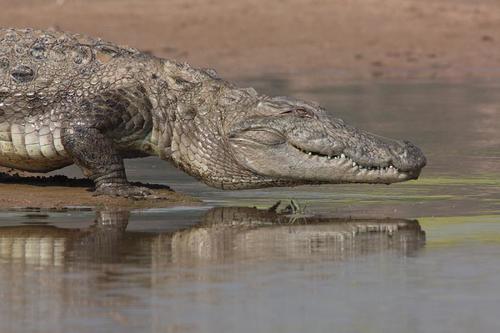
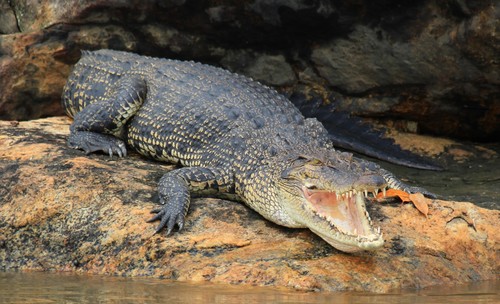
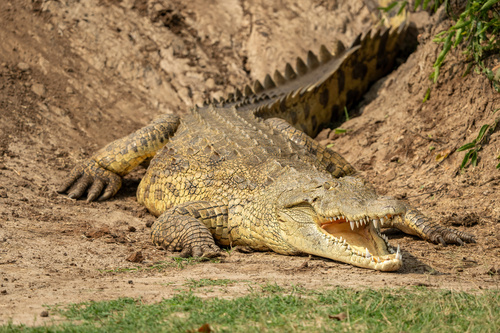
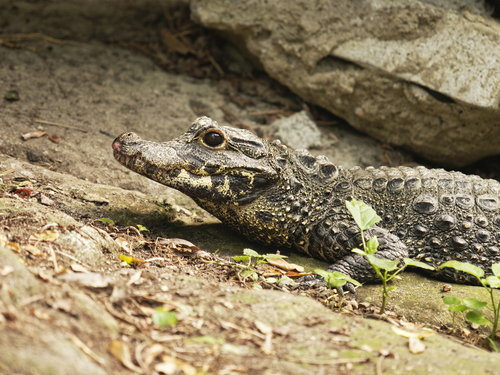
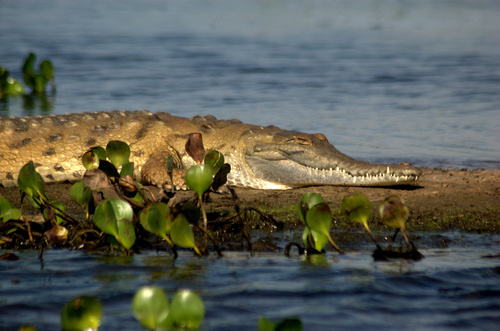
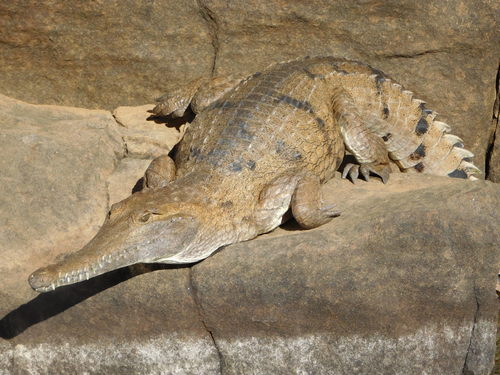
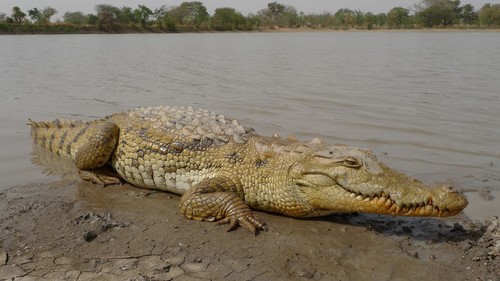
Crocodylus suchus, commonly known as the West African crocodile, has a short, thick muzzle. The distance from the eyes to the tip of the muzzle is 1.5 to 2 times longer than the width of the muzzle at the front edge of the eyes; for juvenile individuals, this ratio is between 1.2 and 1.5 times. Its base body color is generally brown to olive. Juveniles are paler in color and have black banding, most noticeably on the tail. Like all other crocodile species, the eyes of the West African crocodile reflect light at night, making it easy to spot with a flashlight. This species is active both during the day and at night. It can stay submerged underwater for over 30 minutes, and can reach short burst speeds of up to 30 km/h (19 mph). On land, it is often seen basking motionless in the sun, usually with its mouth open. The West African crocodile is smaller than the Nile crocodile, which can grow over 5 m (16 ft 5 in) long. Most West African crocodiles grow to between 2 and 3 m (6 ft 7 in and 9 ft 10 in) in length, and only rarely do occasional males grow over 4 m (13 ft 1 in). Adult West African crocodiles weigh between 90 and 250 kg (200 and 550 lb), and exceptionally large male specimens can weigh more than 300 kg (660 lb). The West African crocodile lives across much of West and Central Africa. Its range extends east to South Sudan and Uganda, and south to the Democratic Republic of the Congo; the West African crocodile may come into contact with Nile crocodiles in all three of these countries. Additional countries where the species occurs include Mauritania, Benin, Liberia, Guinea-Bissau, Nigeria, Niger, Cameroon, Chad, Sierra Leone, the Central African Republic, Equatorial Guinea, Senegal, Mali, Guinea, Gambia, Burkina Faso, Ghana, Gabon, Togo, Ivory Coast and the Republic of Congo. As recently as the 1920s, museums collected West African crocodile specimens from the White Nile, but the species has now disappeared entirely from this river. In Mauritania, this crocodile has adapted to the arid desert environment of the Sahara–Sahel: it stays in caves or burrows in a state of aestivation during the driest periods, which has earned it the alternative common name desert crocodile. When rain occurs, these desert crocodiles gather at gueltas. Across most of its range, the West African crocodile may encounter other crocodile species, and there appears to be some degree of habitat segregation between species. Where West African crocodiles and Nile crocodiles co-occur, Nile crocodiles typically prefer large seasonal rivers in savannah or grassland habitats, while West African crocodiles generally favor lagoons and wetlands in forested regions. The details of this proposed habitat segregation have not yet been definitively confirmed. A study of habitat use by three crocodile species in Liberia – the West African crocodile, the slender-snouted crocodile, and the dwarf crocodile – found that the West African crocodile typically occupied larger, more open waterways including river basins and mangrove swamps. It was also the most tolerant of brackish water among the three studied species. In contrast, slender-snouted crocodiles typically occupy rivers within forest interiors, while dwarf crocodiles live in smaller rivers (mainly tributaries), streams and brooks, also located within forested areas.