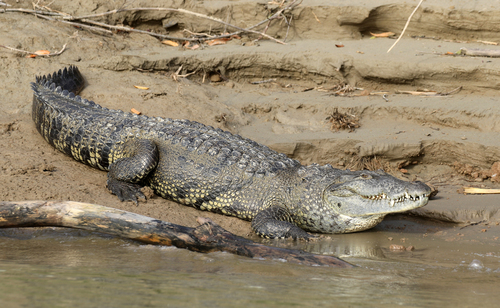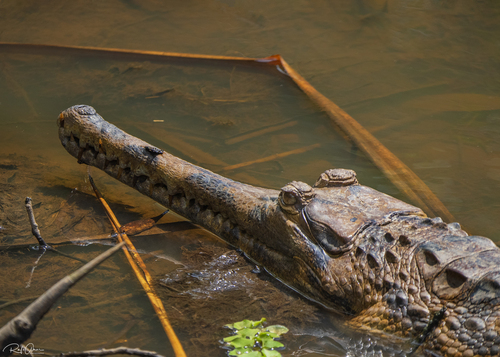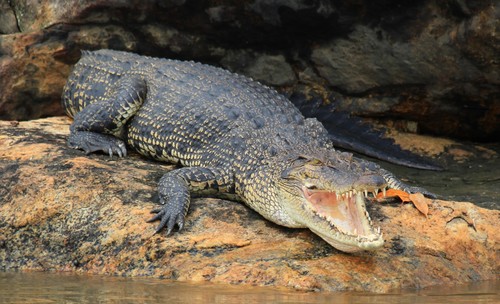
About Crocodylus porosus Schneider, 1801
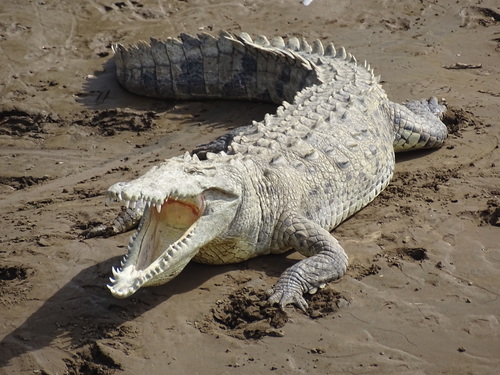
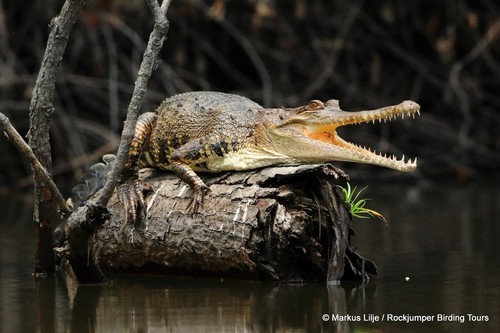
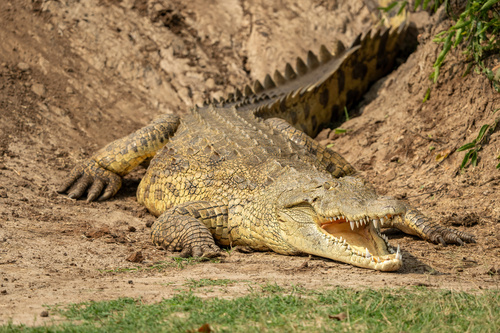
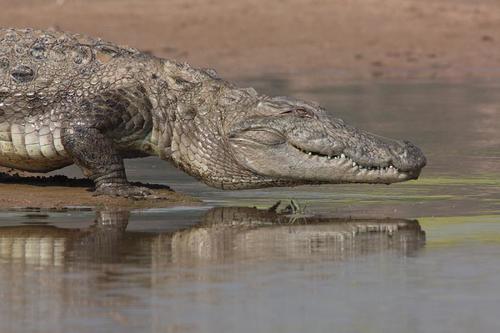
Description: Compared to most crocodiles, the saltwater crocodile (Crocodylus porosus) has a wider snout, but it is longer than that of the mugger crocodile (C. palustris): the snout length is twice its width at the base. A pair of ridges runs from the eyes along the center of the snout. Its scales are oval-shaped; the bony scutes on its back are either smaller than those of other crocodile species, or often completely absent. There is a clear gap between the cervical and dorsal bony shields, and small triangular scutes sit between the posterior edges of the large, transversely arranged scutes of the dorsal shield. This relative lack of scutes is a useful trait to distinguish saltwater crocodiles from other species in captivity, during illegal leather trade, and in the few wild areas where subadult or young saltwater crocodiles need to be identified. It also has fewer armor plates on its neck than other crocodilians. The broad body of an adult saltwater crocodile contrasts with the leaner body of most other crocodiles, which led to early unconfirmed assumptions that this reptile was an alligator. Young saltwater crocodiles are pale yellow with black stripes and spots across their bodies and tails. This coloration stays for several years until the crocodiles mature into adults. Adult saltwater crocodiles are much darker, with a greenish-drab color; lighter tan or grey areas are sometimes visible. Multiple color variations are documented: some adults keep fairly pale skin, while others are so dark they appear almost black. The ventral surface is white or yellow across all age groups. Stripes appear on the lower sides of the body, but do not extend onto the belly. Their tails are grey with dark bands. Distribution and habitat: The saltwater crocodile lives in coastal brackish mangrove swamps, river deltas, and freshwater rivers, ranging from India's east coast, Sri Lanka, and Bangladesh to Myanmar, Malaysia, Brunei, Indonesia, the Philippines, Timor Leste, Palau, the Solomon Islands, Singapore, Papua New Guinea, Vanuatu, and Australia's north coast. The southernmost Indian population lives in Odisha's Bhitarkanika Wildlife Sanctuary; the species has not been recorded in northern Odisha since the 1930s. It occurs along the coasts of the Andaman and Nicobar Islands and in the Sundarbans. In Sri Lanka, it is found mainly in the western and southern parts of the country. In Myanmar, it lives in the Ayeyarwady Delta. It has been recorded in Phang Nga Province, southern Thailand. In Singapore, it inhabits the Sungei Buloh Wetland Reserve and marshes near Kranji and Mandai. The species is locally extinct in Cambodia, China, the Seychelles, Thailand, and Vietnam. In China, it may once have inhabited coastal areas from Fujian province in the north to the Vietnamese border. References to crocodile attacks on humans and livestock during the Han and Song dynasties indicate the species may have occurred in the lower Pearl River, Macau, the Han River, the Min River, parts of coastal Guangxi province, and Hainan Island until the 18th century. There are three historical records of saltwater crocodiles found in Japanese coastal waters: one individual was found off the coast of Iwo Jima in 1744, another off Amami Ōshima in 1800, and a third caught by fishermen in Toyama Bay in 1932. All other records of the species within Japanese territory date to World War II, from areas that were formerly controlled by the Empire of Japan. In Malaysia, it has been recorded in the Klias, Segama, and Kinabatangan Rivers in Sabah. In Sarawak, a camera trap recorded the species in Kuching Wetlands National Park. In the Lesser Sunda Islands, it is present along the coasts of Sumba, Lembata Island, Flores, Menipo, Rote Island, and Timor. Its status on Alor Island is unknown, though one individual was captured there in the 2010s. In the Maluku Islands, it is present around the Kai Islands, the Aru Islands, many other islands in the region, and the Torres Strait Islands. In Papua New Guinea, it is common in the coastal reaches of every river system, such as the Fly River, and in the Bismarck Archipelago. In the Philippines, it occurs in a small number of coastal sites including eastern Luzon, Palawan, the Liguasan Marsh, and the Agusan River on Mindanao. In northern Australia, the saltwater crocodile population is thriving, especially in multiple river systems near Darwin such as the Adelaide, Mary, and Daly Rivers, along with their adjacent billabongs and estuaries. The adult saltwater crocodile population in Australia is estimated at 100,000 to 200,000. Its range extends from Broome, Western Australia, along the entire Northern Territory coast, all the way south to Gladstone, Queensland. The Alligator Rivers in the Arnhem Land region are misnamed, as the name refers to the saltwater crocodile's similarity to alligators, compared to freshwater crocodiles that also inhabit the Northern Territory. The Seychelles held the westernmost historical saltwater crocodile population. Because the species can swim long distances at sea, individual saltwater crocodiles occasionally appear in areas far outside their general range, as far as Fiji. Saltwater crocodiles generally stay in freshwater swamps and rivers during the tropical wet season, moving downstream to estuaries in the dry season. Crocodiles compete fiercely for territory, with dominant males in particular occupying the most suitable stretches of freshwater creeks and streams. Younger crocodiles are therefore forced into marginal river systems, and sometimes into the ocean. This explains the species' large distribution, as well as its occasional appearance in unusual locations such as the Sea of Japan. Like all crocodiles, they can only survive for prolonged periods in warm temperatures, and they seasonally leave parts of Australia during cold spells. Behaviour and ecology: The main behavioural trait that distinguishes the saltwater crocodile from other crocodiles is its tendency to occupy salt water. Although other crocodiles also have salt glands that let them survive in saltwater (a trait alligators do not have), most other species only enter the sea during extreme conditions. Saltwater crocodiles use ocean currents to travel long distances. In Australia, 20 crocodiles were tagged with satellite transmitters; 8 of these entered open ocean, and one individual traveled 590 km (370 mi) along the coast in 25 days, traveling from the North Kennedy River on the eastern coast of Far North Queensland, around Cape York Peninsula, to the west coast in the Gulf of Carpentaria. Another individual swam 411 km (255 mi) in 20 days. By often simply floating instead of actively swimming, this current-riding behaviour lets the crocodiles conserve energy. They interrupt their travels and stay in sheltered bays for a few days until the current changes direction. Sometimes they also swim up and down river systems. The saltwater crocodile is generally very lethargic, a trait that helps it survive for months without food. It usually loiters in the water or basks in the sun through much of the day, and prefers to hunt at night. A study of seasonal saltwater crocodile behaviour in Australia found they are more active and more likely to spend time in the water during the Australian summer; conversely, they are less active and spend more time basking in the sun during winter. Despite this general lethargy, saltwater crocodiles are among the most active of all crocodilians, spending more time cruising and active, especially in water. They are much less terrestrial than most crocodile species, spending little time on land except for basking. At times, they can spend weeks at sea searching for land, and barnacles have been observed growing on their scales, confirming the long periods they spend at sea. Saltwater crocodiles can stay fully submerged underwater for long periods. To extend an aerobic dive, they can reduce their heart rate and oxygen consumption. Voluntary dives of up to two hours have been reported, and even much longer dives are considered possible for large individuals when their metabolic rate is reduced. Diving depth for C. porosus is not well studied, but the species has been recorded at depths of 15 m (49 ft) and can likely dive much deeper. Although crocodilian brains are much smaller than those of mammals (as low as 0.05% of body weight in the saltwater crocodile), saltwater crocodiles can learn difficult tasks with very little conditioning, track the migratory routes of their prey as seasons change, and may have deeper communication abilities than currently recognized. While saltwater crocodiles are the least social and most aggressive crocodilians, they still have variable levels of gregariousness between individuals. Their social systems are dynamic, shaped by the time of year, and the sex and maturity of the individuals involved. Some individuals have been recorded maintaining specific associations with others for up to five years. Reproduction: Males reach sexual maturity when they are around 3.3 m (11 ft) long, at about 16 years of age. Females reach sexual maturity at 2.1 m (6 ft 11 in) long, when they are 12 to 14 years old. Saltwater crocodiles mate in the wet season, when water levels are at their highest. In Australia, males and females carry out courtship in September and October, and females lay eggs between November and March. It is possible that rising temperatures in the wet season trigger reproductive behaviour in this species. While most crocodilians nest every year, there are multiple recorded cases of female saltwater crocodiles nesting only every other year, and one recorded case of a female attempting to produce two broods in a single wet season. The female selects the nesting site, and both parents defend the nesting territory, which is typically a stretch of shore along tidal rivers or freshwater areas, especially swamps. Nests are often placed in surprisingly exposed locations, usually in mud with little to no surrounding vegetation, giving them limited protection from sun and wind. The nest is a mound of mud and vegetation, usually measuring 175 cm (69 in) long and 53 cm (21 in) high, with an entrance averaging 160 cm (63 in) in diameter. Some nests have been found in unexpected habitats, such as rocky rubble or a damp low-grass field. The female crocodile usually scratches a layer of leaves and other debris around the nest entrance, and this covering is reported to produce a surprising amount of warmth for the eggs (coincidentally, this nesting behaviour is similar to that of megapodes, birds that nest in upland areas of the same Australasian regions where saltwater crocodiles are found). Females typically lay 40 to 60 eggs, but some clutches have contained as many as 90. The eggs average 8 by 5 cm (3.1 by 2.0 in) in size, and weigh an average of 113 g (4.0 oz) in Australia and 121 g (4.3 oz) in India. These eggs are relatively small: the average female saltwater crocodile weighs around five times as much as a freshwater crocodile, but lays eggs that are only about 20% larger in measurement and 40% heavier than those of the smaller species. The average weight of a new hatchling in Australia is reported to be 69.4 g (2.45 oz). Although the female guards the nest for 80 to 98 days (ranging from 75 to 106 days in extreme cases), egg loss is often high due to flooding and occasional predation. As with all crocodilians, the sex of hatchlings is determined by incubation temperature. At 28–30 °C, all hatchlings will be female. At 30–32 °C, 86% of hatchlings are male. At 33 °C or higher, hatchlings are predominantly female (84%). In Australia, goannas (Varanus giganteus) commonly eat freshwater crocodile eggs, feeding on up to 95% of a clutch if they find it, but they are relatively unlikely to prey on saltwater crocodile eggs due to the mother's vigilant defense. About 25% of saltwater crocodile eggs are lost to goannas, which is less than half the rate of Nile crocodile egg loss to monitor lizards in Africa. Most egg loss for saltwater crocodiles is caused by flooding of the nest hole. Like most crocodilian species, the female saltwater crocodile shows a remarkable level of maternal care for a reptile. She digs open the nest in response to yelping calls from hatching hatchlings, and even gently rolls eggs in her mouth to help hatching. The female then carries the hatchlings to water in her mouth, a behaviour also observed in female Nile crocodiles and American alligators after their eggs hatch, and stays with the young for several months. Despite her careful care, losses of baby crocodiles are high due to various predators and unrelated adult saltwater crocodiles. Only about 1% of hatchlings survive to adulthood. By crocodilian standards, saltwater crocodile hatchlings are exceptionally aggressive toward one another, and often fight almost immediately after the mother carries them to water. Young saltwater crocodiles naturally begin to disperse after around 8 months, and start showing territorial behaviour at around 2.5 years old. They are the most territorial of all living crocodilians, and due to their aggressiveness toward other members of their species, they are never found in groups or loose aggregations like most other crocodiles, starting from the dispersing immature stage. Even after dispersal, females will not reach full sexual maturity for another 10 years. Saltwater crocodiles that survive to adulthood can reach a very long maximum lifespan, with an estimated life expectancy of over 70 years, and some individuals may possibly exceed 100 years, though no such extreme age has been verified for any crocodilian. While adult saltwater crocodiles have no natural predators, baby saltwater crocodiles may be preyed on by monitor lizards (occasionally the widespread Australian goanna, and further north the Asian water monitor (Varanus salvator)), predatory fish (especially barramundi (Lates calcarifer)), wild boars, rats, various aquatic and raptorial birds (such as black-necked storks (Ephippiorhynchus asiaticus) and white-bellied sea eagles (Haliaeetus leucogaster)), pythons, larger crocodiles, and many other predators. Pigs and cattle also occasionally accidentally trample eggs and nests, and can degrade habitat quality when present in large numbers. Juveniles may also be preyed on by tigers and leopards (Panthera pardus) in some parts of the species' range, though encounters between these predators are rare, and big cats tend to avoid areas with saltwater crocodiles.