About Crocodylus palustris (Lesson, 1831)
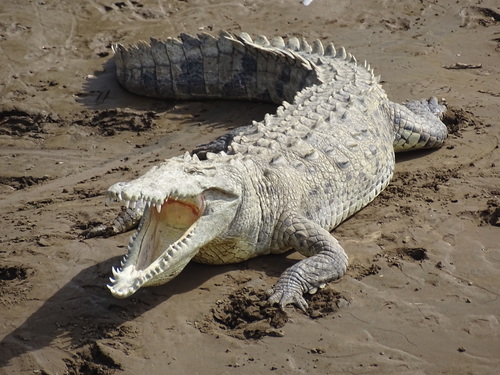
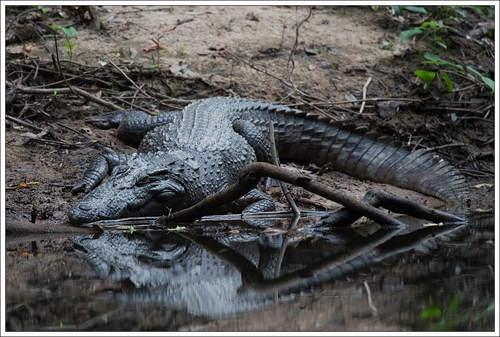
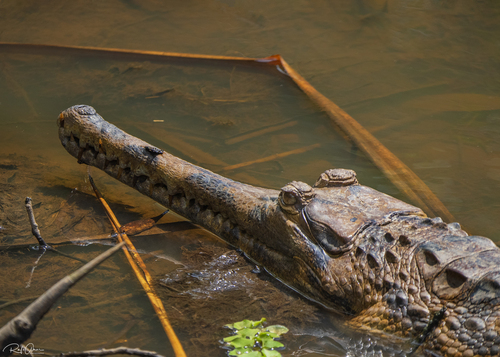
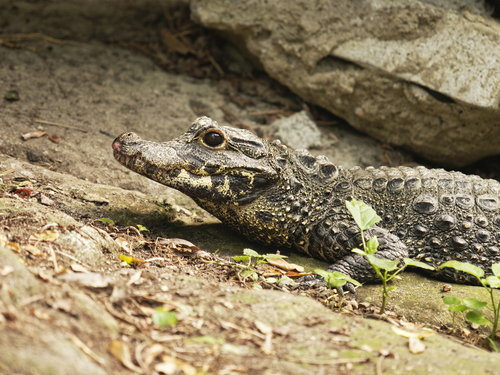
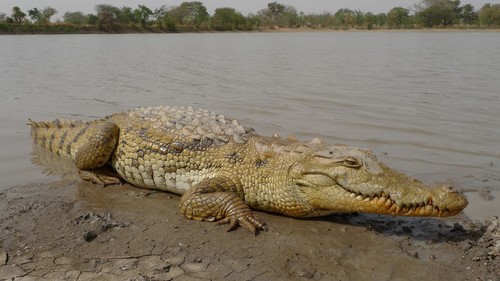
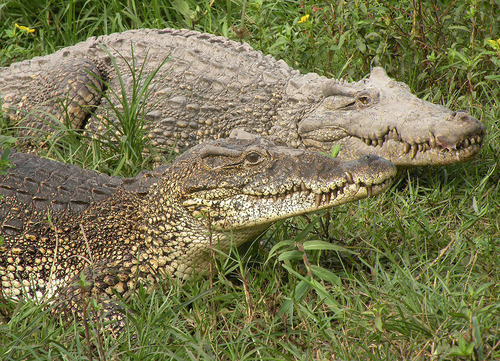
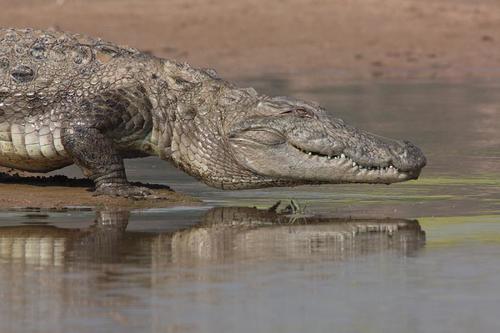
Crocodylus palustris, commonly called the mugger crocodile, has the following physical characteristics. Hatchlings are pale olive with black spots, while adults range in color from dark olive to grey or brown. Its head is rough with no ridges, and it has large scutes around the neck that are well separated from the back. Scutes typically form four longitudinal series, rarely six, and 16 or 17 transverse series. Keeled scales cover its limbs, with serrated fringes along the outer edges of the limbs, and the outer toes are extensively webbed. Its snout is slightly longer than it is broad, with 19 upper teeth on each side. The symphysis of the lower jaw extends to the level of the fourth or fifth tooth. On the palate, the premaxillary suture is nearly straight or curves forward, and the nasal bones separate the premaxilla above. The mugger crocodile is a medium-sized crocodilian, and has the broadest snout of any living crocodile species. It has a powerful tail and webbed feet, with acute vision, hearing, and sense of smell. On average, adult females measure 2 to 2.5 m (6 ft 7 in to 8 ft 2 in) long, while adult males usually measure 3 to 3.5 m (9 ft 10 in to 11 ft 6 in); individuals rarely reach 5 m (16 ft 5 in) long. The two largest known mugger crocodiles, both measuring 5.63 m (18 ft 6 in), were killed in Sri Lanka. One 207 kg (456 lb) individual had a recorded bite force of 7,295 N (1,640 lbf). Large males may reach a weight of 450 kg (1,000 lb). The largest zoological specimen held at the British Museum of Natural History measures 3.7 m (12 ft 2 in) long. One approximately 3 m (9 ft 10 in) long male caught in Pakistan weighed 195 kg (430 lb). The mugger crocodile is found in southern Iran, Pakistan, Nepal, India, and Sri Lanka, up to an elevation of 420 m (1,380 ft). It inhabits freshwater lakes, rivers, and marshes, and prefers slow-moving, shallow water bodies. It also thrives in artificial reservoirs and irrigation canals. In Iran, it occurs along rivers in Sistan and Baluchestan Provinces near the Iran-Pakistan border. Around 200 mugger crocodiles live on the Iranian Makran coast near Chabahar. Human activity and a long drought in the late 1990s and early 2000s pushed this population to the brink of extinction, but much of its habitat was restored after tropical cyclones in 2007 and 2010 flooded formerly dry lakes and hamuns. In Pakistan, a small population lives in 21 ponds around the Dasht River; 99 individuals were counted in the winter of 2007–08, and by 2017 the population had declined to 25 individuals. In Sindh Province, small populations live in the wetlands of Deh Akro-2, Nara Desert Wildlife Sanctuary, near Chotiari Dam, in the Nara Canal, and around Haleji lake. In Nepal's Terai region, it occurs in the wetlands of Shuklaphanta National Park, Bardia National Park, Ghodaghodi Tal, Chitwan National Park, and Koshi Tappu Wildlife Reserve. In India, it occurs along the Chambal, Ken, and Son Rivers in Rajasthan, and in Ranthambore National Park; along the Vishwamitri River, and in several reservoirs and lakes in Kutch, Gujarat; in National Chambal Sanctuary, Madhya Pradesh; in Rajaji National Park, Corbett Tiger Reserve, and Lansdowne Forest Division, Uttarakhand; in Katarniaghat Wildlife Sanctuary and Kishanpur Wildlife Sanctuary, Uttar Pradesh; in Simlipal National Park, and along the Mahanadi and Sabari Rivers, Odisha, where 82 individuals were recorded in Simlipal National Park's river systems in 2019; in Manjira Wildlife Sanctuary, Telangana; along the Kadavi and Warna Rivers, and along the Savitri River in Raigad District, Maharashtra; in Salaulim Reservoir, the Zuari River, and small lakes in Goa; along the Kaveri and Kabini Rivers, in Ranganthittu Bird Sanctuary, Nagarhole National Park, and Tungabhadra Reservoir, Karnataka; in Parambikulam Reservoir and Neyyar Wildlife Sanctuary, Kerala; and at Amaravathi Reservoir, and along the Moyar and Kaveri rivers, Tamil Nadu. In Sri Lanka, it occurs in Wilpattu National Park, Yala National Park, and Bundala National Park; between 1991 and 1996, it was recorded at an additional 102 localities. Historically, it was present in the northern parts of the Sundarbans in Bangladesh, where four to five captive individuals survived in an artificial pond by the 1980s; it is possibly locally extinct in Bangladesh. It became extinct in Bhutan in the late 1960s, but a few captive-bred individuals were released into the Manas River in the late 1990s. It is considered locally extinct in Myanmar. Mugger crocodiles are powerful swimmers that use their tail and hind feet to move forward, change direction, and submerge. They belly-walk, with their belly touching the ground, along the bottom of water bodies and on land. During the hot dry season, they walk over land at night to find suitable wetlands, and spend most of the day submerged in water. During the cold season, they bask on riverbanks, and individuals tolerate one another during this period. Territorial behaviour increases during the mating season. Like all crocodilians, the mugger crocodile is a thermoconformer with an optimal body temperature of 30 to 35 °C (86 to 95 °F). It risks death from freezing when exposed to temperatures below 5 °C (41 °F), and from hyperthermia when exposed to temperatures above 38 °C (100 °F). It digs burrows to retreat from extreme temperatures and other harsh climatic conditions. Burrows are between 0.6 and 6 m (2.0 and 19.7 ft) deep, with entrances located above the water level and a chamber at the end large enough for the crocodile to turn around. The temperature inside the burrow remains constant between 19.2 to 29 °C (66.6 to 84.2 °F), depending on the region. Females reach sexual maturity at a body length of around 1.8–2.2 m (5 ft 11 in – 7 ft 3 in) at approximately 6.5 years of age, while males reach sexual maturity at a body length of around 2.6 m (8 ft 6 in). The reproductive cycle begins as early as November at the start of the cold season, with courtship and mating. Between February and June, females dig 35–56 cm (14–22 in) deep nesting holes between 1 m and 2,000 m away from the waterside. They lay up to two clutches, each holding 8 to 46 eggs. Eggs weigh an average of 128 g (4.5 oz). Laying a single clutch usually takes less than half an hour. After laying, females scrape sand over the nest to close it. Males have been observed assisting females with digging and protecting nest sites. Hatching occurs two months after laying: between April and June in southern India, and between August and September in Sri Lanka. Females excavate the hatchlings, carry them in their snouts to the water, and both females and males protect the young for up to one year. Healthy hatchlings develop at an incubation temperature range of 28–33 °C (82–91 °F). The sex ratio of hatchlings depends on incubation temperature and how much sunlight the nest receives. Only females develop at constant temperatures of 28–31 °C (82–88 °F), and only males develop at a constant 32.5 °C (90.5 °F). The percentage of females in a clutch decreases at constant temperatures between 32.6 and 33 °C (90.7 and 91.4 °F), while the percentage of males decreases at constant temperatures between 31 and 32.4 °C (87.8 and 90.3 °F). In natural nests, temperatures are not constant and vary between day and night. More females hatch in early natural nests, when initial temperatures inside the nest range between 26.4 and 28.9 °C (79.5 and 84.0 °F). The percentage of male hatchlings increases in late nests located in sunny sites. One-month-old hatchlings are 26–31 cm (10–12 in) long and weigh an average of 75 g (2.6 oz). They grow approximately 4.25 cm (1.67 in) per month, and reach a body length of 90–170 cm (35–67 in) by two years of age. Mugger crocodiles have been documented using lures to hunt birds, making them among the first reptiles recorded to use tools. They balance sticks and branches on their heads to lure birds searching for nesting material. This strategy is particularly effective during the bird nesting season.