About Crocodylus niloticus Laurenti, 1768
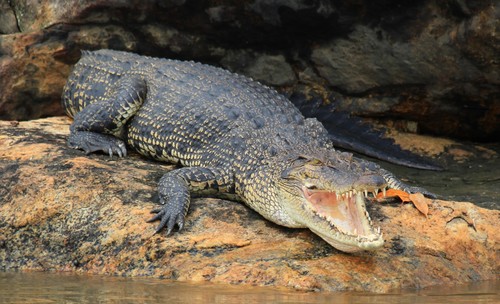
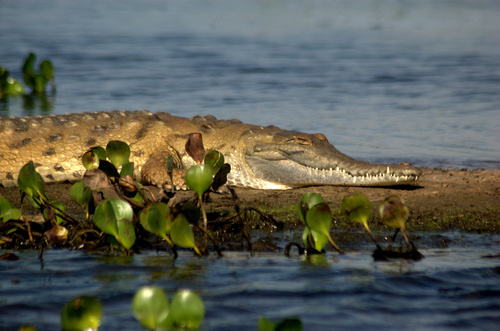
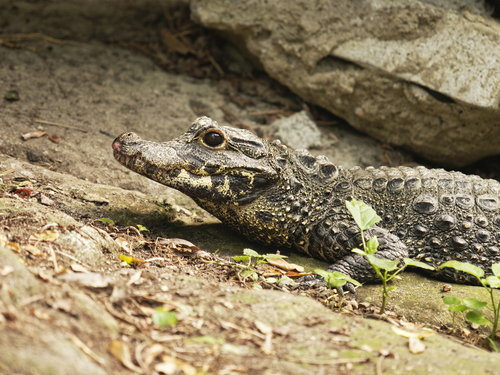
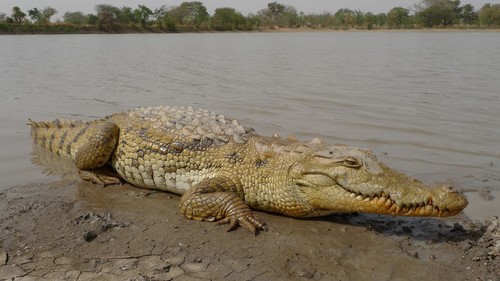
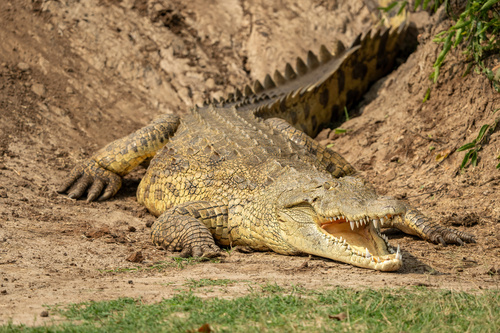
Characteristics and physiology: Adult Nile crocodiles (Crocodylus niloticus) have dark bronze upper bodies, with variable faded blackish spots and stripes across the back, and a dull off-yellow belly; mud often obscures their natural color. Their yellowish-green flanks have dark patches arranged in highly variable oblique stripes. Coloration varies with environment: individuals from fast-flowing water are typically lighter than those from murkier lakes or swamps, a camouflage adaptation that fits their habitat and is an example of clinal variation. All Nile crocodiles have green eyes, and their coloration overall helps with camouflage. Juveniles are grey, multicoloured, or brown, with dark cross-bands on the body and tail, and a yellowish-green underbelly. As they mature, Nile crocodiles become darker, and their cross-bands fade, especially on the upper body. Most other crocodile species show a similar color change during maturation. Most physical traits of Nile crocodiles are typical of crocodilians as a whole. Like all crocodilians, the Nile crocodile is a quadruped with four short, splayed legs, a long, powerful tail, a scaly hide with rows of bony scutes running down its back and tail, and strong, elongated jaws. Their skin has a number of poorly understood skin sense organs that may detect changes in water pressure, likely letting them track prey movements underwater. Nile crocodiles have fewer osteoderms (bony deposits) on their belly than many smaller crocodilian species, where belly osteoderms are much more noticeable. The species does, however, have small, oval osteoderms on the sides of its body and its throat. Like all crocodilians, Nile crocodiles have a nictitating membrane to protect their eyes and lachrymal glands to clean their eyes with tears. Their nostrils, eyes, and ears are located on the top of the head, allowing the rest of their body to stay hidden underwater. They have a four-chambered heart, modified for their ectothermic (cold-blooded) nature by an elongated cardiac septum. This structure is physiologically similar to a bird's heart and is especially efficient at oxygenating their blood. As with all crocodilians, Nile crocodiles have exceptionally high lactic acid levels in their blood, which lets them stay motionless in water for up to two hours. Lactic acid levels this high would kill most other vertebrates. However, strenuous activity can raise lactic acid to lethal levels in crocodilians, causing internal organ failure and death. This is rarely seen in wild crocodiles, and has most often been observed when humans mishandle crocodiles and force them into extended periods of struggling and stress.
Skull and head morphology: Nile crocodiles have 64 to 68 sharply pointed, cone-shaped teeth in their mouth, around 12 fewer than alligators. Broken teeth can be replaced throughout most of the crocodile's life. On each side of the mouth, 5 teeth sit in the front of the upper jaw (premaxilla), 13 or 14 in the rest of the upper jaw (maxilla), and 14 or 15 on each side of the lower jaw (mandible). As is true for all true crocodiles, the enlarged fourth tooth of the lower jaw fits into a notch in the upper jaw and is visible when the jaws are closed. Hatchlings quickly lose the hard egg tooth (a patch of hardened skin on the top of their mouth) that they use to break through their eggshell at hatching. Among crocodilians, the Nile crocodile has a relatively long snout, which is 1.6 to 2.0 times as long as it is wide when measured at the front corners of the eyes. Along with the saltwater crocodile, the Nile crocodile is considered to have a medium-width snout compared to other living crocodilian species. In a search for the largest crocodilian skulls held in museums, the largest confirmed Nile crocodile skulls came from Lake Chamo, Ethiopia, and are housed in Arba Minch. Several of these specimens have a skull length over 65 cm (26 in), with the largest measuring 68.6 cm (27.0 in) long and having a mandibular length of 87 cm (34 in). Nile crocodiles with skulls this size are expected to be 5.4 to 5.6 m (17 ft 9 in to 18 ft 4 in) long, matching the body length recorded by the museum that holds the specimens. Larger skulls may exist, however, as this study focused mostly on Asian crocodilians. The detached head of an exceptionally large Nile crocodile (killed in 1968, with a total body length of 5.87 m / 19 ft 3 in) was found to weigh 166 kg (366 lb), including the large tendons used to close the jaw.
Distribution and habitat: The current distribution of the Nile crocodile extends from the regional tributaries of the Nile in Sudan and Lake Nasser in Egypt, to the Cunene River in Angola, the Okavango Delta of Botswana, and the Olifants River in South Africa. It is the most common crocodilian in Africa, and is found in Somalia, Ethiopia, Uganda, Kenya, Central African Republic, the Democratic Republic of the Congo, Equatorial Guinea, Tanzania, Rwanda, Burundi, Zambia, Zimbabwe, Gabon, Malawi, Mozambique, Namibia, South Sudan and Cameroon. Its historic range reached the Mediterranean coast of Libya, Tunisia, Algeria, and Morocco, and extended across the Red Sea to the Palestine region and Syria. Herodotus recorded seeing Nile crocodiles in Lake Moeris, Egypt. The species is thought to have gone extinct in the Seychelles in the early 19th century. It has only rarely been sighted in Zanzibar and the Comoros. An isolated population exists in western and southern Madagascar, ranging from the Sambirano River to Tôlanaro. The species likely colonized Madagascar after the extinction of the endemic crocodile Voay within the last 2000 years, though a 2022 radiocarbon dating of a Crocodylus skull from Madagascar dated it to around 7,500 years old, indicating that Voay's extinction happened after Nile crocodiles arrived on the island. Nile crocodiles were once thought to live in West and Central Africa, but these populations are now classified as a separate species: the West African (or desert) crocodile. The West African crocodile lives across most of West and Central Africa, ranging east to South Sudan and Uganda where it may come into contact with Nile crocodiles. Nile crocodiles are absent from most of West and Central Africa, but their range extends into the eastern and southern Democratic Republic of the Congo, and along the Central African Atlantic coast north to Cameroon. It is likely that the two species have some level of habitat segregation, but this has not yet been confirmed. Nile crocodiles can tolerate a very broad range of habitat types, including small brackish streams, fast-flowing rivers, swamps, dams, tidal lakes, and estuaries. In East Africa, they are found mostly in rivers, lakes, marshes, and dams, preferring open, broad bodies of water over smaller waterways. They are often found in waters next to open habitats such as savanna or semi-desert, but can also adapt to wooded swamps, large wooded riparian zones, waterways in other woodlands, and forest perimeters. In Madagascar, the remaining Nile crocodile population has adapted to live inside caves. Nile crocodiles will sometimes use temporary ephemeral watering holes. Like all true crocodiles, Nile crocodiles have salt glands, and will occasionally enter coastal and even marine waters. They have been recorded entering the sea in some areas, with one specimen recorded 11 km (6.8 mi) off St. Lucia Bay in 1917.
Reproduction: On average, Nile crocodiles reach sexual maturity between 12 and 16 years old. Males reach sexual maturity when they are around 3.3 m (10 ft 10 in) long and weigh 155 kg (342 lb), which is fairly consistent across populations. Female size at sexual maturity is much more variable, and may reflect the overall health of a regional population. On average, per work by Cott (1961), females reach sexual maturity at 2.2 to 3 m (7 ft 3 in to 9 ft 10 in) in length. Similarly, multiple studies from southern Africa found the average length of mature females at their first breeding to be 2.33 m (7 ft 8 in). Stunted sexual maturity can occur in populations at two opposite extremes: in overpopulated areas and in areas heavily reduced by overhunting. Sometimes females will lay eggs when they are as small as 1.5 m (4 ft 11 in), though it is unclear whether these clutches produce healthy hatchlings. According to Bourquin (2008), the average breeding female in southern Africa is between 3 and 3.6 m (9 ft 10 in and 11 ft 10 in). Earlier studies confirm that breeding is often inconsistent for females smaller than 3 m (9 ft 10 in), and their clutch size is smaller. A female at 2.75 m (9 ft 0 in) reportedly never lays more than 35 eggs, while a female measuring 3.64 m (11 ft 11 in) can lay a clutch of up to 95 eggs. In stunted newly mature females from Lake Turkana measuring 1.83 m (6 ft 0 in), the average clutch size was only 15. Graham and Beard (1968) hypothesized that while both males and females continue growing throughout their lives, females larger than around 3.2 m (10 ft 6 in) in Lake Turkana no longer breed, a conclusion supported by the physiology of the females they examined. However, later studies in Botswana and South Africa found evidence of nesting females at least 4.1 m (13 ft 5 in) in length. In the Olifants River, South Africa, rainfall affected the size of nesting females: only larger females (over 3 m / 9 ft 10 in) nested during the driest years. Breeding females along the Olifants were overall larger than those in Zimbabwe. Most females nest only every two to three years, while mature males may breed every year. During the mating season, males attract females by bellowing, slapping their snouts in water, blowing water out of their noses, and making other various noises. Among larger males in a population, territorial disputes can lead to physical fighting, especially between males of similar size. These clashes can be brutal and sometimes result in death, but usually both the victor and loser survive, with the loser retreating into deep water. After a female is attracted, the pair warble and rub the undersides of their jaws together. Compared to the gentle behavior of the receptive female, copulation is quite rough, even described as "rape"-like by Graham & Beard (1968): the male often roars and pins the female underwater. Cott found no notable difference between the mating habits of Nile crocodiles and American alligators. In some regions, males have been reported mating with multiple females, potentially any female that enters their claimed territory, though annual monogamy appears to be the most common behavior for the species in most regions. Females lay their eggs around one to two months after mating. The nesting season can occur in nearly any month of the year. In the northern extremes of the Nile crocodile's distribution (such as Somalia or Egypt), nesting occurs from December through February, while in the southern limits (such as South Africa or Tanzania), nesting is from August through December. In populations between these two extremes, egg-laying happens in intermediate months, most often between April and July. These dates fall around one to two months into the dry season of the region. The presumed benefit of this timing is that it greatly reduces the risk of nest flooding, and hatching occurs around the start of the rainy season, when water levels are still relatively low but insect prey populations are rebounding. Preferred nesting locations are sandy shores, dry stream beds, or riverbanks. The female digs a hole a few meters from the bank and up to 0.5 m (20 in) deep, and lays an average of 25 to 80 eggs. Clutch size varies partially based on the female's size. The most important requirements for a nesting site are soil deep enough for the female to dig a nest mound, shade the mother can retreat to during hot daytime hours, and access to water. The female finds a spot soft enough to dig a slanted sideways burrow, deposits the eggs in the chamber at the end of the burrow, then packs sand or earth back over the nest pit. While all crocodilians dig a hole as a nest site, unlike most modern crocodilians, female Nile crocodiles bury their eggs in sand or soil rather than incubating them in rotting vegetation. The female may occasionally urinate on the soil to keep it moist, which prevents the soil from hardening excessively. After burying the eggs, the female guards them for the three-month incubation period. Nests are rarely placed in concealed spots such as under bushes or in grass, and are normally found in open spots on the bank. It is thought that Nile crocodiles cannot nest under heavy forest cover, unlike two of the three other African crocodile species, because they do not use rotting leaves (an effective way to produce heat for eggs) and thus require sunlight on the sand or soil above the egg chamber to provide enough warmth for embryo development. In South Africa, the invasive plant Chromolaena odorata has recently spread widely along banks traditionally used by crocodiles as nesting sites, and has caused nest failure by blocking sunlight over the nest chamber. When Nile crocodiles experienced little to no human disturbance in the past, they sometimes nested communally, with nests so close that the crater rims were almost touching after hatching. These communal nesting sites are not known to exist today. The most recent remaining sites were recorded on the Ntoroko peninsula, Uganda, where two sites persisted until 1952: one area held 17 craters in a 25 yd × 22 yd (75 ft × 66 ft) space, and another held 24 craters in a 26 yd × 24 yd (78 ft × 72 ft) area. Communal nesting areas were also reported from Lake Victoria (until the 1930s), and in the 20th century at Rahad River, Lake Turkana and Malawi. The behavior of nesting female Nile crocodiles is considered unpredictable, and may be shaped more by the local level of prior human disturbance and persecution than by natural variation. In some areas, mother crocodiles only leave the nest to cool off (thermoregulate) with a quick dip or to find shade. Females will not leave the nest site even if rocks are thrown at their back, and several authors have noted a trance-like state when they stand near the nest, similar to crocodiles in aestivation but unlike any other life stage. In this trance, some mother Nile crocodiles show no visible reaction even when pelted with stones. At other times, females will fiercely attack anything that approaches their eggs, sometimes joined by another crocodile that may be the sire of the young. In other areas, nesting females will leave when a potential disturbance approaches, which helps both the female and her buried nest avoid detection by predators. Despite the attentive care from parents, nests are often raided by humans, monitor lizards, or other animals when the female is temporarily absent. The incubation period is around 90 days: notably shorter than that of the American alligator (110–120 days) but slightly longer than that of the mugger crocodile. Nile crocodiles have temperature-dependent sex determination (TSD), meaning the sex of hatchlings is not determined by genetics (as it is in mammals and birds), but by the average temperature during the middle third of incubation. If the nest temperature is below 31.7 °C (89.1 °F), or above 34.5 °C (94.1 °F), all offspring will be female. Males can only develop if the temperature falls within this narrow range. Before hatching, hatchlings make high-pitched chirping noises, which signal the mother to rip open the nest. It is thought that hatchlings find it difficult or impossible to escape the nest burrow without help, because the soil above them can become very heavy and packed. The mother crocodile may pick up eggs in her mouth and roll them between her tongue and upper palate to crack the shell and release her offspring. After the eggs hatch, the female may lead the hatchlings to water, or even carry them there in her mouth, as has been observed in female American alligators. Newly hatched Nile crocodiles are 280 to 300 mm (11 to 12 in) long and weigh around 70 g (2.5 oz) at first. They grow roughly this same length each year for their first several years. The new mother protects her offspring for up to two years. If multiple nests are in the same area, the nesting mothers may form a shared crèche for the young. During this time, mothers may pick up their offspring in their mouths or throat pouch to keep the babies safe. The mother will sometimes carry her young on her back to protect them from predators, which can be surprisingly bold even when the mother is nearby. Nile crocodiles under two years old are much less often seen than larger specimens, and are spotted less frequently than similarly aged young of many other crocodile species. Young crocodiles are shy and evasive because they face many predators in sub-Saharan Africa, so they spend little time sunning and are mostly active at night when possible. Crocodiles two years old and younger spend a surprising amount of time on land, as shown by the variety of terrestrial insects found in their stomachs. Their lifestyle is more similar to a semi-aquatic mid-sized lizard than to the fully aquatic lifestyle of older crocodiles. By the end of the two years, hatchlings are around 1.2 m (3 ft 11 in) long, and will naturally leave the nest area to avoid the territories of older, larger crocodiles. After this stage, crocodiles may associate loosely with other similarly sized crocodiles, and many join feeding groups of crocodiles once they reach 2 m (6 ft 7 in) long, at which point predators and cannibalistic crocodiles are much less of a threat. Crocodile longevity is not well understood, but larger species like the Nile crocodile live longer, and may have a maximum potential lifespan of 70 to 100 years. No crocodilian species commonly lives more than 50 to 60 years in captivity, however.