About Crocodylus moreletii (Duméril & Bibron, 1851)
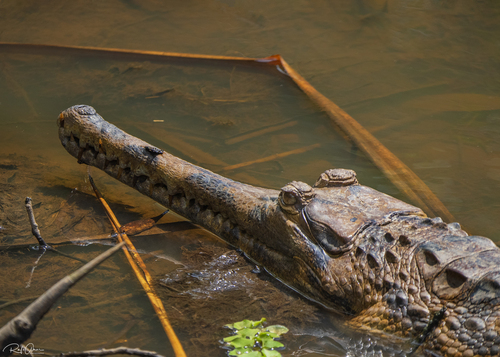
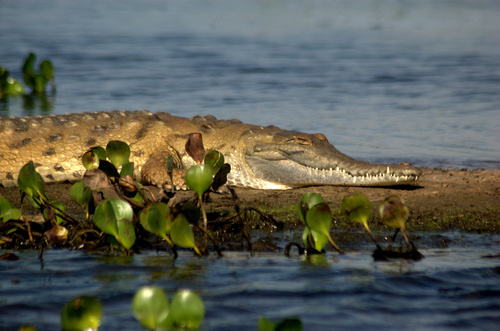
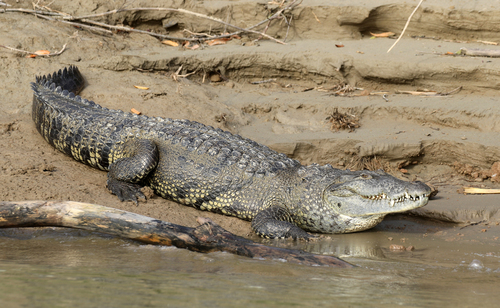
Morelet's crocodile, with the scientific name Crocodylus moreletii, is similar in appearance and morphology to the Cuban crocodile (Crocodylus rhombifer) and the larger American crocodile (Crocodylus acutus). When fully mature, it has a broad snout that holds 66 to 68 teeth. Its base body color is grayish-brown, marked with dark bands and spots across its body and tail; this patterning matches that of other crocodiles such as the American crocodile, but Morelet's crocodile is generally somewhat darker. Juvenile Morelet's crocodiles are bright yellow with dark bands. The species has a silvery brown iris, four short legs that produce a sprawling gait, a long webbed-hind foot tail used for swimming. Despite its short legs, Morelet's crocodile can run quickly. It is smaller than most other crocodile species, though it is larger than the dwarf crocodile (Osteolaemus tetraspis). Adult males are typically larger than adult females. The average total length (including tail) of an adult Morelet's crocodile is roughly 2.1 m (6 ft 11 in), with a typical length range of 1.5 to 2.7 m (4 ft 11 in to 8 ft 10 in); the lower end of this range is the mean total length of a sexually mature female, which reaches maturity at around 7 to 8 years old in the wild. Almost all Morelet's crocodiles longer than 2.5 m (8 ft 2 in) are males. At this late stage of maturity, males undergo a significant change in skull bone structure: the skull becomes broader and more robust. Large adult males can reach 3 m (10 ft) in length, and any individual longer than this is exceptionally rare for the species. The maximum reported length for the species is 4.5 m (15 ft), with two other unusually large specimens reported at 4.1 m (13 ft) and 4.3 m (14 ft) respectively. One mature adult specimen measuring 2.84 m (9 ft 4 in) and weighing 110 kg (240 lb) had a measured bite force of 4,399 N (989 lbf). The average estimated weight of a large wild 3 m (10 ft) male is around 150 kg (330 3⁄4 lb), and unusually large individuals tend to weigh much more. One large male with an estimated total length of around 3.5 m (11 ft 6 in) weighed about 250 kg (550 lb), and another large individual 3.3 m (10 ft 10 in) long weighed 180 kg (400 lb).
Morelet's crocodile inhabits freshwater habitats in Central America and along the Gulf of Mexico, spanning Belize, Guatemala, and Mexico, and occurs in ecoregions such as the Belizean pine forests. Within its freshwater range, it prefers secluded, isolated areas. It is found mainly in inland freshwater swamps and marshes, as well as in large forested rivers and forested lakes, where surrounding forest provides cover. It can also be found in coastal brackish waters and grassy savannas of the Yucatán Peninsula. Its distribution expands during rainy seasons, when flooding makes it easier for the crocodiles to move to new areas. Juvenile Morelet's crocodiles live in very dense cover to protect themselves from predators, and stay there until they are old enough to defend themselves. Adult crocodiles dig burrows to use during dry seasons. The range of Morelet's crocodile can overlap with the range of the American crocodile, which sometimes causes the two species to be confused with one another. Morelet's crocodile generally prefers mainland freshwater habitats, while American crocodiles in this shared range typically live in saline mangrove areas, often on cays or atolls. Hybridization between the two species has been recorded in Mexico and coastal Belize. More recently, Morelet's crocodile has been introduced to the Rio Grande (called Río Bravo in Mexico). Newspaper reports from the Mexican side of the border note that crocodiles living in the river do not match the native Texas American alligator, and are instead Morelet's crocodile, which is native to Tamaulipas from San Fernando southward. Crocodiles have been spotted in the cities of Matamoros, Reynosa, and as far north as Nuevo Laredo. These sightings have led multiple municipal police departments to post signs warning people against entering the river.
Breeding for Morelet's crocodile usually occurs between April and June, and eggs are laid before the rainy season begins. Unlike other North American crocodiles, Morelet's crocodile only builds mound nests, rather than using both mound and hole nests. These mound nests are approximately 3 m (10 ft) wide and 1 m (3 ft 3 in) high, and are built either near water or on floating vegetation. A female Morelet's crocodile can lay between 20 and 45 eggs, and nests have been found that hold eggs from more than one female. The eggs are buried, and females guard the nests. Eggs typically hatch after 80 days, and hatchlings are normally around 17 cm (6 1⁄2 in) long. After hatching, the female carries her young to the water, where both parents protect the hatchlings. Females are highly protective of their young; they have been reported to aggressively drive off intruders including humans if they hear distress calls from baby crocodiles, and male crocodiles have also been observed defending young crocodiles. In captivity, adult crocodiles act aggressively toward juvenile crocodiles, but never toward hatchlings.